Lightning strikes may have supplied primordial Earth with enough phosphorus to support the emergence of life, according to new research that offers an alternative explanation as to how living organisms were born.
Phosphorus is a vital building block of life as we know it, forming basic cell structures and the double helix shape of DNA and RNA.
Billions of years ago on early Earth, most of the available phosphorus was locked away in insoluble minerals. However one mineral, schreibersite, is highly reactive and produces phosphorus capable of forming organic molecules.
Since most schreibersite on Earth comes from meteorites, the emergence of life here has long been thought to be tied to the arrival of extraterrestrial rocks. But schreibersite is also contained within the glass-like rock formed by lightning strikes in some types of clay-rich soils.
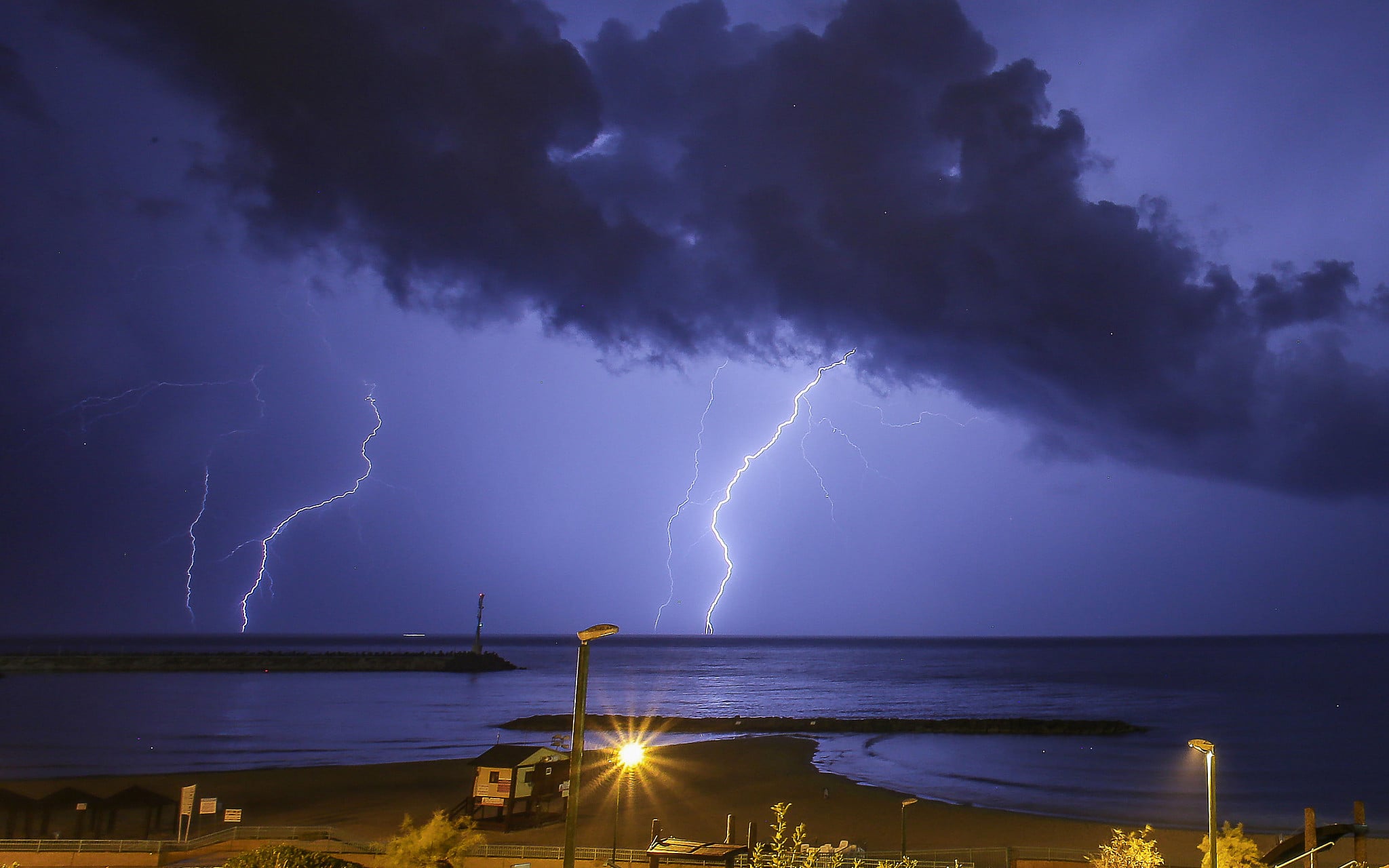
Lightning over Ashkelon, November 16, 2015. (Edi Israel/Flash90)
Researchers in the US and Britain used state-of-the-art image techniques to analyze the amount of the phosphorus-giving mineral formed in each lightning strike. They then estimated how much schreibersite could have been produced over the eons before and around the time of the emergence of life on Earth, around 3.5 billion years ago.
“Lightning strikes on early Earth may have provided a significant amount of reduced phosphorus,” Benjamin Hess, lead study author from Yale’s Department of Earth and Planetary Sciences, says.
Help us report truthfully on social media
As a multimedia journalist, my job is to take the quality, fact-based journalism produced by The Times of Israel newsroom and make it accessible across every platform — from Instagram posts to podcasts to short-form videos.
This is how many, especially young people, consume news these days. But misinformation is rampant on social media. Our team at ToI produces accurate, responsible short-form reporting on Israel and the Jewish world.
If you believe in the importance of factual social media journalism, please consider joining our reader support group, The Times of Israel Community. Your financial support is essential to sustain responsible multimedia reporting.
We’re really pleased that you’ve read X Times of Israel articles in the past month.
That’s why we started the Times of Israel - to provide discerning readers like you with must-read coverage of Israel and the Jewish world.
So now we have a request. Unlike other news outlets, we haven’t put up a paywall. But as the journalism we do is costly, we invite readers for whom The Times of Israel has become important to help support our work by joining The Times of Israel Community.
For as little as $6 a month you can help support our quality journalism while enjoying The Times of Israel AD-FREE, as well as accessing exclusive content available only to Times of Israel Community members.
Thank you, David Horovitz, Founding Editor of The Times of Israel


 From the Liveblog of
Tuesday, March 16, 2021
From the Liveblog of
Tuesday, March 16, 2021
 Add ToI as a Preferred Source on Google