

 From the Liveblog of
Wednesday, January 14, 2026
From the Liveblog of
Wednesday, January 14, 2026
Witkoff declares start of Gaza plan’s 2nd phase, says US expects Hamas to comply with commitments
 Add ToI as a Preferred Source on Google
Jacob Magid is The Times of Israel's US bureau chief
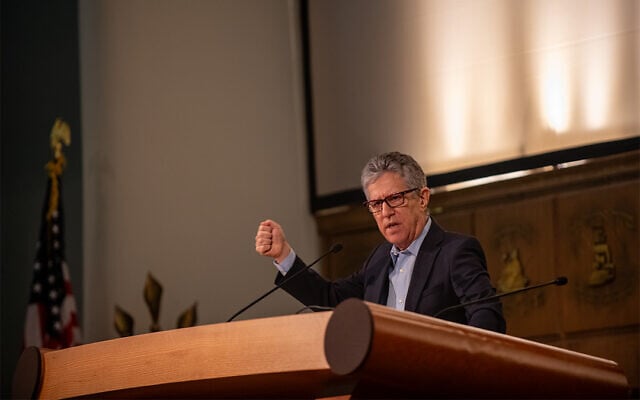
US special envoy Steve Witkoff announces the launch of phase two of President Donald Trump’s 20-point plan for ending the Gaza war.
Witkoff says in a statement that this new phase will consist of “moving from ceasefire to demilitarization, technocratic governance and reconstruction.”
“Phase two establishes a transitional technocratic Palestinian administration in Gaza — the National Committee for the Administration of Gaza (NCAG) — and begins the full demilitarization and reconstruction of Gaza, primarily the disarmament of all unauthorized personnel,” Witkoff says.
“The US expects Hamas to comply fully with its obligations, including the immediate return of the final deceased hostage. Failure to do so will bring serious consequences,” the US envoy adds.
“Importantly, phase one delivered historic humanitarian aid, maintained the ceasefire, returned all living hostages and the remains of 27 of the 28 deceased hostages,” Witkoff says, thanking fellow mediators Egypt, Turkey, and Qatar “for their indispensable mediation efforts that made all progress to date possible.”
Israel pushed back on transitioning to phase two before Hamas had given up its weapons and returned the body of Ran Gvili. Top US officials told Prime Minister Benjamin Netanyahu during his Mar-a-Lago meetings last month that Washington is committed to those two goals, but doesn’t want to condition the commencement of phase two on either, a US official and two sources familiar with the matter told The Times of Israel last week.
Notably, Witkoff’s announcement does not include the unveiling of the Board of Peace, which is supposed to be made up of world leaders who will oversee the NCAG. The US had initially planned to reveal the Board of Peace’s members last month but has struggled to rally international support around its plan amid heavy skepticism that Hamas will agree to disarm or that Israel will agree to further withdraw from the Strip and allow for its reconstruction.
While Witkoff’s statement speaks of demilitarization, no agreement has been reached yet on how that will be executed.
The US has been in talks with Mideast mediators Egypt, Qatar and Turkey, which have assured Washington that Hamas will agree to a gradual disarmament plan that would begin with the terror group giving up its heavy weaponry and the launch of a “buy-back” program for lighter weapons, according to the US official and two Arab diplomats, who said the goal is to begin implementing the program in the coming weeks.
It is not clear whether this framework will be sufficient for Israel, and Hamas officials have publicly asserted that the organization will only agree to give up its weapons in a negotiated process that results in the establishment of a Palestinian state. For its part, the US has claimed that Hamas agreed to disarm during a meeting between top officials from each side hours before phase one of the ceasefire was inked in October.
That deal has barely held in the nearly three months since, with mutual allegations of violations and over 400 Palestinians killed, according to the Hamas-run health ministry, which doesn’t differentiate between civilians and combatants.
While aid has increased significantly during this period, humanitarian groups say Israeli restrictions have hampered their efforts to serve the people of Gaza, where hundreds of thousands are displaced in often flimsy tents at the peak of winter.








The Times of Israel Community.