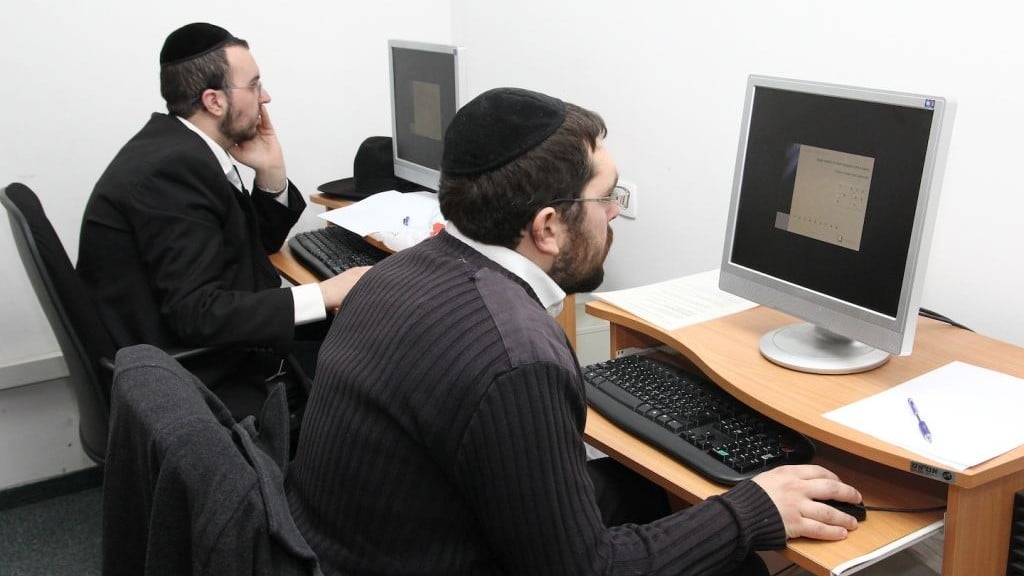
Illustrative: Ultra-Orthodox men study toward professional degrees at Kemach, a Jerusalem-based organization that guides Haredim through study programs and job placement. (photo credit: Kemach/JTA)
More than 50 percent of ultra-Orthodox men are participating in the workforce for the first time in recorded Israeli history, the Central Bureau of Statistics said. The new numbers marked a continuation of a 12-year trend, the CBS reported this week.
In 1995 male ultra-Orthodox participation in the workforce hit 48% and seemed to be on the rise, but then the trend reversed, dipping as low as 36% in 2003. In that same year, then-finance minister Benjamin Netanyahu implemented a series of welfare cutbacks designed to promote participation in the Israeli workforce. Since then numbers have been steadily on the rise, and have finally passed 50% among male Haredim.
The data presented by the CBS show that Haredi women have an even more impressive presence in the workforce, with 73% of them working. This compares to workforce participation among the general Jewish population of 80%.
The city that features the largest Haredi workforce participation is Bnei Brak, where 82% go to work.
Ultra-Orthodox men study toward professional degrees at Kemach, a Jerusalem-based organization that guides Haredim through study programs and job placement. (photo credit: Kemach/JTA)
The participation in the workforce among male Haredim is still far smaller than in the general Jewish population, where 86% of males work. Still, in an interview with Channel 2, Dr. Gilad Malach, researcher of Haredi culture at the Israel Democracy Institute, called the new numbers “a historic change” and said they show that Haredim have gone from being a Torah-learning society to a working and Torah-learning society.
Get The Times of Israel's Daily Editionby email and never miss our top stories
According to Malach, the rising numbers of working Haredim within Israeli society is bound to bring about major historical, sociological and cultural changes.
Help us report truthfully on social media
As a multimedia journalist, my job is to take the quality, fact-based journalism produced by The Times of Israel newsroom and make it accessible across every platform — from Instagram posts to podcasts to short-form videos.
This is how many, especially young people, consume news these days. But misinformation is rampant on social media. Our team at ToI produces accurate, responsible short-form reporting on Israel and the Jewish world.
If you believe in the importance of factual social media journalism, please consider joining our reader support group, The Times of Israel Community. Your financial support is essential to sustain responsible multimedia reporting.
We’re really pleased that you’ve read X Times of Israel articles in the past month.
That’s why we started the Times of Israel - to provide discerning readers like you with must-read coverage of Israel and the Jewish world.
So now we have a request. Unlike other news outlets, we haven’t put up a paywall. But as the journalism we do is costly, we invite readers for whom The Times of Israel has become important to help support our work by joining The Times of Israel Community.
For as little as $6 a month you can help support our quality journalism while enjoying The Times of Israel AD-FREE, as well as accessing exclusive content available only to Times of Israel Community members.
Thank you, David Horovitz, Founding Editor of The Times of Israel


 Add ToI as a Preferred Source on Google