

‘No future for Jews in Western Europe,’ says French prosecutor
In a legal war on bigotry, Charles Baccouche, 70, fights anti-Semitism the only way he knows how — in the courtroom
 Add ToI as a Preferred Source on Google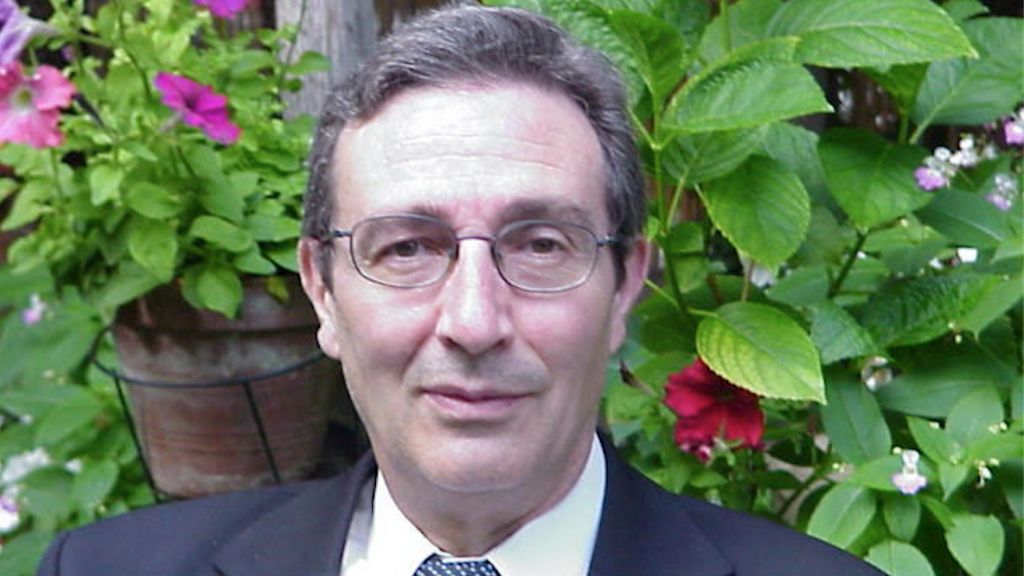
PARIS — In the land known for “Liberté, Egalité et Fraternité,” (“liberty, equality, and brotherhood”) the headquarters of French Jewry, known as the Consistoire, remain under constant armed guard.
The heavily secured entrance of a beautiful 19th century exterior is surrounded by metal barriers, reminiscent of Israel’s Ben-Gurion Airport in the early 1980s. Like something out of a period piece on the silver screen, this feature unfolds in grayscale.
Visitors approaching a plain concrete section of the building must first pass the sentry, who bears an automatic weapon inside a bulletproof booth, where he questions “who goes there.” After clearing that first hurdle, guests approach heavy metal doors observed via security camera. They ring a bell and state their business, and an audible click allows guests to push the heavy doors open and enter a dimly lit foyer.
One at a time, visitors approach a small speaker, announce themselves, and if approved to proceed further, are admitted beyond another heavy door. Standing sequestered between two sets of locked doors, visitors must again explain the nature of the visit. And now the security gets even tighter.
The male voice of an unseen guard behind a darkened reception window with a small clear spot questions guests and requests government-issued identification. A small metal receptacle near the floor swings open to transfer visitors’ belongings, which the guard examines, still invisible in the darkness beyond. Once the bag clears the search, the receptacle swings open, returning the effects to their owner. Another click is heard and visitors are allowed to proceed inside.
Whether guests have a scheduled meeting or are seeking a place for afternoon prayers, they undergo the same screening.
Given the tenor of France today, the precautions are understandable.
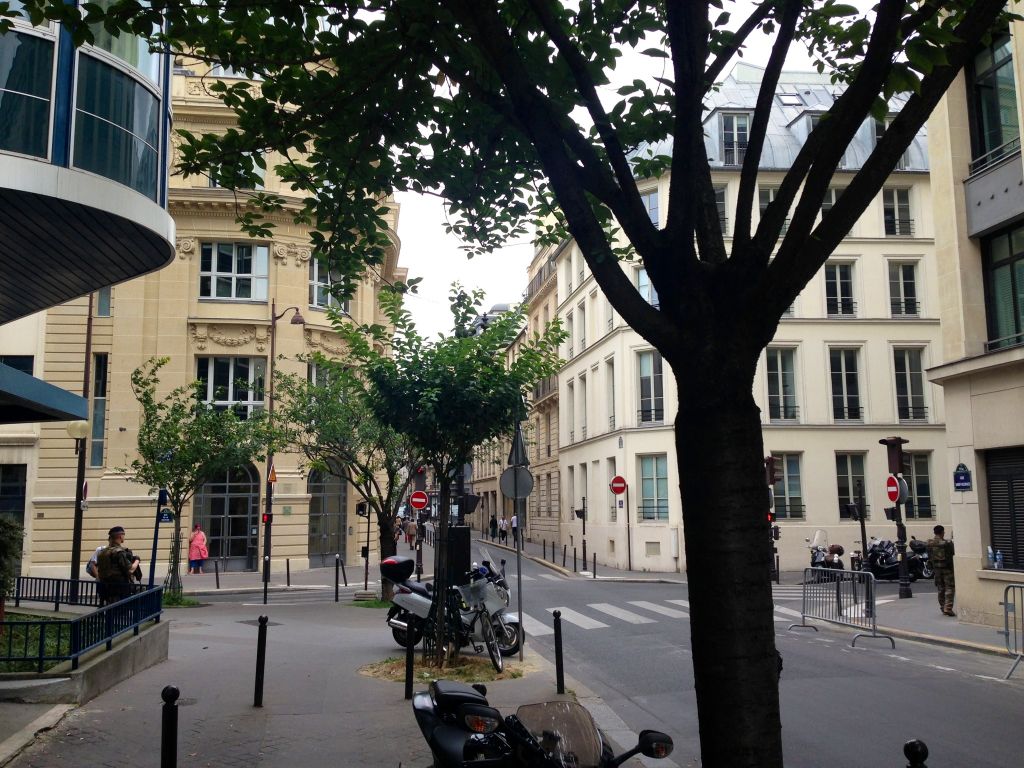
In contrast to the spectacular architecture and elaborate interior of the adjacent La Victoire synagogue, this brain center of French Jewry is noticeably sparse. Plain walls embrace standard issue metal desks and office chairs. Israeli posters, Consistoire publications and kosher snacks dot a plain waiting room. A small but charming vintage elevator surrounded by a circular staircase is one of the few design elements that hint at French Jewry’s finer days.
The Consistoire’s focus is clearly not on appearances but content. And on this visit, the subject is truly menacing: violence and hate speech against Jews. This is the charge of Charles Baccouche, the second in command of the Bureau National de Vigilance Contre l’Antisemitisme, or, the National Bureau for Vigilance Against Anti-Semitism.
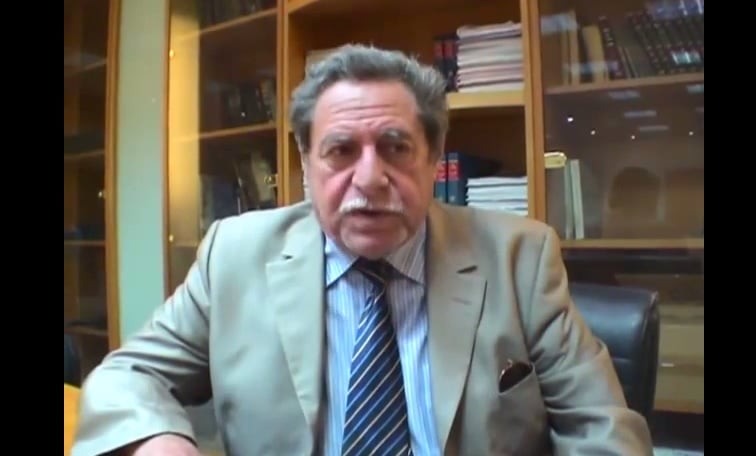
Founded by retired Paris-area police commissioner Sammy Ghozlan, the BNVCA has worked for more than 15 years to combat French anti-Semitism and boycotts against Israel. These include the physical acts of aggression against rabbis, children, synagogues and Jewish schools which began escalating in 2000.
In 2014, for instance, the Jewish community reported 851 anti-Semitic incidents, of which 241 were violent attacks, up from 423 and 105, respectively. Although Ghozlan has retired to Netanya, he frequently returns and is in constant touch with his team, including his right hand man, Baccouche.
‘The most important thing is to submit complaints to the French government’
It is Baccouche who represents the BNVCA on behalf of French Jewry in legal proceedings. His adversaries are not only the terrorists set on taking Jewish lives but also France’s most notorious and most vocal anti-Semites. These include Dieudonne, Alain Soral, Jean Marie Le Pen and Zeon aka Fernandez, whom he pursues in court four or five times a year.
“Court is very slow and they delay it repeatedly,” he says. “The most important thing is to submit complaints to the French government.”
Over the past three years, in fact, he has submitted an estimated 400 complaints about anti-Semitic acts, a process he has continued since 2009 — “each time there is an anti-Semitic act,” says Baccouche, who resides near the Eiffel Tower.
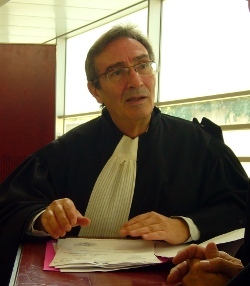
Although he is well known in France for his legal efforts, published work and public addresses, Baccouche is virtually unknown elsewhere. At a meeting in the Consistoire, he discussed his concerns in an exclusive interview with The Times of Israel.
The building’s dim atmosphere hints at the questionable future of French Jewry. The city’s Judaic populace is “afraid since the attack on Hyper Cacher,” he says, referring to the high end kosher market where four men were killed in a massacre in 2015.
The market, which continues to operate, remains under armed guard.
“Even with our security forces, there are attacks,” Baccouche says. “In short, they don’t feel good in France now.”
The attack at the Bataclan night club is another horrific example of the violence the community has suffered.
‘The managers were Jewish and the terrorists knew that’
“The managers were Jewish and the terrorists knew that and sold that,” Baccouche says.
In his 70s, Baccouche, who has Israeli citizenship, has no imminent plans to retire, although his intent is to make aliyah.
“One day I will return home,” he says. “I am Jewish but I am in the middle of the war because I go to trial from time to time. So I am in the struggle.”
He says the French establishment maintains that things aren’t all that bad, but Baccouche argues that this is just a way to “mask reality. It is a sheker pumbi — a public falsehood — all is well,” he says, peppering his French with select Hebrew phrases. “But nothing is going well,” he says. “There is a French breakdown in general.”
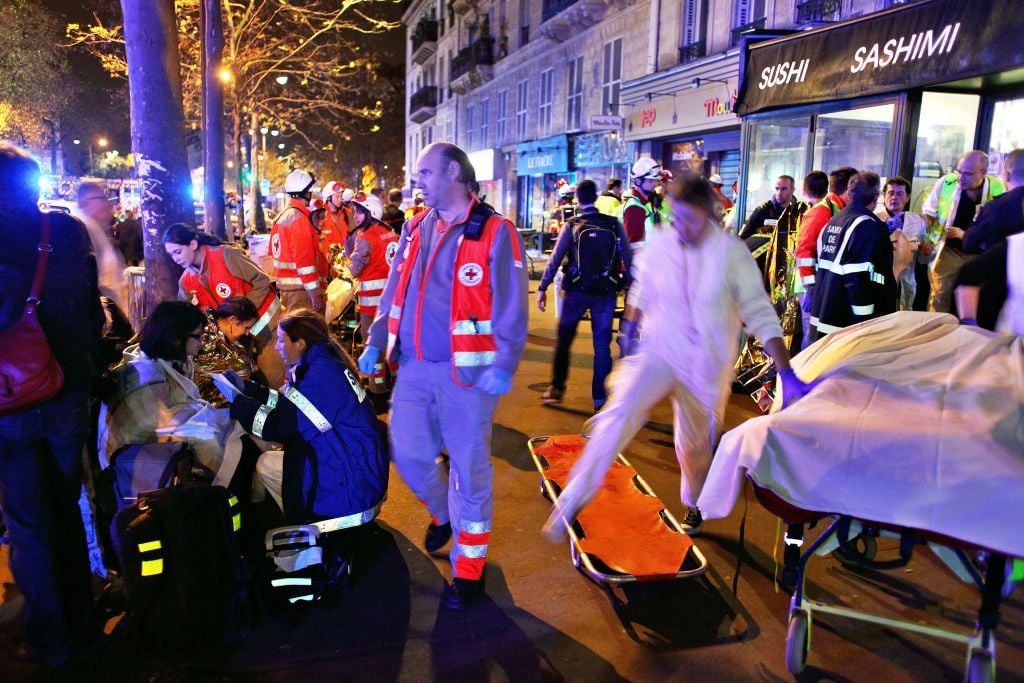
The overall experience of the French public, which has experienced a number of indiscriminate terror attacks this summer — at the Bastille Day celebrations in Nice, and at a cathedral in the North — has driven the fear home for Jews, as well, Baccouche says.
“In every place, wherever there is a breakdown, Jews experience it more intensely because that is the fate of Jews,” he says.
And even though there is no suggestion the violence will end, it is no less shocking to Jews who previously enjoyed great safety in France.
‘It’s like there is no salt in the soup. The Jews are the soup’
“It’s like there is no salt in the soup,” Baccouche says. “In this example, the Jews are the soup. It’s much worse. They exact blows. They kill us. This is the first time since World War II that they attack and murder Jews.”
Baccouche points to the phrase “In France, a Jew is happy as God” — an old Yiddish saying dating from the 18th century when Jews obtained the right to become French citizens.
“France was the country of freedom and human rights,” he says. “From [chief of state of Vichy France Philippe] Petain, it began to fall apart. [Former president of France Charles] de Gaulle was the one who caused harm to the Jews because he described them as a strong, dominating and confident people. And the environment degraded and became more severe.”
As a means to counter the violence, Baccouche pursues legal action against violent acts as well as expressions of anti-Semitism, which are also outlawed in France.
“We always win because I am not alone here,” he says. “I am the state prosecutor. And this is criminal.”

Baccouche considers himself “responsible toward the Jewish people in my way. We each have a portion in Eretz Yisrael and in the fate of the Jewish people, whether we want it or not,” he says. “I’m near pension age, 70, but I don’t take my pension so I can continue this struggle. I could have taken retirement for a while, but I decided to work with Sammy and these good people.”
As he speaks, he waves his arm toward the young woman who serves as a part-time administrative aide to the BNCVA. Elisheva Cohen, a married 22-year-old, prefers to use an alias for fear of her own safety. When she must go to French bureaucratic offices, she prefers to wear a wig instead of her head covering that suggests she is a religious Jew. Like Baccouche, she sees aliyah in her future.
“The danger is there if I am Orthodox or not because even the secular wear a Magen David,” she says, referring to the Star of David necklaces favored by many French Jews. “It’s a danger for everyone… I don’t feel the danger but I put a wig when I go to French offices because I feel a difference when I am with a head covering or a wig. Even the ‘true’ French look at me as a Jew.”
‘The danger is there if I am Orthodox or not because even the secular wear a Magen David’
As for Baccouche, the BNVCA’s volunteer lieutenant president, he doesn’t wear a yarmulka or a Magen David necklace.
“I put tefillin (phylacteries) on and go to synagogue since I was young,” he says, matter of factly.
When asked why, his simple answer is “Because. It has no connection to anti-Semitism,” he says. “I feel myself as a Jew from North Africa but I decline to say what country I’m from. For me, it’s not important.
“I’m not a prophet or a prince but there is no future for Jews in all of Western Europe. Not only because of the war in the Mediterranean basin but because anti-Semitism is part of the Koran. I don’t think there is a future for Jews in France. There will be a day when all of Israel will be gathered back in our country,” Baccouche says.
Despite his negative predictions of Europe, Bacchouche says, “We are not going to our deaths. We live. Jews are more and more living amongst ourselves. There are always interactions with non-Jews but all our social interactions are with Jews, more and more. For example, ‘Elisheva’ has to remove her Jewish symbols but it’s a shame. She doesn’t bother anyone.”









The Times of Israel Community.