

Out of self-interest, genuine opportunity
Never mind the cynics, the Netanyahu-Mofaz partnership could produce change… if its protagonists follow through on their fine rhetoric

 Add ToI as a Preferred Source on Google
David Horovitz is the founding editor of The Times of Israel. He is the author of "Still Life with Bombers" (2004) and "A Little Too Close to God" (2000), and co-author of "Shalom Friend: The Life and Legacy of Yitzhak Rabin" (1996). He previously edited The Jerusalem Post (2004-2011) and The Jerusalem Report (1998-2004).
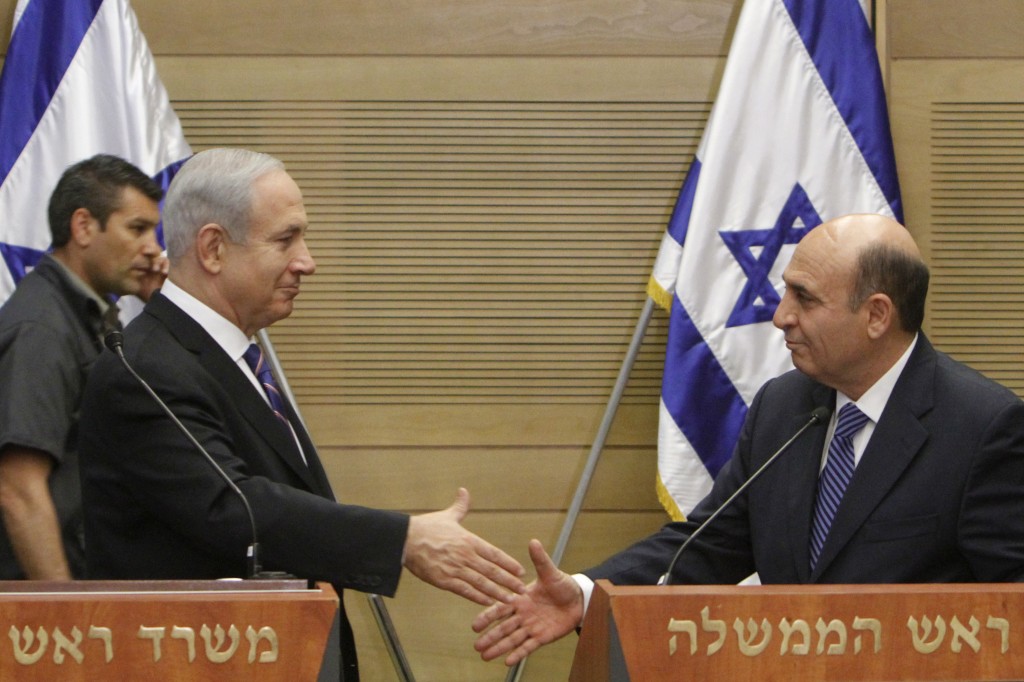
The cynicism that greeted Prime Minister Benjamin Netanyahu’s coalition agreement with Kadima’s Shaul Mofaz Tuesday is easily understood.
Mofaz has made a gold-medal-worthy sprint from bitter foe to warm ally of the prime minister. One minute he was calling Netanyahu a liar and vowing never to negotiate with him. The next, they were Best Friends Forever, or at least until Netanyahu tires of him.
Never place your faith in someone who says “trust me,” runs the old adage. The same, in political circles, surely applies to leaders who swear blind that everything they are doing is “in the national interest.” It was hard to keep count of how many times Netanyahu and Mofaz made that assertion in their joint appearance.
Most of the analysts’ criticism has been heaped on Mofaz. Netanyahu achieved stability at almost no price — a single ministerial position for Mofaz when, three years ago, a partnership with Tzipi Livni’s morally magnificent Kadima would have cost him half the seats at the cabinet table. Netanyahu brought 28 more seats into his coalition, but won’t have to compromise his agenda in the slightest to Kadima’s (insofar as it has one). He was able to stave off a confrontation with Likud hardliners over the composition of a Knesset slate for elections he never wanted. A win-win-win for him.
Mofaz, however, sold Kadima “like a stall-holder in Mahane Yehuda (vegetable market) minutes before Sabbath-eve closing time,” declared Channel 2’s political analyst Amit Segal. “It’s a complete capitulation… The end for Mofaz… The beginning of the end for Kadima.”
Segal may well be right about that. If the great big new coalition achieves anything, it is the prime minister who will reap the political benefits when Israel does go to the polls next year. If all we see is 18 months of immobility, anesthetist Mofaz will get the blame.
And yet the Netanyahu-Mofaz partnership really could produce change, if its protagonists follow through on their fine rhetoric.
It is hard to believe the alliance will have any great effect on peacemaking with the Palestinians, notwithstanding the appeals by both men to the Palestinian Authority to return to the negotiating table.
It is hard to believe the alliance will have any great effect on peacemaking with the Palestinians, notwithstanding Tuesday’s appeals by both men to the Palestinian Authority to return to the negotiating table. If the prime minister truly, passionately wanted to break the deadlock with PA President Mahmoud Abbas, he could have done so without Mofaz. Whoever is in his coalition, he’ll have to face down his own right wing to do so, and has continually shown every sign of wanting to avoid that battle. Even Tuesday, with Mofaz at his side, he made no pledge to honor the Supreme Court’s order to demolish illegal homes in Beit El’s Ulpana neighborhood.
Likewise, Mofaz’s presence at the cabinet table will have no impact on policy regarding Iran. If Netanyahu believes the Jewish State faces imminent annihilation, he will act. Until then, he won’t. Period.
And while Mofaz has made a transparently expedient attempt to recast himself as a champion of social justice, Kadima’s coalition presence is not going to spark a radical remake of government economic policy. Mass social protest might do that. Moaning from Mofaz will not.
Where promised electoral reform is concerned, however, progress in the next 18 months is conceivable — hard to believe, but not impossible. Netanyahu and Mofaz could take advantage of the new, rare marginalization of the smaller parties to change the system. The public wants a more accountable process for electing and rejecting its leaders; the politicians want a more manageable one.
But perhaps the greatest opportunity for real change with this new coalition is over legislation to require national service for all — notably including the ultra-Orthodox community.
But perhaps the greatest opportunity for real change with this new coalition is over legislation to require national service for all — notably including the ultra-Orthodox community. The national consensus is that the current situation — where a substantial part of the Jewish demographic is subsidized by the rest; where the burden of protecting the country is unfairly distributed; and where the norm of a mass of Jewish scholars studying rather than working full-time represents a stark departure from authentic Orthodoxy — is untenable and must change.
Here is an issue with wide public resonance. Here is an issue vital to Israel’s economic and security well-being. Here is an issue where reform is most emphatically in both the national interest and the narrow interest of our two new leaders.
Here is an issue where progress would utterly silence the cynics.


The Times of Israel Community.