

Paris Square is burning: What the press is saying on August 23
A protest outside the prime minister’s office turns violent, with videos and pictures showing cops beating demonstrators, and papers get pumped about a possible budget compromise
 Add ToI as a Preferred Source on Google
Joshua Davidovich is The Times of Israel's Deputy Editor
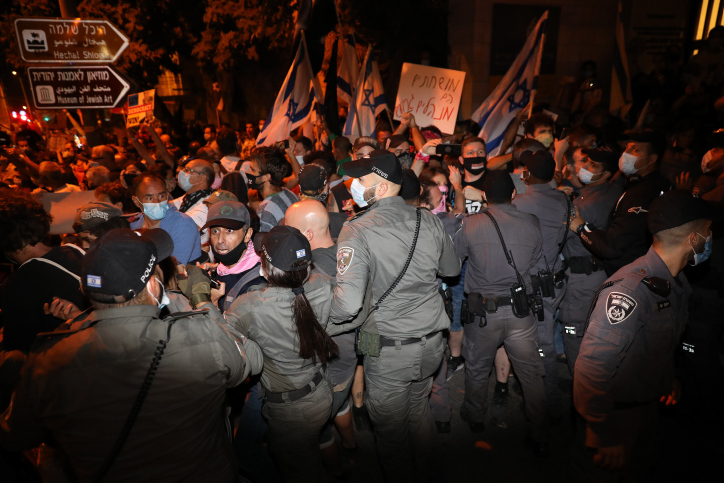
1. Scrapping in the square: Reports and testimonies of police violence at a protest outside Prime Minister Benjamin Netanyahu’s residence in Jerusalem’s Paris Square dominate news headlines Sunday morning.
- Yedioth Ahronoth runs a picture on its front page showing an officer leaning on top of a protester who is laying supine on the ground, shoving his elbow into his face as the protester tries to push the officer away.
- “With a strong hand,” reads the paper’s headline accompanying the story, with several oddly overt biblical allusions in its coverage, which also includes running in full, as a column, a speech by author Meir Shalev from the Friday protest that leans heavily on the weekly Torah portion.
- The paper describes the fighting as “unprecedented scuffles.”
- “I’ve been at protests for many years, I’ve never seen police be so purposefully hostile as at this protest,” Nadav Gillon, the spokesman for the Crime Minister protest group tells Army Radio.
- The violence at the protests get wide coverage in other papers as well, though Israel Hayom, which is seen as heavily pro-Prime Minister Benjamin Netanyahu — the target of the protesters’ derision, makes do with only a picture and an extended caption reporting on “radicalized violence from the police and from the protesters.”
- While police say that they were attacked, and call reports of violence “fake news,” Times of Israel reporters at the scene say they saw no violence toward the police, though they did seem to be raring for a confrontation.
- According to ToI’s Aaron Boxerman and Anat Peled, the protest turning violent may be linked to a court decision that the protests need to shut down at a reasonable hour so neighborhood residents can get sleep. In the past, police would clear out protesters after midnight or later, when only a few were still around, this time they started doing so when some estimated 10,000 people were there.
- But police deputy Ofer Shomer tells Kan that the trouble started when protesters refused police orders that they choose a different route for a march from the Strings Bridge at the city’s western entrance heading to the city center: “These were not arbitrary decisions. The entrance to Jerusalem is a main throughway, and blocking it can really mess up life in the city. This could have caused a very severe loss of public order.”
2. Camera obscura: The officer pictured on the cover of Yedioth is identified as none other than deputy police chief Niso Guetta, who was already in the dog house after a video emerged showing him smacking and shoving one protester who apparently got too close to him, and then chasing down and throwing to the ground another protester who apparently dislodged his mask during the altercation, which the police describe as an “attack” (on Guetta).
- Haaretz reporter Nir Hasson describes Guetta as “losing it,” with the protesters.
סגן ניצב ניסו גוואטה (הזכור ממחוז ירושלים) מאבד את זה הערב בצעדה בדרך לבלפור. pic.twitter.com/kHTu2llPfm
— نير حسون Nir Hasson ניר חסון (@nirhasson) August 22, 2020
- He’s not the only alleged bad apple, though. Another video shows a cop leaping over a metal barricade and grabbing a protester on the other side, setting off more scuffles and chaos.
Just look at this https://t.co/H4FROOkPzO
— Noga Tarnopolsky נגה טרנופולסקי نوغا ترنوبولسكي (@NTarnopolsky) August 22, 2020
- Activist Achiya Schatz, who seemingly has a press pass, posts a video of himself being shoved to the ground by the cops because he could not get his pass out quickly enough.
גם צלמים חוטפים. לא הספקתי להוציא תעודה pic.twitter.com/Rcq0ztddqM
— Achiya Schatz (@schatzah) August 22, 2020
- And Or-ly Barlev, another activist/journalist writes on Twitter that she was felt up by a cop during the protests. “This was not by accident … I’m fine, the harassing cops can bite me. There are many other women who would feel different in the same situation, so it’s important to talk about. This is a common and criminal method for suppressing protest.”
3. Can we agree to not agree? Meanwhile, the “threat” of elections continues to hover over the country with a Monday deadline looming for a budget or legislation to kick the can down the road, and several reports point to a compromise being in the works.
- Channel 12 reports that a deal coming together would see both sides push off the budget deadline by 100 days, which it says will still allow Netanyahu to “have two exit points,” which appears to be its way of describing the options to collapse the government without having to give up the prime minister’s seat to Blue and White head Benny Gantz as per the coalition agreement.
- “It’s very likely that the sides won’t manage to finish the work on the budget by the end of November, and so will need another extension, until the end of March. The estimation is that elections in this period will be better for Netanyahu since it will take place after the winter, and perhaps after a coronavirus vaccine is finally found,” reports the channel, without explaining why a vaccine or warmer weather would benefit Netanyahu.
- The channel does note, though, that Gantz has agreed to the deal, along with the ultra-Orthodox parties, which should put pressure on Netanyahu to take it.
- Israel Hayom is less sure about those prospects, calling it a “compromise with a question mark.”
- The paper reports that while Gantz appears to be gung ho about the deal, Likud is “more skeptical.”
- “We don’t want elections, but we won’t give in on our fundamental principles,” Coalition whip Miki Zohar is quoted telling the paper.
- Kan reports that sources around Blue and White MK Zvi Hauser, who proposed the 100 day compromise, say that one of the main points to consider for both Netanyahu and Gantz are the tensions on the northern and southern borders, “which do not really allow for going to elections at this time.”
- The broadcaster also notes that an option floated by the opposition to keep Israel from elections, forming an alternative government headed by Blue and White with the rest of the opposition, is not really an option because Hauser and fellow Derekh Eretz MK Yoaz Hendel won’t agree to it, without mentioning the fact that what they won’t agree to is joining a coalition with the Arab-led Joint List. “Blue and White vociferously deny even looking into the option.”
- Labor Party head Amir Peretz tells Army Radio that if the offer is real it should be checked out, but not if it’s just a political maneuver. “To me, it seems like this is pretty low down.”
4. To vote or not to vote: Not everyone thinks elections will be avoided, or that a compromise will lead to sunshine and happiness.
- Israel Hayom’s Moti Tuchfeld notes that the compromise won’t answer Netanyahu’s demand to have a say in appointments of senior law enforcement officials: “Even if there is a compromise and Zvi Hauser’s bill makes it possible for the state budget to be approved three months from now rather than this Monday, the major issue will remain unsolved.”
- In Yedioth, Sever Plotzker writes that while many consider the prospect of a new election to be a “disaster,” given the current state of play, maybe it would actually be a good thing.
- “A fourth round of elections is definitely not desired, but the alternative, the continuation of a squabbling, paralyzed government, is even worse. The cost of campaigns and election day are dwarfed by the heavy costs of economic policies without a budget, without an agenda, without a perspective, accompanied by caving to special interest groups.”
- But in ToI, Haviv Rettig Gur notes that new elections, which would mean still no budget, would be a disaster, though he also bemoans the state of Israeli politics.
- “A baseline immorality has become the resting state of Israeli politics, and few even consider that it could ever have been another way, that in the governments of previous Likud prime ministers, the verbal promise of the prime minister was considered a guarantee,” he writes. “The trouble isn’t any one politician — though of course the man at the top of the heap bears more responsibility than those beneath him — but rather a systemic culture of double-dealing and duplicity that goes beyond the ordinary run of political ruthlessness. The Knesset struggles to consider legislation or pass budgets, often because MKs from opposing factions do not trust each other enough to carry on the political wheeling and dealing that legislation requires.”
5. Sling and a miss: In Haaretz, Yossi Verter writes that whether or not there are elections, Netanyahu is in full campaign mode, claiming that “the previews alone set new records for mudslinging,” in a rant filled with inside baseball and derision for both the pro-Netanyahu media and the mainstream media for airing Likud’s claims.
- The paper’s lead editorial also expresses disgust at what appeared to be a Likud campaign aimed at Justice Minister Avi Nissenkorn and Foreign Minister Gabi Ashkenazi, for supposed quid pro quos with Attorney General Avichai Mandelblit: “The incitement machine explained that Mandelblit had secretly closed an investigation into Nissenkorn; in return, Nissenkorn removed acting State Prosecutor Dan Eldad, who ‘had begun to investigate legal matters relating to Mandelblit.’ Nissenkorn later replaced Eldad with Mandelblit, ‘who halted the investigation against himself.’ In the real world, no criminal file was ever opened on Nissenkorn.”
- As it notes, the only hint of an investigation ever opened into Nissenkorn was a preliminary probe after former Labor Party head and contender for the head of the Histadrut Labor union Shelly Yachimovich complained about vote rigging.
- Yaya Fink, who ran Yachimovich’s campaign tells Army Radio that “There were counterfeits from the Nissenkorn camp so we filed a complaint, but it was not against him. They did not even try to check the facts, the spin is so transparent. I trust the law enforcement authorities who closed the case.”
- On Twitter, Zman Yisrael editor Biranit Goren notes that Likud’s response to a Channel 12 interview with Ashkenazi focused on him “refusing to speak about” another supposed scandal with Mandelblit.
- “Ashkenazi looks at [interviewer Rina Matzliah] with confusion, ‘Did you even ask me about that?’ ‘No,’ Matzliah answers, ‘they prepared the response before the interview.’



The Times of Israel Community.