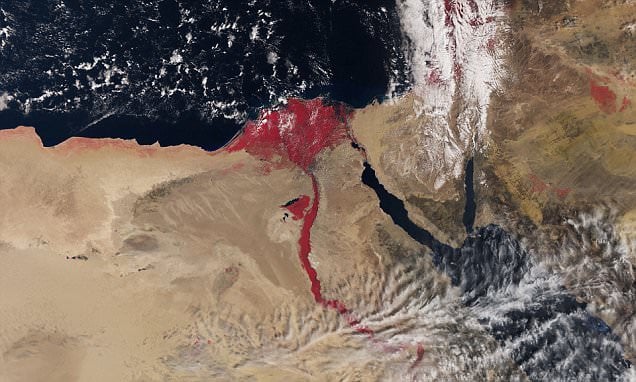
A satellite image of the Nile using infrared technology colors the river in red (Courtesy European Space Agency, April 2016)
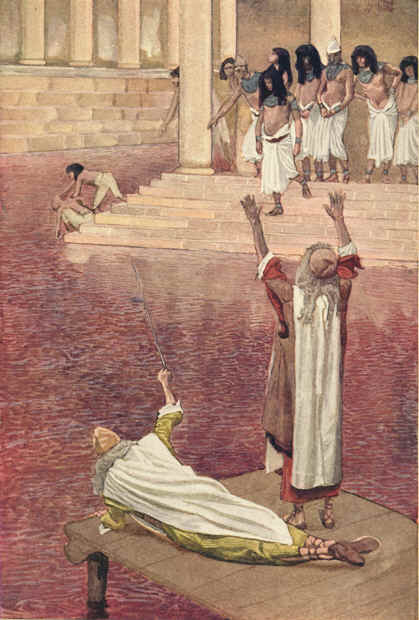
A newly released satellite image of Egypt’s Nile river shows the river colored deep red, bringing to mind the biblical first plague in which the waters of the great river turned to blood.
But, this time at least, it is not the wrath of god that is responsible for the river’s crimson hue: The European Space Agency’s Sentinel-3A satellite, which took the picture, uses a radiometer to measure infrared energy.
The heat radiated by vegetation around the river is therefore responsible for the red color.
The satellite, launched in February, is designed to monitor environmental changes. It is the third of more than a dozen “eyes in the sky” that make up the Copernicus program, which the ESA describes as the most sophisticated Earth observation system ever launched.
The First Plague: Water Is Changed into Blood, by 19th century French painter James Tissot (Wikipedia)
Two satellites already in orbit are equipped with radar and high-resolution cameras, to which Sentinel-3A adds instruments for measuring sea and surface temperatures, among other things.
Get The Times of Israel's Daily Editionby email and never miss our top stories
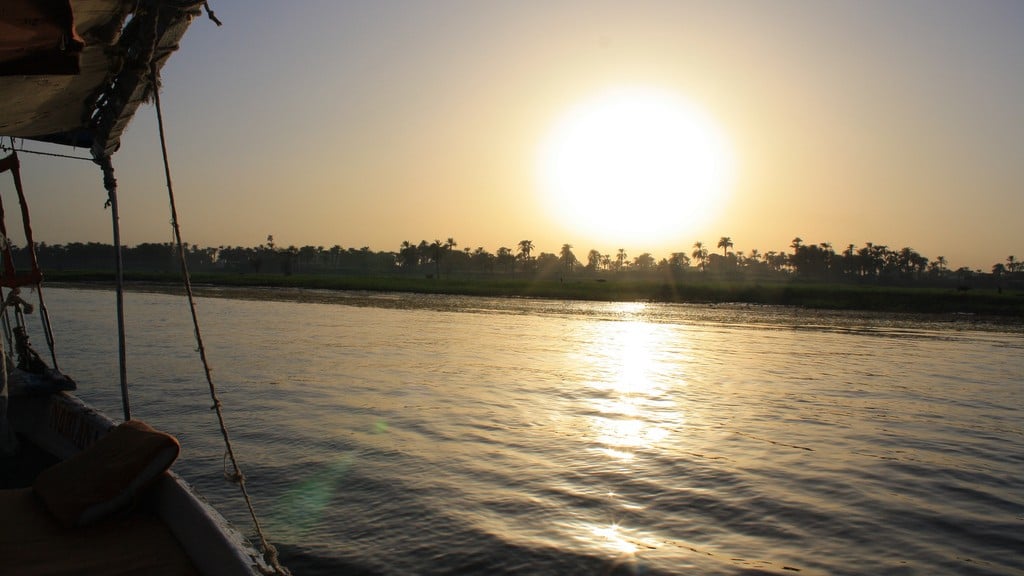
A view of the Nile River. (CC-BY plusgood, Flickr.com)
The satellite will be able to spot upcoming droughts by detecting subtle changes in surface color that suggests crops are failing.
One of Sentinel-3A’s greatest advantages is its ability to scan the entire planet in just over a day and send back data within hours, giving scientists and policy-makers detailed information on environmental changes in close to real time. By measuring sea temperatures it will boost short-term weather forecasts and help track the impact of climate change.
AP contributed to this report.
Advertisement
Help us report truthfully on social media
As a multimedia journalist, my job is to take the quality, fact-based journalism produced by The Times of Israel newsroom and make it accessible across every platform — from Instagram posts to podcasts to short-form videos.
This is how many, especially young people, consume news these days. But misinformation is rampant on social media. Our team at ToI produces accurate, responsible short-form reporting on Israel and the Jewish world.
If you believe in the importance of factual social media journalism, please consider joining our reader support group, The Times of Israel Community. Your financial support is essential to sustain responsible multimedia reporting.
We’re really pleased that you’ve read X Times of Israel articles in the past month.
That’s why we started the Times of Israel - to provide discerning readers like you with must-read coverage of Israel and the Jewish world.
So now we have a request. Unlike other news outlets, we haven’t put up a paywall. But as the journalism we do is costly, we invite readers for whom The Times of Israel has become important to help support our work by joining The Times of Israel Community.
For as little as $6 a month you can help support our quality journalism while enjoying The Times of Israel AD-FREE, as well as accessing exclusive content available only to Times of Israel Community members.
Thank you, David Horovitz, Founding Editor of The Times of Israel


 Add ToI as a Preferred Source on Google