

Snow in north, flash floods in south as Israel hit by storms
Roads close in both areas of the country; temperatures plummet to -4 degrees at Mount Hermon on Golan
 Add ToI as a Preferred Source on Google
Roads were closed in northern and southern parts of Israel on Saturday, as snow fell in the former and flash floods hit the latter during a heavy winter storm felt across the country.
On the Golan Heights, sections of routes 91, 98, 958 and 959 were closed, causing heavy traffic jams, television channels 2 and 10 said. In the south, flash floods closed sections of routes 90 and 234 in the Dead Sea area.
Parts of the Golan saw heavy snowfall by Saturday morning, with some 45 centimeters hitting the lower parts of Mount Hermon and 60 cm on its upper slopes overnight, the Walla news outlet said. The large amounts of snow have forced the closure of the site, which holds the country’s only ski resort.
The snow is expected to resume on the Hermon on Sunday night, Walla reported, while temperatures at the site have plummeted to -4 degrees Celsius.
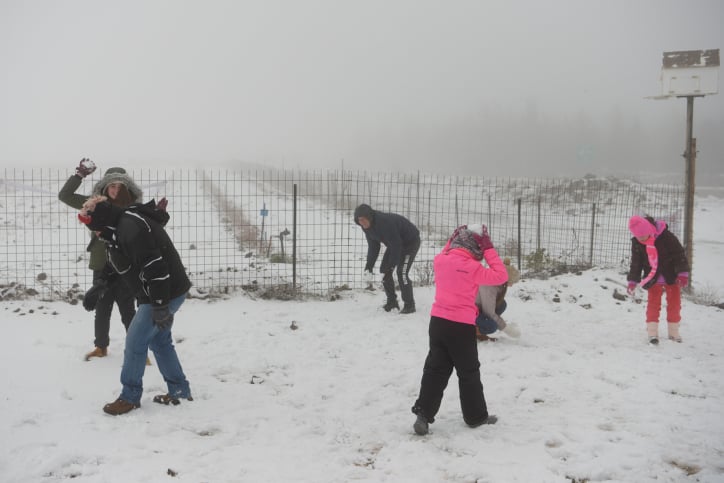
Snow mixed with rain began to fall in mountainous parts of Israel early Friday in the first serious snowfall of the winter, while meteorologists warned the weekend would be characterized by unusually cold, stormy weather.
Light snow also began to fall Friday morning in the Bethlehem and Gush Etzion areas of the West Bank, south of Jerusalem, as well as in the mountainous Galilee city of Safed and in parts of the Golan, including the Druze village of Majdal Shams.
Some 60 millimeters of rain fell on the Upper Galilee and Golan through the night Thursday, leading to swollen rivers and creeks in the area and a three-centimeter rise in the level of the Sea of Galilee. Two major rivers — the Jordan, along Israel’s eastern border; and the Yarkon, that runs through Tel Aviv — have risen dramatically, according to eyewitnesses.
The rainfall, which is expected to last intermittently until as late as Monday, has led to fears of flash floods in desert wadis, or riverbeds. Police warned aspiring flood-chasers and hikers to steer clear of the floods, whose powerful undercurrents can carry away vehicles from roads that cross their path.
Snow was expected in more areas throughout the country, leading to school closures in some mountainous areas, including Safed and Sasa, a village on the Lebanese border.
The snow, winds and rain led to downed power lines in parts of the country, with hours-long power outages reported in the Carmel Hatzarfati neighborhood of Haifa and in the Bethlehem-area West Bank settlements of Tekoa, Nokdim and Kfar Eldad.
Haifa’s Haganah Boulevard was closed to traffic Friday morning after a power cable reportedly fell into the street.










The Times of Israel Community.