

The long and winding road to Geneva
The Gulf has saved Egypt from economic collapse and paved the way to presidency for Gen. El-Sisi, Saudi news channel claims
 Add ToI as a Preferred Source on Google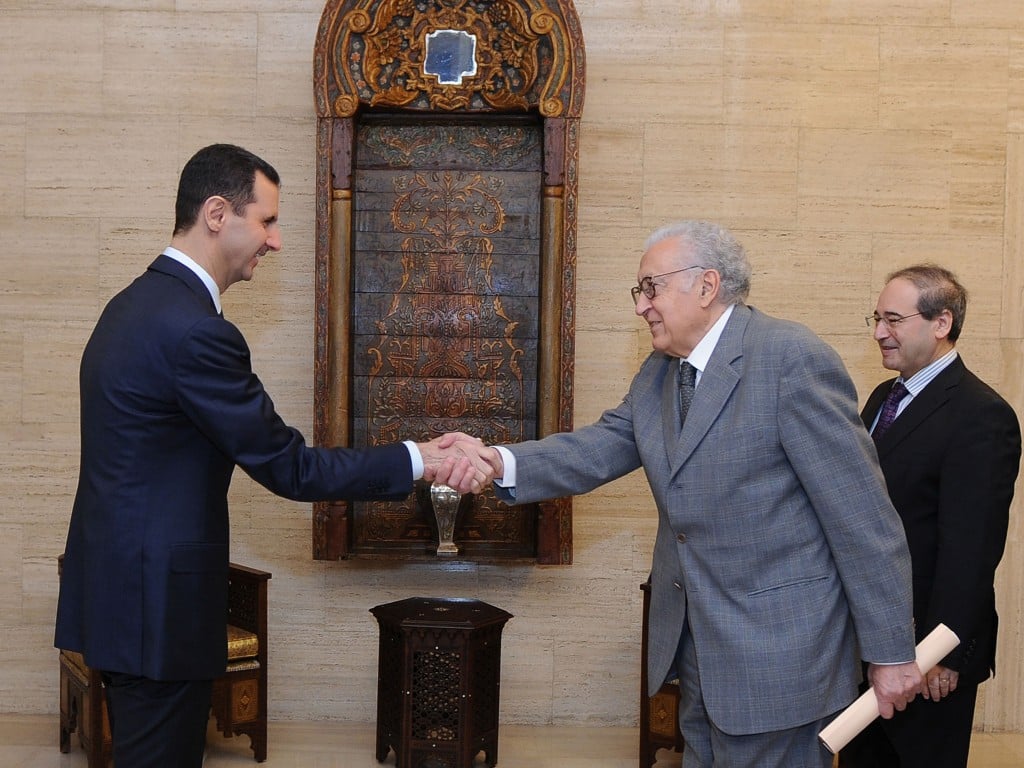
The constant reshuffling of the Arab political deck is most apparent in two themes covered extensively by Arab dailies on Sunday: the announcement of Iran’s participation in Geneva II on Syria and the growing discord between Saudi Arabia and the United States.
“Brahimi preempts his Damascus stop, emphasizing the ‘necessity’ of Iran to attend Geneva II,” reads the headline in the London based Al-Hayat. Reporting on UN and Arab league special envoy to Syria Lakhdar Brahimi’s press conference in Tehran Saturday, the paper quotes the envoy as saying that Iran’s participation in the summit will be “natural, necessary and helpful.” Brahimi is touring Middle Eastern capitals to lay the ground for the summit — and his next destination is to be a second visit to Syria.
Not everybody is happy about the expected Iranian presence in Geneva. Al-Hayat quotes the main Syrian opposition body, the Syrian National Coalition, which said it categorically rejects Iran’s participation in the summit because it is Syria’s “occupier,” a reference to Iran’s longstanding support of the Bashar Assad regime.
The SNC has its backers. Saudi-owned A-Sharq Al-Awsat, reporting on Brahimi’s calls for Tehran to participate in Geneva II, says that “the Syrian opposition has been refusing calls from Arab and Western countries for it to attend the peace talks, saying that it will not participate if there is a chance Assad will remain in power.”
The headline in the Qatari-based news channel Al-Jazeera, which does not conceal its support for the Syrian opposition, reads “Brahimi continues his trip and fighters place conditions for ‘Geneva II’.” The article covers the press conference and emphasizes its acceptance among different segments of the Syrian opposition. “The segmented opposition” does not present one voice regarding participation in the coming summit, some announcing their absence and some yet to announce anything.
In an angry op-ed titled “The Syrian holocaust, an American political bargaining chip,” Al-Hayat columnist Khaled Al-Dakhil laments US President Barack Obama’s hesitance on Syria.
“When the position of the American president is so hesitant or indifferent toward a crisis of the magnitude of the Syrian crisis, this clearly indicates that he does not view the crisis as significantly as he should,” writes Dakhil.
Obama, he argues, has neglected Syria for two reasons: the Iranian nuclear threat, and his administration’s shift of attention from the Middle East to the Pacific rim. Ironically, Obama’s policy of nonintervention in Syria plays into the hands of Assad, who requires more time in order to crush his domestic opposition.
Dakhil’s heated tone concerning the US comes amid a tense period in US-Saudi relations. Saudi-owned news channel Elaph claims that the Gulf has saved Egypt from economic collapse by pumping billions of dollars in aid into Egypt’s central bank, giving it “the kiss of life.”
“The economy is still able to stand on its feet, and has not collapsed, especially following the ouster of former president Mohammed Morsi,” reads the article, which accuses the Brotherhood of intentionally planning to sabotage Egypt’s economy.
“Despite the Brotherhood and Islamist groups’ bet on the collapse of the economy — sending supporters of Morsi to demonstrate against what they consider a ‘military coup’ — Gulf states are able to defuse the Brotherhood scheme and pave the road for Morsi to the presidency by pumping billions more into Egypt’s coffers,” reads the article.
In contrast, Al-Jazeera dedicates an article to a new opposition protest movement called “the revolution way,” whose members have taken to the streets to protest two new draft laws banning demonstrations and defining every assembly of over three people “a terrorist organization.”
According to the pro-Brotherhood channel, demonstrators carried signs reading “No to the return of the oppressive state.”





The Times of Israel Community.