

Trump moves forward with border wall, weighs refugee cuts
US president signs executive order for US-Mexican barrier, strips funding for so-called sanctuary cities
 Add ToI as a Preferred Source on Google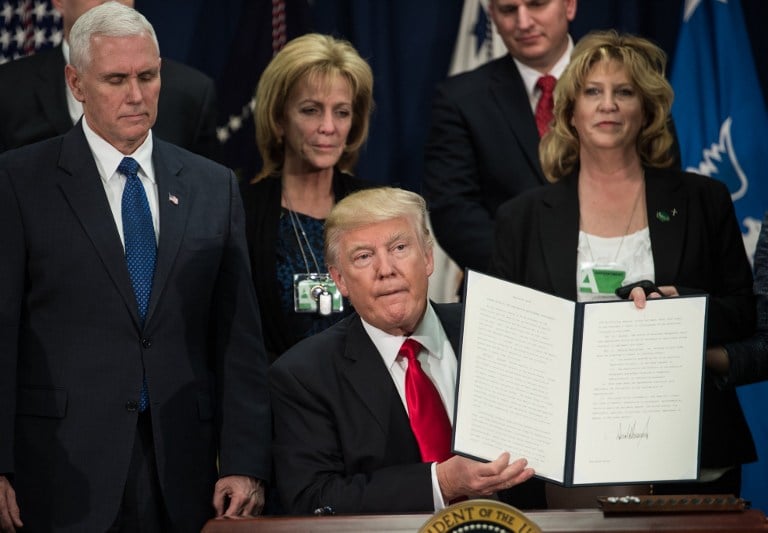
WASHINGTON (AP) — US President Donald Trump signed two executive orders in keeping with campaign promises to boost border security and crack down on immigrants living in the US illegally.
The president signed the two orders Wednesday during a ceremony at the Department of Homeland Security after honoring the department’s newly confirmed secretary, retired Gen. John Kelly.
The executive orders jump started construction of a US-Mexico border wall, one of his signature campaign promises, and strip funding for so-called sanctuary cities, which don’t arrest or detain immigrants living in the US illegally.
On his personal Twitter account Tuesday night, Trump tweeted: “Big day planned on NATIONAL SECURITY tomorrow. Among many other things, we will build the wall!”
Big day planned on NATIONAL SECURITY tomorrow. Among many other things, we will build the wall!
— Donald J. Trump (@realDonaldTrump) January 25, 2017
Trump, in an interview Wednesday with ABC News, said he expected construction of the wall to begin within months. US taxpayers are expected to pay for the upfront costs, though Trump continues to assert that Mexico will reimburse the money through unspecified means.
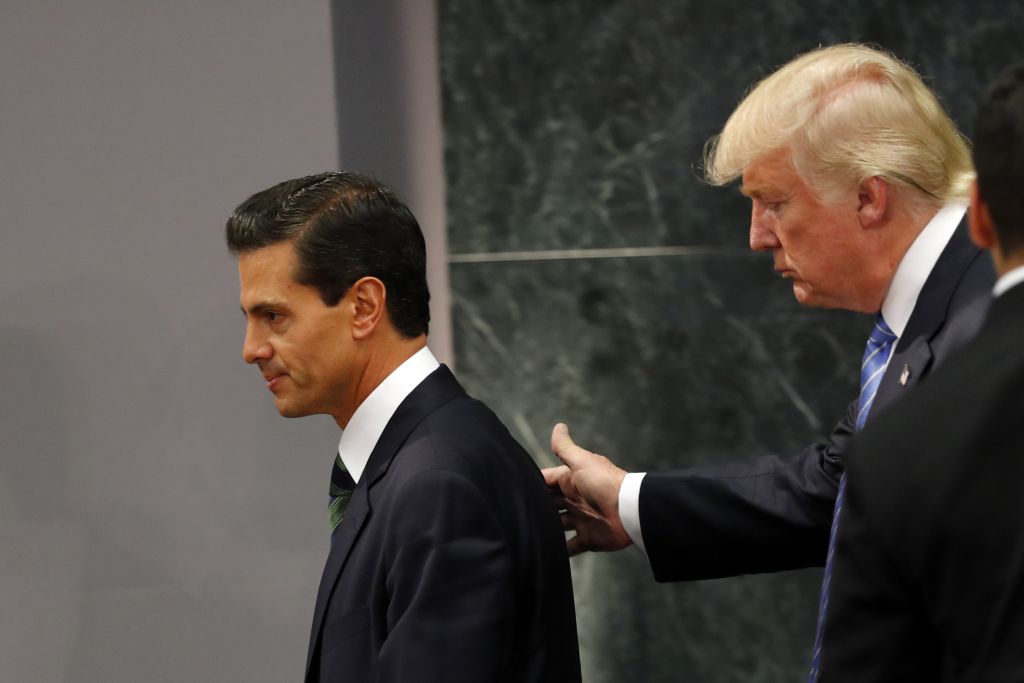
“There will be a payment, it will be in a form, perhaps a complicated form,” Trump said, adding that negotiations with Mexico would begin soon. Mexican President Enrique Pena Nieto, who has insisted his country will not pay for a wall, is to meet with Trump at the White House next week.
The president is said to still be weighing the details of plans to curb the number of refugees coming to the US The current proposal includes at least a four-month halt on all refugee admissions, as well as a temporary ban on people coming from some Muslim-majority countries, according to a source from a public policy organization that monitors refugee issues. The person was briefed on the details of that proposed action by a government official and outlined the plan to The Associated Press.
The officials and the public policy organization source insisted on anonymity in order to outline the plans ahead of the president’s official announcements.
Trump issues executive order for wall to be built along Mexican border https://t.co/vBRgKAoZvk pic.twitter.com/yePtTTq2gQ
— TheJournal.ie (@thejournal_ie) January 25, 2017
Trump campaigned on pledges to tighten US immigration policies, including strengthening border security and stemming the flow of refugees. His call for a border wall was among his most popular proposals with supporters, who often broke out in chants of “build that wall” during rallies.
In response to terrorism concerns, Trump controversially called for halting entry to the US from Muslim countries. He later turned to a focus on “extreme vetting” for those coming from countries with terrorism ties.
In claiming authority to build a wall, Trump may rely on a 2006 law that authorized several hundred miles of fencing along the 2,000-mile frontier. That bill led to the construction of about 700 miles of various kinds of fencing designed to block both vehicles and pedestrians.
The Secure Fence Act was signed by then-President George W. Bush, and the majority of that fencing in Texas, New Mexico, Arizona and California was built before he left office. The last remnants were completed after President Barack Obama took office in 2009.
The Trump administration also must adhere to a decades-old border treaty with Mexico that limits where and how structures can be built along the border. The 1970 treaty requires that structures cannot disrupt the flow of the rivers, which define the US-Mexico border along Texas and 24 miles in Arizona, according to The International Boundary and Water Commission, a joint US-Mexican agency that administers the treaty.
Other executive actions expected Wednesday include ending what Republicans have labeled a catch-and-release system at the border. Currently, some immigrants caught crossing the border illegally are released and given notices to report back to immigration officials at a later date.
If Trump’s actions result in those caught being immediately jailed, the administration would have to grapple with how to pay for additional jail space and what to do with children caught crossing the border with their parents.
It appeared as though the refugee restrictions were still being finalized. The person briefed on the proposals said they included a ban on entry to the US for at least 30 days from countries including Iran, Iraq, Libya, Somalia, Sudan and Yemen, though the person cautioned the details could still change.
There is also likely to be an exception for those fleeing religious persecution if their religion is a minority in their country. That exception could cover Christians fleeing Muslim-majority nations.
As president, Trump can use an executive order to halt refugee processing. Bush used that same power in the immediate aftermath of the September 11 attacks. Refugee security vetting was reviewed and the process was restarted several months later.






The Times of Israel Community.