

US duo William Nordhaus and Paul Romer win Nobel Economics Prize
Nordhaus, who has Jewish roots, honored for integrating climate change into growth analysis; Romer hailed for tech innovations, says he ignored calls thinking they were spam
 Add ToI as a Preferred Source on Google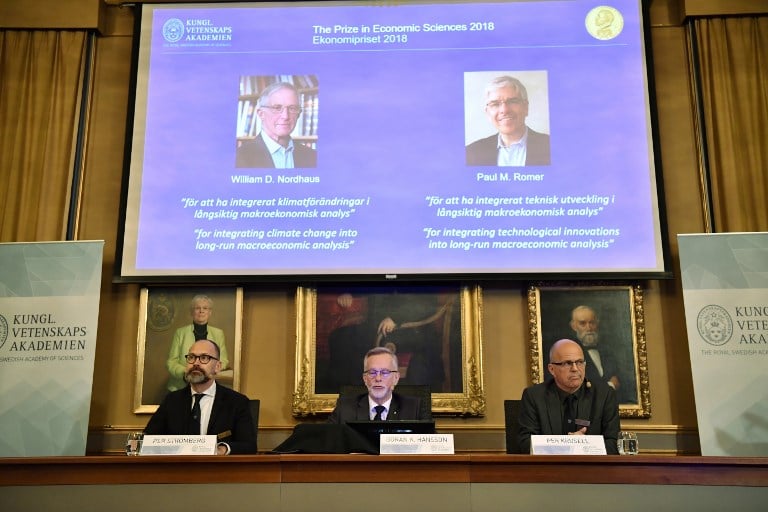
STOCKHOLM, Sweden — US economists William Nordhaus and Paul Romer on Monday shared the 2018 Nobel Economics Prize for integrating innovation and climate with economic growth, the jury said.
Nordhaus, a professor at Yale University, and Romer, a former World Bank chief economist now at New York University’s Stern School of Business, have addressed “some of our time’s most basic and pressing questions about how we create long-term sustained and sustainable growth,” the Royal Swedish Academy of Sciences said in a statement.
It said the pair have “significantly broadened the scope of economic analysis by constructing models that explain how the market economy interacts with nature and knowledge.”
Nordhaus, 77, was specifically honored for “integrating climate change into long-run macroeconomic analysis.”
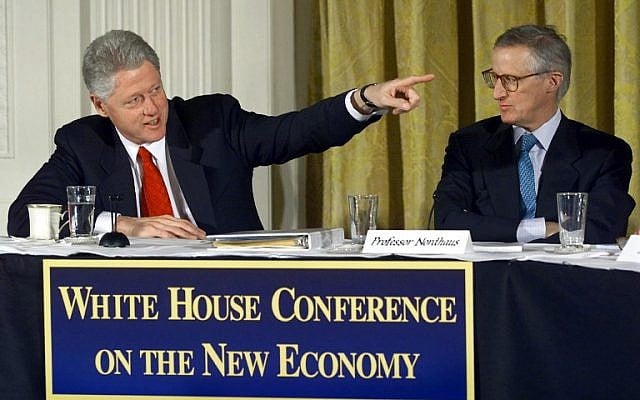
His family has Jewish roots, with origins in a German-Jewish immigrant wave in the early 19th century, according to his profile on the website of the scientific journal Proceedings of the National Academy of Sciences of the United States of America.
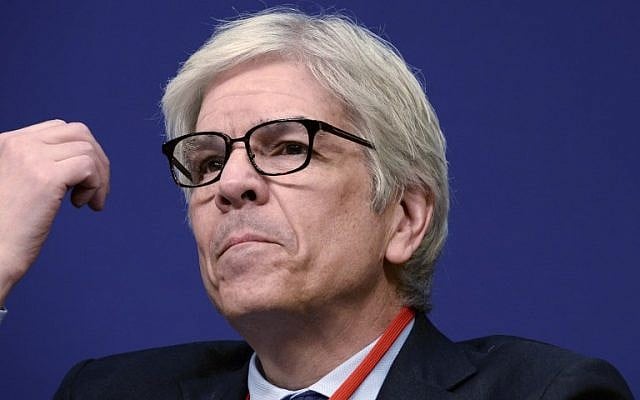
The 62-year-old Romer meanwhile won for “integrating technological innovations into long-run macroeconomic analysis.”
Romer said Monday morning that he originally ignored two telephone calls, thinking they were spam calls, before the Swedish Royal Academy of Sciences was able to get through to him.
Both have been tipped as frontrunners for the Nobel in recent years.
The pair will share the nine million Swedish kronor (about $1.01 million or 860,000 euro) prize.
Last year, the honor went to US economist Richard Thaler, a co-founder of the so-called “nudge” theory, which demonstrates how people can be persuaded to make decisions that leave them healthier and happier.
Unlike the other Nobel prizes which were created in Swedish inventor and philanthropist Alfred Nobel’s last will and testament and first awarded in 1901, the economics prize was created by the Swedish central bank, the Riksbank,in 1968 to mark its tricentenary. It was first awarded in 1969.
The Nobel, which also consists of a diploma and a gold medal, will be presented at a formal ceremony in Stockholm on December 10.
The Nobel economics prize wraps up the 2018 awards season, notable this year for the lack of a literature prize, postponed by a year for the first time in 70 years over a rape scandal that came to light as part of the #MeToo movement.
Last week, after the prizes for medicine, physics and chemistry were announced, the most highly-anticipated Nobel, that for peace, went to Yazidi women’s campaigner Nadia Murad and Congolese doctor Denis Mukwege for their work in fighting sexual violence in conflicts around the world.








The Times of Israel Community.