

Weiners, zombies and goats: Sundance’s Jewish highlights
As Utah’s annual film festival comes to a close, we bring you the best the mishpocha had to offer
 Add ToI as a Preferred Source on Google
Jordan Hoffman, a member of the New York Film Critics Circle, is The Times of Israel's long-time film reviewer and the co-host of The Reel Schmooze.
Each year the ski town of Park City in the middle of Mormon Utah has an opportunity to quote Mel Brooks’ 2000 Year-Old Man’s misunderstood version of Paul Revere: “The Yiddish are coming!” During the Sundance Film Festival the city is overrun by entertainment industry types from Los Angeles and New York, and everyone is the better for it. They get the boost to their economy, we get to complain about the high altitude drying out our sinuses (I brought my Neti Pot, don’t worry. If we wandered snowy mountains for forty years instead of a desert, manna from heaven would mean saline solution).
There are hundreds of motion pictures that make their debut at this predominantly independent festival, and some of the best this year had members of the Hebraic faith in their credits, or dealt with, as we like to say here at the Times of Israel, “topics of Jewish interest.” So let’s get to it: what was kosher at this year’s Sundance?
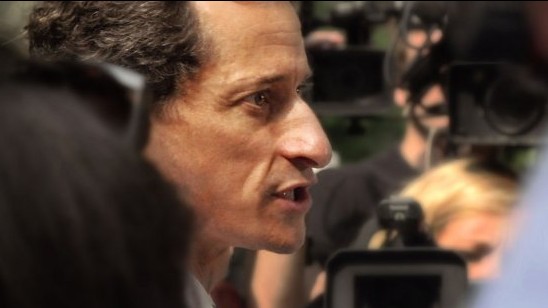
Front and center, for all to see, one of our greatest shondas. That putz Anthony Weiner, you remember him? The driven politician who was a rising star in the House of Representatives? Well it wasn’t just his career that rose. Energetic and, at heart, well-meaning, this klutz with a gorgeous wife and beautiful son felt the need to show off what the mohel left behind in a misdirected tweet, ruining his career.
Foolishly, he and his wife (Hillary Rodham Clinton adviser Huma Abedin) thought it wise for him to give politics a second go and run for mayor of New York. First time feature directors Elyse Steinberg and Josh Kriegman were embedded with the campaign and given a tremendous amount of access — just in time for wave two of the scandal to hit (does the name Carlos Danger ring a bell?). The resulting film, “Weiner,” is one of the most hilarious, engaging and thrilling political documentaries ever made. Bonus points: a showdown in a kosher bakery in Brooklyn with a judgmental Orthodox man where everyone loses their cool. I love New York!
While Weiner gave the most memorable Jewish performance at Sundance, there were some others that were scripted. Daniel Radcliffe gives it his all in “Swiss Army Man,” a weird midnight film in which he plays a zombified corpse that castaway Paul Dano “uses” to make his way back to civilization. In the pre-title sequence Dano rides Radcliffe like a jet ski, propelled by the expulsion of his intestinal gas. Yes, there are many scenes that involve Radcliffe’s flatulent, naked, hirsute derriere, so if you want to see Harry Potter turn Hairy Farter, this movie is for you (I must also point out that, in addition to being juvenile and shocking, “Swiss Army Man” ends up being something of a profound statement about individuality in a conformist world. The phrase “not for everyone” is made for movies like this, but don’t let the “dead guy farts” headline stink up the entire film).
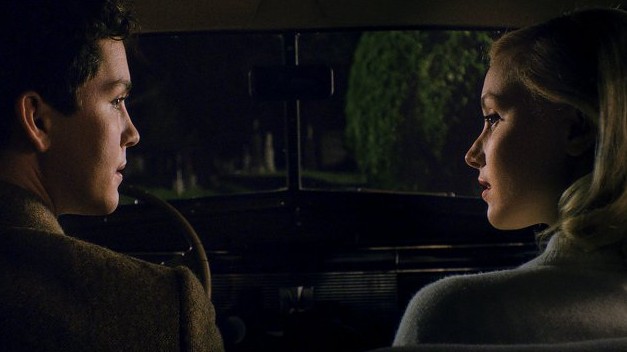
Logan Lerman gives a bravura turn in the 1950s-set “Indignation.” Based on Philip Roth’s short novel of the same name, Lerman’s Marcus, from a working class Jewish family in Newark, goes to college in Ohio and tries to shake his roots. An avowed atheist, Marcus doesn’t fit with the Christians, and vexes the lone Jewish fraternity. The highlight of the film is a tense fifteen minute philosophical debate between young Marcus and the Dean, played by Tracy Letts. It’s the type of thing that normally gets snipped out of a book adaptation, but James Schamus (a legendary screenwriter making his directing debut) realizes that if you are going to do Roth you may as well do it right. This sequence was met with applause at the Sundance premiere; maybe it reminded members of the audience of their nights spent arguing with their intellectual uncles after a seder.
A quick shout-out, also, to new Bar Mitzvah James Franco. Andrew Neel’s “Goats” is a frank look at fraternities on campus, and Franco swoops in as an aging rager in a cameo that steals the show.
Israeli director Elite Zexer’s “Sand Storm” is a fascinating (and altogether depressing) look at the Bedouin community inside Israel. Put bluntly, it’s not a particularly good time there if you are a woman. Imagine the indignity of having to clean up after the party for your husband’s second marriage. “Sand Storm”’s lead character Layla, nicely played by young Lamis Ammar, is that most doomed of creatures: an intelligent, independent young woman born into a rigid patriarchy. What’s most heartbreaking is how her father (Haitham Omari) would like to see her be happy and marry the boy from outside the village that she loves. But the System just won’t allow it, so he presses her into an arrangement.
Or, maybe he’s just pretending to be upset. It’s hard to tell. Perhaps his machismo is crushed that someone in his family has an independent thought? This ambiguity is what makes this movie so engaging, as well as Layla’s mother (Ruba Blal-Asfour) finally saying “enough.”
Every year there’s one or two Israeli movies that break out worldwide, and you can count on “Sand Storm” being one of them in 2016. Zexer is a strong director, and works impressively with what I’m sure was a small budget. You an also bank on some controversy. This was shot with a Jewish and Arab crew, but it is, on the face of it, condemning a minority group within Israel with Israeli financial backing.
On the documentary side, “The Settlers” is a Frontline-esque look at West Bank settlements that Screen Daily’s Anthony Kaufman says “doesn’t exactly cover the freshest material” and describes it as “yet another convincing example of Israel’s self-critical cinema, and the endless intractability of the Israeli-Palestinian conflict.” I personally didn’t see it (you can’t see everything, I’m sorry!) so I can’t give you my thoughts other than “oy.”
I did, however, see “Jim: The James Foley Story,” a straightforward yet infuriating look at the American journalist captured and killed by Islamic State in Syria. Sequences in which family members describe how their loved one’s last, terrified moments became an icon for war are incredibly touching. However, the film, made by one of Foley’s close friends, is a little selective with information.
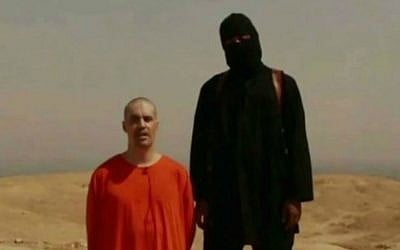
There’s the implication that the United States government didn’t do enough to free Foley, and the fact that all of Foley’s fellow European captives are now alive and safe speaks to some truth there. However, the movie makes no mention of President Obama’s failed rescue attempt. Considering how fast the news cycle runs, I’d forgotten myself until I spoke about this with a colleague after the screening.
Two Jewish veterans of Sundance returned to the fest with wildly different movies. Kenneth Lonergan (Jewish despite the name) brought the house down with “Manchester By The Sea,” a riveting tale of grief starring Casey Affleck. The independently financed picture sold for $10 million, not an unheard of amount at a festival, but the twist here is that it went to Amazon’s streaming service. Between this and “Transparent” (plus all that free shipping) it might be time to spend on Amazon Prime after all. Far less successful was Todd Solondz’s new one “Weiner-Dog,” a nasty, nihilistic picture that friends of mine tried to rationalize as “a treatise on mortality” or the about “difficulty of the creative process” but I’m ready to call it a disappointment that will most certainly not be playing at a theater near you.
Another Sundance in the books. The Tribeca Film Festival and Cannes are just around the corner.









The Times of Israel Community.