

Dressing up the past
Fashion designers offer new twists on the old in a recently opened Israel Museum exhibit
 Add ToI as a Preferred Source on Google
Jessica Steinberg, The Times of Israel's culture and lifestyles editor, covers the Sabra scene from south to north and back to the center
It takes a Tel Aviv designer to offer a new take on an black burka from 18th century Afghanistan. And if that designer is Yaniv Persy, the newfangled version is a black, knee-length sheath dress with an attached cape.
“Women who wear burkas today often wear sexy, colorful clothing underneath,” said Persy. “I was thinking about who sees that clothing: the collective or just the individual? This is a takeoff of that.”
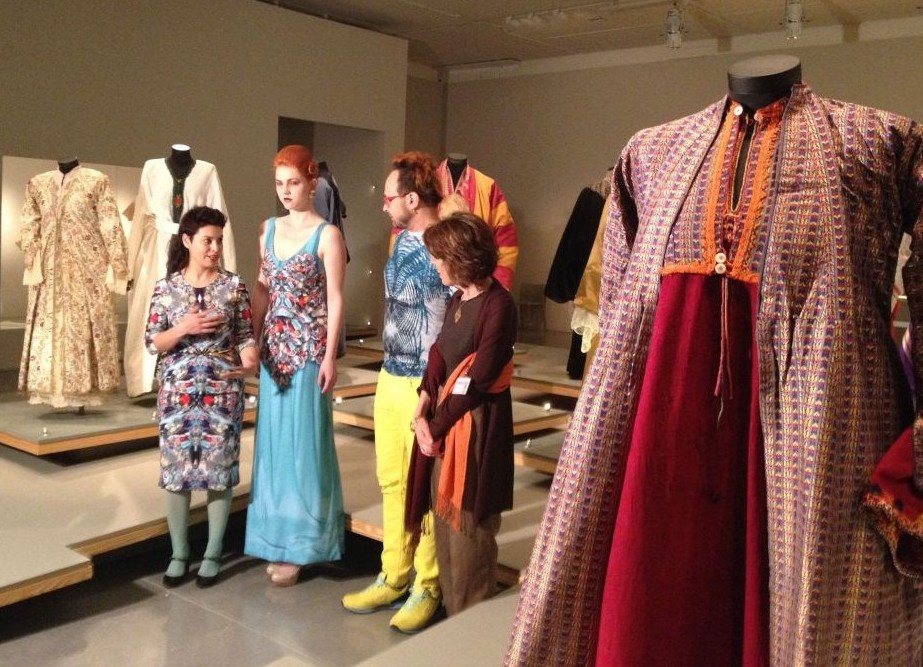
Persy was one of six designers asked by the Israel Museum to contribute their interpretations of the antique styles and patterns to a recently opened exhibit, “Dress Codes: Revealing the Jewish Wardrobe.”
Gathered from the museum’s collection of Jewish dress from the 18th through the 20th centuries, the exhibit’s 100+ costumes from four continents cast light on the cross-cultural history of Jewish dress and how traditional garments have stimulated historical and current fashion design.

There were Philip Blau and Helaina Blaustein of Frau Blau, showing a jewel-imprinted column dress as their interpretation of a Baghdadi gown; the colors, said Blau, echoed the printed bodice traditionally worn underneath, both covering and accentuating the wearer’s chest.
“They covered what they had, and we like to bring it out,” said Blau.

Maskit, the recently renewed label traditionally known for its embroidery, stayed true to its roots with hand-embroidered pieces on a tallit-inspired wedding dress — echoing back to the prayer shawl that belonged to a Turkish chief rabbi — featuring curlicued silver epaulettes on the white, cotton-and-silk gown.
“It was all about standing out from the crowd — much as it is now,” said Efrat Assaf-Shapira, who curated the collection. “That was as important for the rabbi as it for us.”
The exhibition is on view through October 25.









The Times of Israel Community.