

Kerry meets Putin, will ask to delay S-300 transfer to Iran
Moscow blames Washington for strains in ties as two discuss Ukraine crisis, Yemen, Syria and halting air defense system sale
 Add ToI as a Preferred Source on Google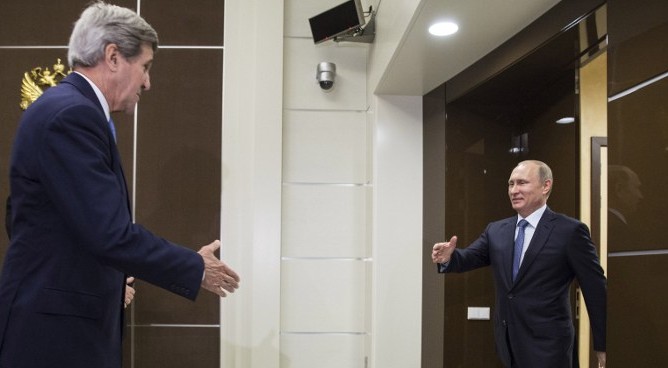
SOCHI, Russia — US Secretary of State John Kerry met Tuesday with Russian President Vladimir Putin in a bid to ease badly strained relations over the conflicts in Ukraine and Syria, but the tone ahead of the meeting didn’t augur well for a breakthrough on any of the many issues dividing the two powers.
On his first trip to Russia since the Ukraine crisis began, Kerry held more than four hours of talks with Russian Foreign Minister Sergey Lavrov at a hotel in the Black Sea resort of Sochi before seeing Putin at his presidential residence in the city. Putin is in Sochi meeting with Russian defense officials for a week.
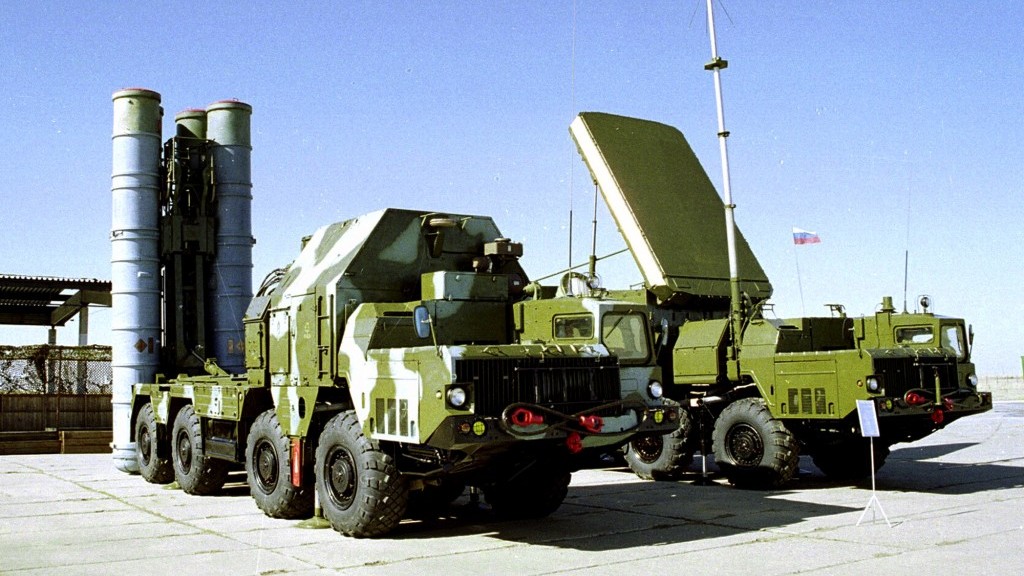
The top US diplomat will make the case to Putin that Russia should not proceed with its planned transfer of an advanced air defense system to Iran.
Diplomats in Moscow and Washington are at odds over an announcement last month that Russia would lift a five-year ban on delivery of an air defense missile system to Iran, drawing a hasty rebuke from the United States and Israel.
The White House said the missile system would give the Islamic Republic’s military a strong deterrent against any air attack. The Kremlin argues that the S-300 is a purely defensive system that won’t jeopardize the security of Israel or any other countries in the Middle East.
Three hours into the Kerry-Putin meeting, Russia’s Foreign Ministry issued a statement saying that Kerry and Lavrov had a “long and sincere conversation on a broad range of issues.”
But the statement echoed the defiant tone of earlier ministry comments that blamed Washington for strains in relations and said Moscow would not back down on matters critical to its national interests.
“Sergey Lavrov noted that we aren’t to blame for the current crisis in relations with Washington,” the statement said. “Russia is ready for constructive cooperation with Washington both on bilateral issues and on global arena, where our countries bear special responsibility for the global security and stability. However, cooperation is only possible on an honest and equal basis, without attempts at diktat and enforcement.”
The statement added that additional sanctions pressure on Russia would result only in continued deadlock because “Russia will not be forced to compromise on its national interests and its principled stance on the issues it considers as key for itself.”
Kerry was also to discuss Yemen and Libya and brief Putin on the negotiations on curtailing Iran’s nuclear program. He was accompanied by chief US negotiator Wendy Sherman who will travel to Vienna on Wednesday for a new round of Iran talks.
Kerry planned to test Putin’s willingness to make pro-Russia separatists in Ukraine comply with an increasingly fragile ceasefire agreement, according to US officials traveling with him.
Kerry also sought to gauge the status of Russia’s support for embattled Syrian President Bashar Assad, whose forces have been losing ground to rebels, and press Moscow to support a political transition that could end that war, the officials said.
Kerry’s trip comes at a time when relations between Washington and Moscow have plummeted to post-Cold War lows amid the disagreements over Ukraine and Syria.
In a sign of the considerable strains, the Kremlin would not confirm Kerry’s meeting with Putin until just an hour before he arrived in Sochi, a full day after US officials had announced it. And Russia’s Foreign Ministry had previewed the talks by blaming Washington for the breakdown in relations.
Putin’s spokesman welcomed Kerry’s decision to travel to Russia but with a point. “We have repeatedly stated at various levels and the president has said that Russia never initiated the freeze in relations and we are always open for displays of political will for a broader dialogue,” Dmitry Peskov told journalists in Sochi.
The rhetoric signaled there would be few breakthroughs if any on the many issues dividing the US and Russia. Nevertheless, both sides stressed the importance of trying to work through some of the rancor that buried President Barack Obama’s first-term effort to “reset” ties with Moscow.
Kerry began his short visit to Sochi by laying a wreath at a World War II memorial with Lavrov, with whom Kerry has had a warm personal relationship despite tensions over policy.
At a working lunch, Lavrov presented Kerry with tomatoes and potatoes that were “distant” descendants of the two Idaho potatoes that Kerry gave him last year, a spokeswoman for Lavrov said. For his part, Kerry “presented the Russian side with a list of quotations from the Russian media that in his view don’t reflect the real potential of broad Russian-American relations, which he is convinced need to be improved,” spokeswoman Maria Zakharova wrote on her Facebook page.
Improving ties, however, hinges largely on violence decreasing in Ukraine, however.
The Western-backed government in Kiev continues to be embroiled in a sporadic conflict between government and separatist rebel forces despite a cease-fire agreement sealed in mid-February. Russia was party to that deal; although the US was not, one State Department official said it is important for Putin “to hear directly from the United States that we are firmly committed to (its) implementation.”
Western nations say Russia supports the separatists with arms and manpower, and even directs some battlefield operations — all claims Moscow denies. In return, the Russians bristle at Washington’s provisions to Ukraine of military assistance in the form of hardware and training.
On Syria, Russia has defied a chorus of international condemnation to remain allied with Assad.
AFP contributed to this report.





The Times of Israel Community.