

One ringing phone call
Obama speaks to Rouhani; Israel and Palestinians at apparent dead end in talks; two Hebrew U professors hope for Nobel Prize
 Add ToI as a Preferred Source on Google
Aaron Kalman is a former writer and breaking news editor for the Times of Israel
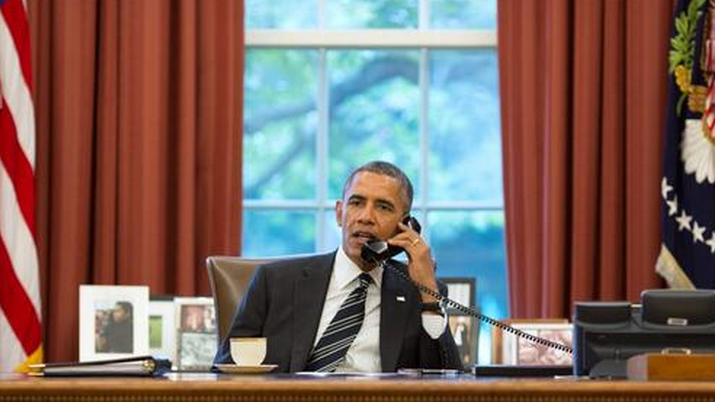
All four of Sunday’s Hebrew dailies focus on the historic phone call between US President Barack Obama and his Iranian counterpart Hasan Rouhani, pushing other matters to the inner pages.
The 15-minute chat leads Haaretz‘s front page. “I do believe that there is a basis for resolution,” the paper quotes Obama as saying after the conversation, which was the first official direct contact between the countries’ leaders in 34 years.
According to the report, most of the talk was dedicated to Iran’s nuclear program, with Obama reiterating his position of support for Tehran’s right to develop nuclear energy plants for peaceful purposes, but emphasizing that he was absolutely against the development of nuclear materials for military use.
“A path to a meaningful agreement will be difficult, and at this point both sides have significant concerns that will have to be overcome,” Obama said. “But I believe we’ve got a responsibility to pursue diplomacy and that we have a unique opportunity to make progress with the new leadership in Tehran.”
Yedioth Ahronoth reports that Israel was informed of the conversation before it took place. It also notes that Prime Minister Benjamin Netanyahu ordered his ministers to keep their mouths shut and not talk about the recent developments on the Iranian front.
Besides the phone call, the paper reports that the US has already performed one goodwill gesture and returned an ancient wine goblet to Iran. The vessel, a 2,700-year-old piece in the shape of a griffin, was smuggled to the US over a decade ago and confiscated upon arrival by the custom services.
The daily reports that for 13 years the US refused to return the artifact to Iran, citing the lack of diplomatic relations as the main reason. However, it reports, on Wednesday the piece was handed over to the Iranian delegation in New York and returned to the Islamic republic.
“I will tell the truth,” reads Israel Hayom‘s headline as the tabloid highlights Netanyahu’s response to the recent developments. According to the paper, Netanyahu hopes to explain to the world that smiles are nice but they don’t stop the centrifuges from spinning and producing military-grade uranium for Iran.
The daily also quotes coalition and opposition legislators who voiced their mistrust of Rouhani’s latest “charm offensive.” Home Front Defense and Communications Minister Gilad Erdan is quoted as saying Friday that Netanyahu will present information “the world has not yet been exposed to” at the UN. Meretz leader Zahava Gal-on is quoted as saying that one should not be naive, and that there is no reason to believe that the nuclear program is for peaceful purposes.
In two columns, two of the paper’s top writers explain the problems facing Netanyahu — and Israel — in the wake of the recent developments on the Iranian front.
Dan Margalit says that Netanyayhu will have a “very hard job” of convincing Obama that issues in the Middle East need to be separated, and that the Iranian drive for a nuclear weapon must be stopped regardless of progress on the Palestinian front.
Margalit writes that when the feeling around the world is that “appeasement at any cost” is what leads the diplomatic effort, no one will listen to the very serious threats at hand. Comparing the situation to what happened recently in Syria, and almost 80 years ago in Munich, he says Israel’s worries are justified.
Boaz Bismuth’s piece focuses on Netanyahu’s need to convince the world that Rouhani is putting on an act. Writing that “it’s not fun to be the party-pooper,” he claims that the world wants to think positively and frowns upon people like Netanyahu who point out the negative.
Using the fable of the emperor’s new clothes, Bismuth says Netanyahu needs to convince the world Rouhani is indeed naked. “The problem is, no one wants to believe it, even if it’s true.”
Besides the report on the phone conversation between Rouhani and Obama, Maariv‘s front page highlights two other important stories.
Looking at the ongoing negotiations between Israel and the Palestinian Authority, the paper reports that “the talks are stuck” and have reached a dead end. “Unless the US interferes, or Netanyahu meets [PA President Mahmoud] Abbas,” the meetings between the sides are pointless, a foreign diplomat is quoted as saying.
According to the report, the issue of borders between Israel and a future Palestine is now at the center of the discussions — but the sides are not able to make any progress. The paper says Israel made it clear large settlement blocs would remain in Israel’s hands after the final agreement was signed. However, the daily reports, chief negotiator Tzipi Livni and Netanyahu’s special envoy Yitzhak Molcho refused to say what compensation the Palestinians would receive or even what settlements were included in the plan.
The report notes that Abbas and the US are insistent that the future Palestinian state be on no less than 22 percent of the territory between the Jordan River and the sea — the exact size of the West Bank. Netanyahu, in contrast, believes that while some settlements will remain, the PA should receive a form of compensation that is not territory.
The daily also reports that two professors from Jerusalem’s Hebrew University appear to be leading candidates for a Nobel Prize in physiology or medicine — the winner of which will be announced next week.
The report says 70-year-old Haim Cedar and 78-year-old Aharon Razin are at the top of the list of candidates for this year’s prize in light of their work in the field of genetic research and understanding genetic diseases.




The Times of Israel Community.