

Two headlines, one reporter
Makor Rishon and Maariv run two different reports about the same incident, by the same writer
 Add ToI as a Preferred Source on Google
Ilan Ben Zion is an AFP reporter and a former news editor at The Times of Israel.
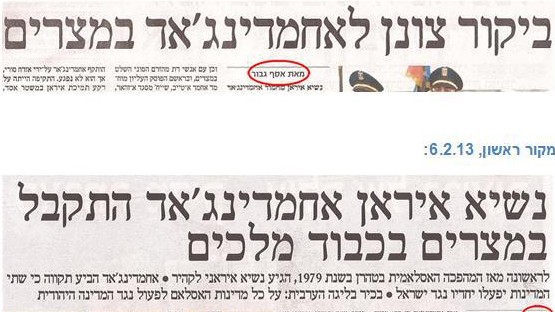
One writer’s report about one event was given two very different treatments by editors Tuesday night.
A writer for Hebrew daily Makor Rishon reported on Iranian President Mahmoud Ahmadinejad’s arrival in Cairo on Wednesday, but the article appeared in Makor Rishon and its subsidiary, Maariv, with two diametrically opposite headlines.
Makor Rishon, a religious-nationalist right-wing newspaper, acquired Maariv, a traditionally centrist tabloid, in November, raising concern over the editorial direction of the subsidiary paper.
Israeli press watchdog Presspectiva noted that Assaf Gibor, the Arab affairs correspondent for Makor Rishon, published a report headlined “Iranian President Ahmadinejad received in Egypt with kingly honors.” Maariv ran a report by the same author on the same day with the headline “Chilly reception for Ahmadinejad in Egypt.”
Gibor wrote in the first paragraph of the Maariv report that the Egyptians greeted Ahmadinejad with great fanfare, but that he was later attacked by a Syrian citizen during his visit to Cairo’s premier Sunni Islamic institution.
The Makor Rishon report omitted that incident altogether, but reported on his visit to al-Azhar University.
Maariv reported Ahmadinejad held a “difficult conversation” with Grand Imam Ahmed Muhammad Ahmed el-Tayeb of the al-Azhar Mosque. Makor Rishon sufficed to report the two met.
Makor Rishon is owned and operated by Shlomo Ben-Tzvi, a newspaper magnate residing in the West Bank settlement of Efrat.


The Times of Israel Community.