

Dating conflict at 50 years old, Trump appears to quietly adopt Arab stance
While US president added in ‘or more’ to delivered speech, White House’s use of Six Day War as starting point of strife may indicate it sees pullback toward 1967 lines as key to reaching peace
 Add ToI as a Preferred Source on Google
Raphael Ahren is a former diplomatic correspondent at The Times of Israel.
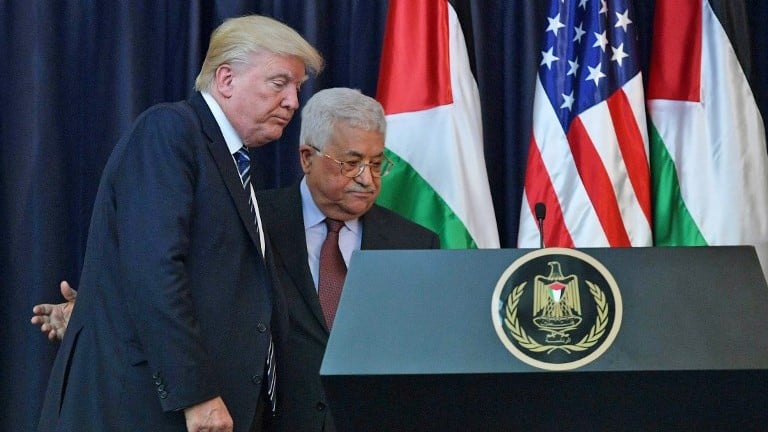
Did Donald Trump adapt the Palestinian narrative on the source of the Israeli-Arab conflict?
In his address Tuesday at the Israel Museum, the US president showered the Jewish state with effusive praise and vowed to “always stand with Israel.” He did not endorse Palestinian statehood. But he asserted that “the Palestinians are ready to reach for peace” and, in a little-noticed phrase, appeared to suggest that the conflict could end as soon as Israel withdraws from the West Bank.
“We know, for instance, that both Israelis and Palestinians seek lives of hope for their children,” Trump said. “And we know that peace is possible if we put aside the pain and disagreements of the past and commit together to finally resolving this crisis, which has dragged on for nearly half a century or more.”
The last phrase — a clear reference to the 1967 Six Day War, the 50th anniversary of which will be marked next month — could be interpreted as implying that the Israeli-Palestinian conflict started with Israel’s “occupation” of the West Bank.
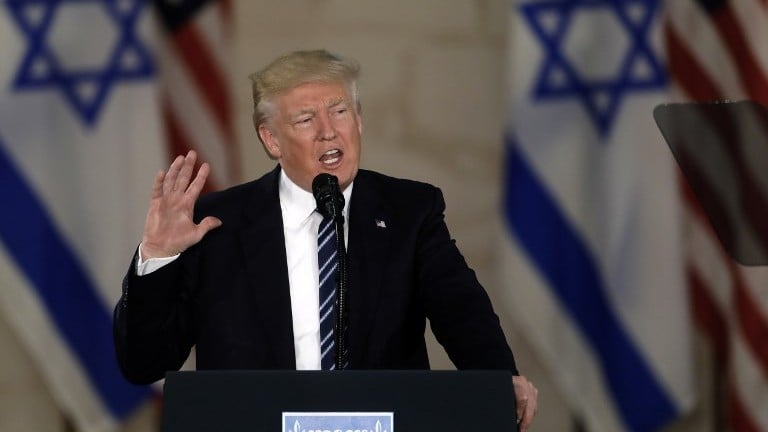
Israeli leaders put the conflict at nearly 100 years old, dating it to anti-Jewish riots in the 1920s, and Trump’s addition “of more,” which did not appear in the prepared remarks, was likely meant as a nod to them.
But the “nearly half a century” remark explicitly marked in the written speech would seem to imply that the White House believes an Israeli withdrawal from the territories captured 50 years ago would be the key to ending the conflict.
This is exactly how the Arab world portrays the matter: As soon as Israel evacuates the territory it occupied in the Six-Day War, the conflict will end, they promise. Full normalization with nearly the entire Arab and Muslim world in exchange for an Israeli pullout from the West Bank, East Jerusalem and the Golan Heights is the central idea behind the Arab Peace Initiative, which Trump was likely told about at great length during his meetings in Saudi Arabia over the weekend.
“Our fundamental problem is with the occupation and settlements,” Palestinian Authority President Mahmoud Abbas declared during a meeting with Trump in Bethlehem. “The problem is not between us and Judaism. It’s between us and occupation.”
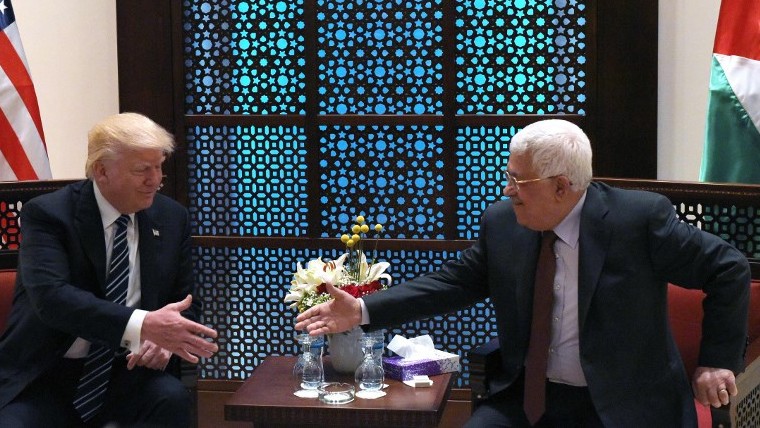
Israeli officials were hesitant to criticize Trump, who notably made no explicit mention of Palestinian statehood, 1967 lines or settlement building, which was seen by many on the right as confirmation of a US policy shift away from being wedded to a two-state solution based on a withdrawal from the West Bank.
But in the months since Trump took office, the White House has consistently muddled its way through the sensitive minefield of Israeli-Palestinian policy, leaving analysts scratching their heads over how much importance to ascribe to sometimes contradictory statements from Trump and administration officials.
“It would be a mistake to read too much into the president’s remarks,” said Michael Oren MK, a former historian who currently serves as deputy minister for diplomacy in the Prime Minister’s Office.
But Oren, who authored a highly regarded history of the 1967 war, said the notion that troubles between Israel and the Palestinians began 50 years ago is mistaken.
“Clearly, the conflict predates 1967 by many decades,” he told The Times of Israel on Wednesday. “The cause of the conflict, however, remains unchanged: the unwillingness of the Palestinians to accept a Jewish state in any borders.”
Prime Minister Benjamin Netanyahu’s office did not reply to a Times of Israel query on this matter.
It is no secret, however, that Netanyahu deeply objects to any attempt to describe the Israeli-Palestinian conflict as a territorial dispute that could be solved by an Israeli withdrawal to the 1967 lines.
“The reason why we haven’t had peace for a hundred years is not the settlements, but the persistent [Palestinian] refusal to recognize a nation-state for the Jewish people in any boundary,” he told UK Foreign Secretary Boris Johnson earlier this year. “I think if you want to solve a problem, go to the core of the problem.”
In 2015, Netanyahu also put the conflict near the century mark when speaking of his own family history.
“My grandfather came to Jaffa in 1920,” he said. “Several months later [in May 1921], Arab rioters burned the Jewish immigration office where he had gone. They murdered several Jews there including famed author Yosef Chaim Brenner. I note that year as the start of the armed struggle against Zionism; we are approaching 100 years.”
And just a month ago, President Reuven Rivlin told diplomats from Denmark and Costa Rica that “we have lost 100 years,” when speaking about solving the conflict with the Palestinians.



The Times of Israel Community.