

Foreign policy change won’t come easily to newly GOP Congress
US is swathed in red, but Republican control of Congress can only go so far in redirecting talks with Iran or the peace process
 Add ToI as a Preferred Source on Google
Rebecca Shimoni Stoil is the Times of Israel's Washington correspondent.
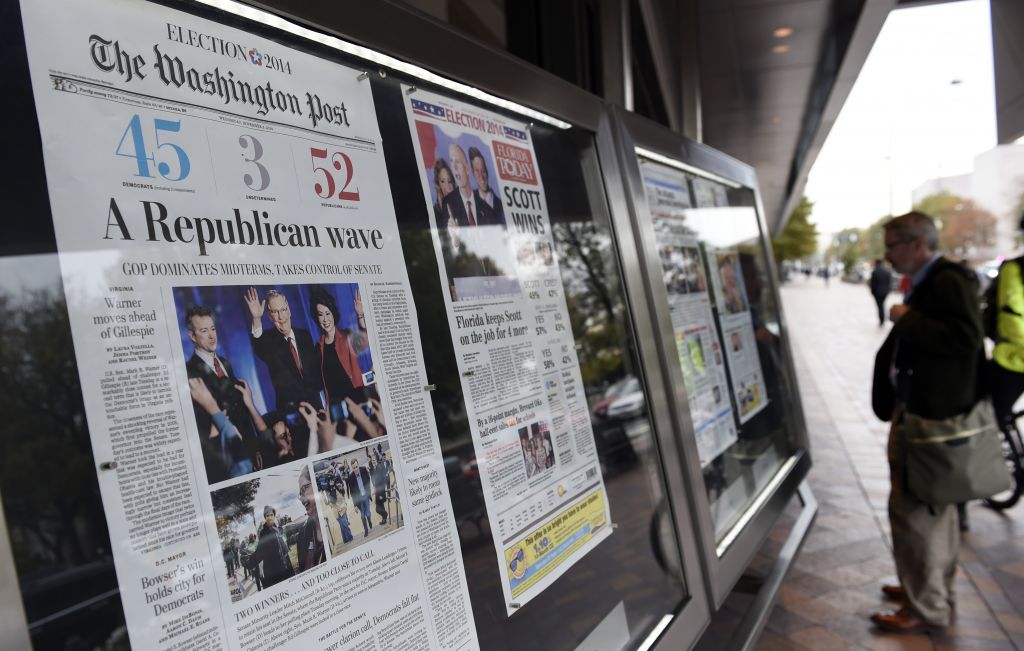
WASHINGTON — US midterm elections are not normally known as a foreign policy battleground.
But Tuesday’s vote, which saw a Republican victory in key Senate seats, may have long-reaching implications for President Barack Obama’s Mideast policy during the upcoming lame-duck period.
Although still armed with executive veto powers, Obama will be stuck fending off legislative attempts to shift his foreign policy agenda.
In a triumphal victory message, the Republican Jewish Coalition cast the Republican takeover of the Senate as a strong – if functionally limited – voice against the administration’s controversial Middle East agenda.
“The Republican-led 114th Congress will offer alternatives to the policies of the Obama administration and pursue critical priorities, including enhanced sanctions to prevent a nuclear Iran…as well as standing up to the undisguised hostility of the Obama administration against Israel and Prime Minister Netanyahu and rebuilding our essential relationship with Israel,” the RJC promised in a statement issued as election results tumbled in.
That is not to say that it is likely Senate Leader Mitch McConnell (R-KY) will spend his first day in office trying to reconfigure sanctions against Iran or advancing the stalled Menendez-Kirk bill set to place preconditions on continuing P5+1 talks.
But in a Republican caucus torn over how to repeal Obamacare, and with markedly different perspectives toward where exactly federal spending needs to be trimmed, tough talk toward Tehran seems like a consensus-building exercise among all but the most isolationist members.
With so called P5+1 talks between Iran and six world powers set to conclude later this month, any attempt at brokering an extension will face the specter of a Republican Congress which is likely to attempt to obstruct any additional relaxation of sanctions.
In the broad field known as the Middle East Peace Process – the various permutations of talks aimed at ending the Israeli-Palestinian conflict – the impact of Congress is grayer.
Dovish group J Street took a hit in the Senate races, with endorsees losing three of four key races. J Street-backed candidates Michelle Nunn (GA), Bruce Braley (IA), and incumbent Sen. Mark Udall (CO) all were soundly defeated, with only incumbent Sen. Jeanne Shaheen (D-NH) staving off opponent Scott Brown.
Congress has not flexed much muscle historically on the issue, although it has certainly been rhetorically involved for quite a while. Under both parties, support for Israel in Congress has remained high, and key defense packages for Israel tend to move quickly through the House and Senate regardless of who’s in charge.
Even when relations go sour – as they certainly are now – between the executive branch and Jerusalem, Congress has little capacity to intervene to make the going easier for Israel when it comes to delayed defense transfers or heated State Department condemnations.
Congress’s ability to intervene regarding administration policy toward Israel is, after all, at the heart of the Zivotofsky v. Kerry case which is currently being heard at the Supreme Court.
One interesting way, however, in which Congress can exercise its power of the purse is in attempting to influence what happens some 200 miles to the north, at the United Nations. Republican foreign policy hawks, most notably former UN ambassador John Bolton, have argued that Congress’s best response to anti-Israel practices at the UN is to cut funding to the organization.
Limited manifestations of that policy have already been seen, with Washington cutting funds to UNESCO after it recognized Palestine as a member state.
But Congressional initiatives can only go so far in the face of presidential veto powers. Republicans in the House are some 40 votes short of a veto-busting two-thirds majority, and depending on Senate outcomes, Republicans are down something like 12 votes there.
The veto override could get interesting when it comes to Iran, a topic on which key Democrats like Sen. Robert Menendez (D-NJ) have bucked the administration’s stance in supporting – even sponsoring – legislation that changes the conditions under which US negotiators can operate.
Winter is coming to Washington — a city that finds itself paralyzed by ice storms — early this year. Only this year, in the lamest of lame duck sessions, the paralyzing freeze is likely to be seen on a brief stretch of pavement measuring the 1.5 miles down Pennsylvania Avenue from the blue White House to a Capitol freshly painted red.







The Times of Israel Community.