

Gaza Strip tease: 10 things to know for October 4
Gaza’s leader says he doesn’t want war, but few believe him and with the IDF fetching more troops, the Strip seems headed that way even after Qatar agrees to throw fuel at the fire
 Add ToI as a Preferred Source on Google
Joshua Davidovich is The Times of Israel's Deputy Editor
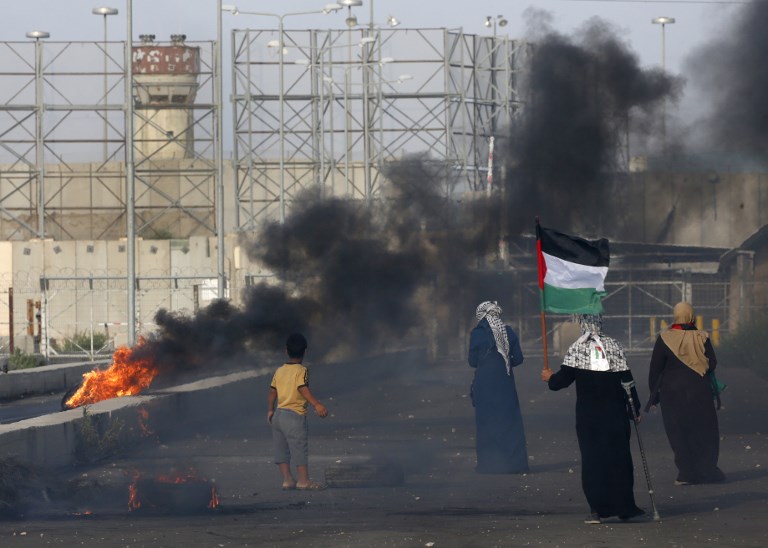
1. Blockade means no quiet: Hamas leader Yahya Sinwar, considered one of the most hard-line officials in the terror group, has granted a rare interview to an Israeli newspaper, telling an Italian freelancer in Gaza that his organization is sick of fighting but unwilling to allow the blockade on the Strip to continue.
- With the winds of war increasingly blowing amid daily Hamas-led protests on the Gaza fence, Sinwar says he is willing to talk to Yedioth Ahronoth because he “sees an opportunity for real change,” apparently referring to indirect ceasefire talks between Israel and the de facto Gaza rulers.
- “I didn’t say I won’t fight anymore. I said we don’t want more wars. What I want is an end to the blockade,” the former terror convict says. When asked if Hamas is willing to return quiet with quiet he answers “No. Quiet for quiet for an end to the blockade. The blockade is not quiet.”
2. A platform for terror? The piece, which is just a preview of a fuller interview set to run in Yedioth on Friday, includes no small amount of self defense both from writer Francesca Borri (who penned an excellent piece about demands on war reporters in Syria a few years back), and from others at the paper attempting to head off concerns about given a terrorist a soapbox.
- “I tried to do the most professional journalism possible, to ask tough questions and not to give Sinwar any breaks,” she writes.
- Unfortunately, Sinwar’s bureau is now claiming he had no idea he was speaking to an Israeli paper and thought Borri was writing for an Italian one, ToI’s Avi Issacharoff writes on Twitter.
- Columnist Ben Dror Yemini also defends the paper’s decision to publish: “Don’t forget for moment who and what Hamas is, and who and what its leader Sinwar is. But when the head of Hamas in Gaza asks to have his voice heard by readers in Israel, you shouldn’t keep from publishing it,” he writes.
- In the same paper, Yoaz Hendel writes that one should read the interview as “knowing your enemy, not as factual information,” calling Sinwar a liar.
3. Throwing gas to lower the flames: Haaretz reports that Qatar is set to begin supplying fuel to Gaza, in a move that that may help lower tensions.
- According to the report, the fuel will double the amount of electricity Gazans get a day, to a whopping eight hours.
- “ Israel hopes that this development, which should provide an immediate improvement to residents’ daily lives, will reduce the risk of a military confrontation with Hamas,” the paper’s Amos Harel reports.
- The family of Hadar Goldin, a soldier whose body is being held by Hamas, slam the move and accuse the Israeli government of caving to Hamas.
- “Instead of pressuring Hamas to return our sons first, Israel is caving and abandoning the residents of the Gaza border region, and not stopping the arson balloons or riots,” parents Leah and Simcha Goldin write on their Twitter account.
4. Fetch troops: In a sign that everything may not be getting better, the army says Thursday it is ordering more troops to beef up the border with Gaza over the next several days.
- Then again, this is the same army that devoted a tweet to a Mean Girls meme.
#MeanGirlsDay #October3rd https://t.co/Wkh2iGjeko
— Israel Defense Forces (@IDF) October 3, 2018
5. German incursion: Gaza is expected to be one of the topics of conversation between Prime Minister Benjamin Netanyahu and German Chancellor Angela Merkel, who’s in Israel on a one-day visit.
- Despite considerable differences in thinking on everything from Iran to the Palestinians, and Netanyahu’s campaign to drive a wedge within the EU, government mouthpiece Israel Hayom attempts to play up the closeness between the countries, noting that it’s the leaders’ third meeting within a year.
- Despite that, ties have still been strained, especially after a visit last year by then-foreign minister Frankwalter Steinmeier in which Netanyahu essentially blackballed him because he met with the left-wing Breaking the Silence group.
- Columnist Eldad Beck in Israel Hayom accuses Germany of treating Israel like a wayward colony and only favoring one side of the political spectrum while funding anti-Israel organizations and ignoring what he calls “the new Israel,” i.e. the Netanyahu- and settler-led right-wing.
- “The time has come for Germany recognize Israel as it is, and not try to force Israel to be what it thinks it should be,” he writes.
- With Israel apparently holding off on evacuating and razing Bedouin village Khan al-Ahmar until after Merkel leaves, Haaretz’s lead editorial writes that what’s good for the German should be good for the gander.
- “The government seems to understand very well that it has turned its back on the values that were once shared by Israel and Western Europe. The government is prepared to dress up for a few days and behave properly, but once the visit is over, it will return to business as usual.”
6. Gaffe-a-minute: Merkel’s visit has been gaffe-free so far, putting it in stark contrast with many other visits by German leaders, which always seem to be overshadowed by controversy, most of them relating to the countries’ special relationship.
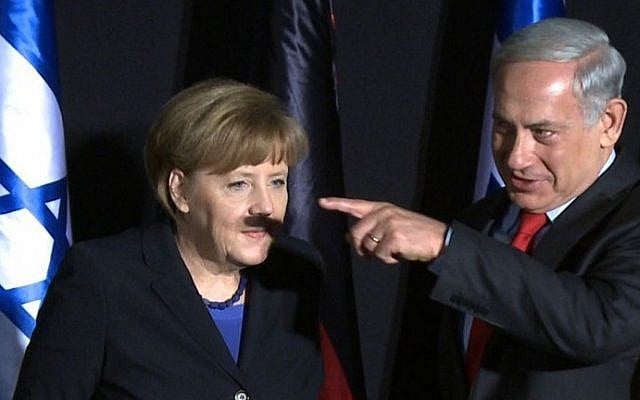
- Merkel’s last visit, in 2014, saw Netanyahu cast an infamous Hitler mustache on the leader, with photographer Marc Israel Sellem caught at the perfect angle, making headlines around the world.
- In 2000, then chancellor Gerhard Schroeder accidentally extinguished an “eternal” memorial flame at the Yad Vashem Holocaust memorial.
7. Haters gonna hate: The Seventh Eye, a media watchdog run by the Israel Democracy Institute, preempts a hit piece that it says Israel Hayom is getting ready to run by publishing its own snide response.
- The piece will apparently allege that the Seventh Eye is an extreme leftist organization that gets money from the New Israel Fund.
- The site responds that yes, it did get money from NIF, which it did not hide, and pushes back at claims of bias, which it says are rich coming from the pro-Netanyahu, pro-Trump Sheldon Adelson-owned free tabloid.
- “We’ve already written about Israel Hayom accusing other journalists of political bias. Israel Hayom. Accusing. Of political bias. The same newspaper that was founded as an instrument of bias for one politician, which is used as an outspoken mouthpiece for its owners, a pair of Las Vegas billionaires,” the site’s Shuki Tausig writes.
8. Birds of a feather: Meanwhile, the Jewish Federation of San Francisco is in hot water after an expose by the Forward that it is a major funder behind Canary Mission, which doxes pro-Palestinian students at universities and others.
- The story, which apparently took two years to report according to a Forward editor, lists the Helen Diller Foundation, controlled by the federation, as a main funder of the shadowy group.
- Several hours after the story appears, the federation has put out a statement saying it and the foundation will no longer support Canary Mission.
Read @jewishbayarea's response to @jdforward's article: https://t.co/DfyrP3BkYP pic.twitter.com/7R7Jw8hqao
— Jewish Federation (@JewishBayArea) October 3, 2018
9. Go phage yourself: Canary Mission would likely have had a field day with biologist George Smith of the University of Missouri who won the Nobel Prize in Chemistry. After Smith’s big win, some media in Israel focus on his outspoken anti-Israel advocacy.
- “Smith is known in the US for his harsh criticism of Israel and describes himself as ‘post-Zionist,’” Yedioth reports.
10. Rubble-washing in secret: In the past, Israel has been known to make showy offers of support to disaster-stricken countries considered enemies in order to show itself being the bigger person — with those offers almost always turned down. With Indonesia struggling to recover from an earthquake and tsunami, though, Jerusalem appears to be doing the opposite, providing aid but keeping mum.
- The Kan state broadcaster reports that Israel has sent water purification system to hard-hit Sulawi. However, asked repeatedly by The Times of Israel about offers of aid, both before and after the report, both the Prime Minister’s Office and Foreign Ministry have refused to comment.
- The world’s most populous Muslim country, Indonesia by no means has much in the way of ties with Israel, but it has shown more willingness than many other places to speak to Israelis, as last week at the UN when Netanyahu met with vice president Jusuf Kallu.
- The government may be refusing to say boo, but deputy minister Michael Oren tweets out proudly about the aid.
Israel, a world leader in disaster relief, offers medical and rescue aid to Indonesia, the world’s largest Muslim country and one that has no diplomatic ties with us. This again demonstrates our compassion and humanity and our willingness to share our expertise for its betterment
— Michael Oren (@DrMichaelOren) October 3, 2018








The Times of Israel Community.