

Grieving families blame police as spiking murder rate bleeds through Arab society
No community seemingly left untouched with violent crime among Arabs nearing new record high even as arrests of suspects fall, feeding anger and mistrust of law enforcement
 Add ToI as a Preferred Source on Google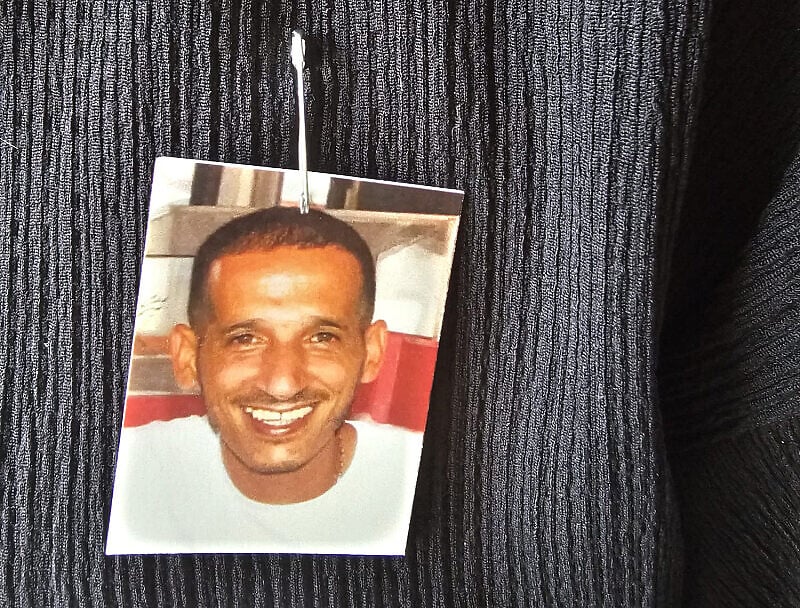
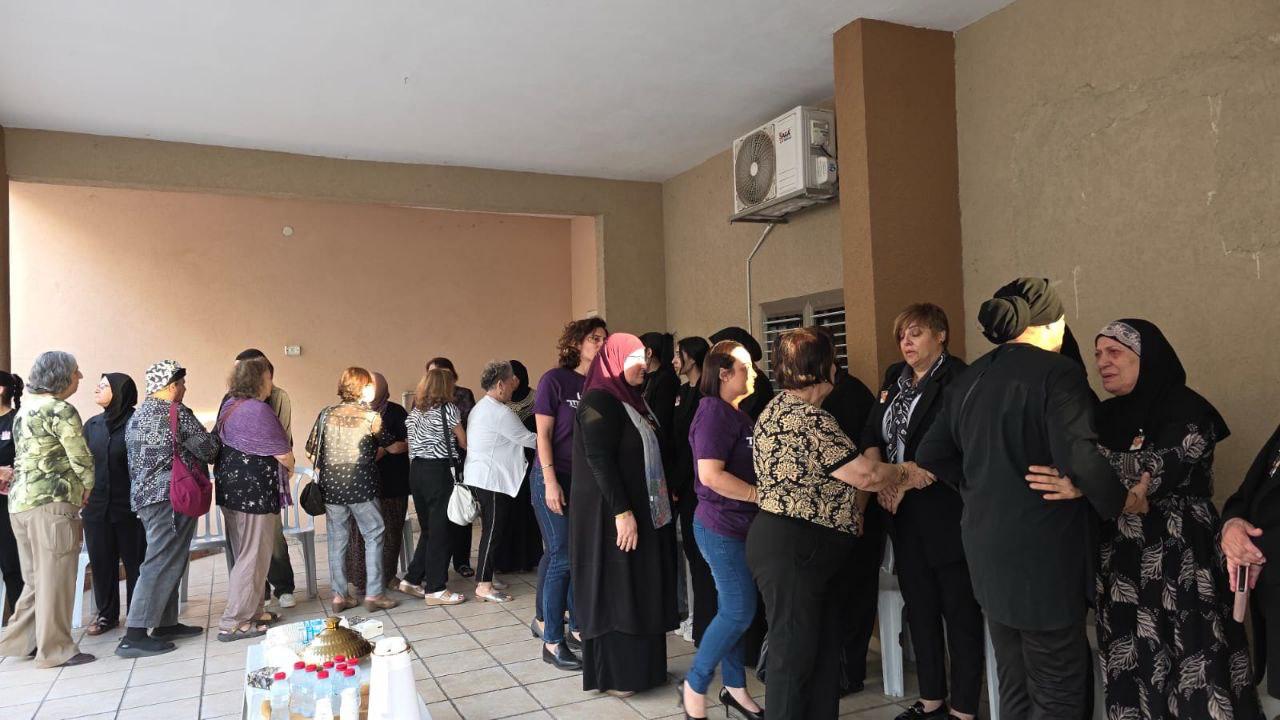
As the sun set on the northern village of Kafr Yasif on a recent evening, neighbors somberly gathered in the backyard of the Masadeh family to grieve the loss of their son, Nidal.
Relatives and residents took seats on white plastic chairs, men on the right, women on the left. A teenage boy quietly approached the guests, offering them a date and black coffee in a paper cup. Family members each wore a photo of the slain man clipped onto their black clothing.
Nidal Masadeh, 35, was working as a security guard for the Al-Bustan High School when he was shot and killed by unknown assailants the morning of October 15 on the school grounds.
The killing was shocking for its proximity to a school and the fact that it took place during the day. But perhaps just as disturbing was the mundanity of the bloodletting, one of over two hundred homicides that have rocked the Arab community since the beginning of this year.
Though largely linked to the criminal underworld, the unprecedently high number of homicides among Arabs have by now seeped into all aspects of life, leaving virtually no town or neighborhood untouched. For the past three years, murder rates have spiked to dizzying heights, with 2025 on pace to be the deadliest yet.
A week after Masadeh’s family and neighbors gathered to remember him, the scene repeated itself in the nearby city of Tamra, where mourners gathered outside a home to comfort the family of Muhammad Hejazi, 53. On October 23, Hejazi was shot and killed while sitting on the balcony with his wife, who was also injured by the gunfire.
At both gatherings, each person who got up to speak before the crowd and pay their respects had their own story to tell of a loved one — a cousin, child or partner — who had been violently killed.
“What did he do? He hadn’t done anything,” said Wafiq, one of Hejazi’s three sons. The mild-mannered bearded young man is a bus driver for Netiv Express, like his father had been. He was working a route when his cousin phoned to tell him his father had been killed.
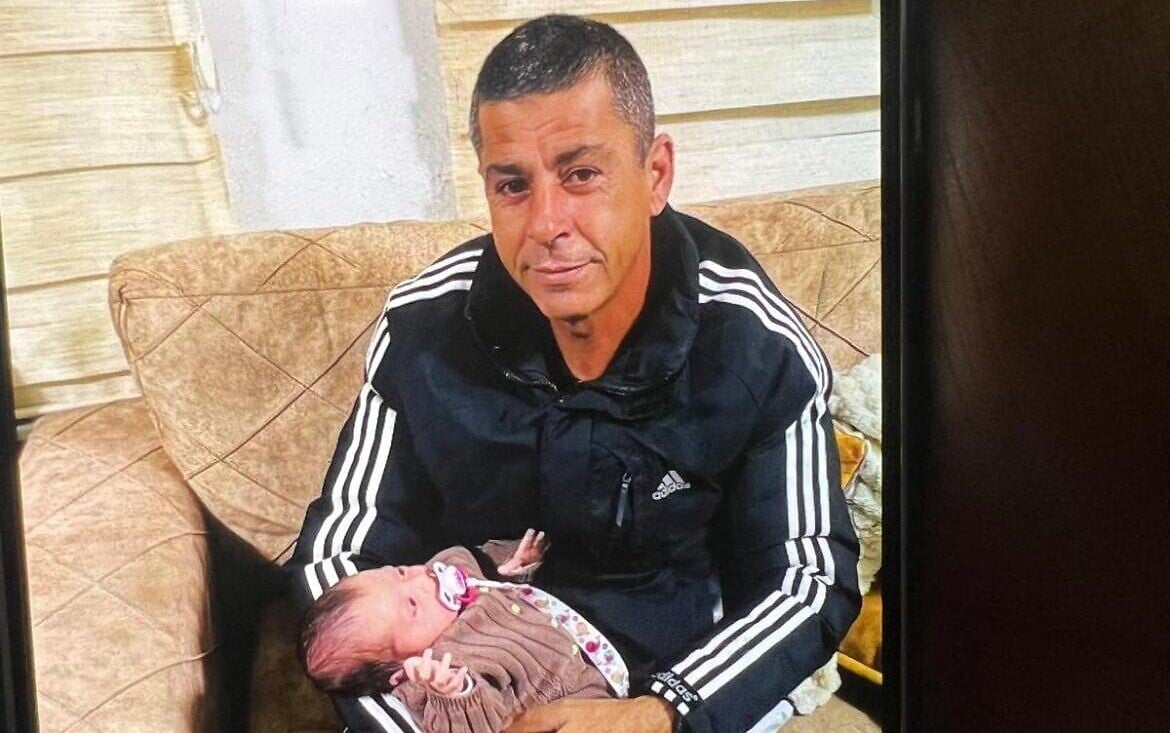
Emad Hejazi, who works as a farmer on lands just north of the sprawling Arab city, described his younger brother as a quiet man who loved feeding the cats who came to his doorstep.
“He took a day off from work [the day he was killed], because his son was to be engaged on Friday,” he said. “I had been sleeping. My wife told me: ‘They killed your brother,’ and I turned around in shock.”
Both men’s families say they have no knowledge of them being involved in any criminal activity.
Fuad Masadeh told The Times of Israel that his slain nephew “worked hard in order to help others.”

“All the kids in school knew and trusted him. If a mother forgot her kid at school she would call him and at the end of the day he would take the child back home,” he continued. “The entire village loved him.”
“This man was even working two jobs, because he had many kids and not enough income,” he said. “There’s no one like him, smart, well-behaved, polite, he never harmed an ant, always went straight from work to home, from home to work.”
‘What police?’
The leap in violent crime has been almost exclusively felt by Israel’s Arabs, who make up about a fifth of the population but are some 14 times more likely than Jewish Israelis to be homicide victims, according to a recent study.
While Israel’s overall murder rate is around 1.6 per 100,000, among Arabs the rate is around 12 per 100,000, higher than El Salvador’s and on par with Venezuela’s.
Community members have pointed fingers at a host of problems, from a lack of policing to government policies that have allowed organized crime to fester and grow.
Residents’ deep frustration with law enforcement, alongside rampant mistrust of police, bubbled to the surface again and again in speeches and conversations at both memorials. Many mentioned National Security Minister Itamar Ben Gvir, a Jewish nationalist who oversees law enforcement and has become something of a symbol for the perceived desertion of Arab towns.
Relatives of Masadeh and Hejazi said that no suspects had been named or apprehended in either killing. Police did not respond to requests for updates in either case.
“What police? What are the police doing? They aren’t doing anything,” Emad Hejazi replied with indignation when asked about law enforcement efforts in his brother’s case.
He claimed that officers ignored him when he showed up at his brother’s house following the shooting.
“They sat, muttering to one another. They didn’t speak to me at all,” he said. Police at that point had not yet reached out to anyone in the family, he said.
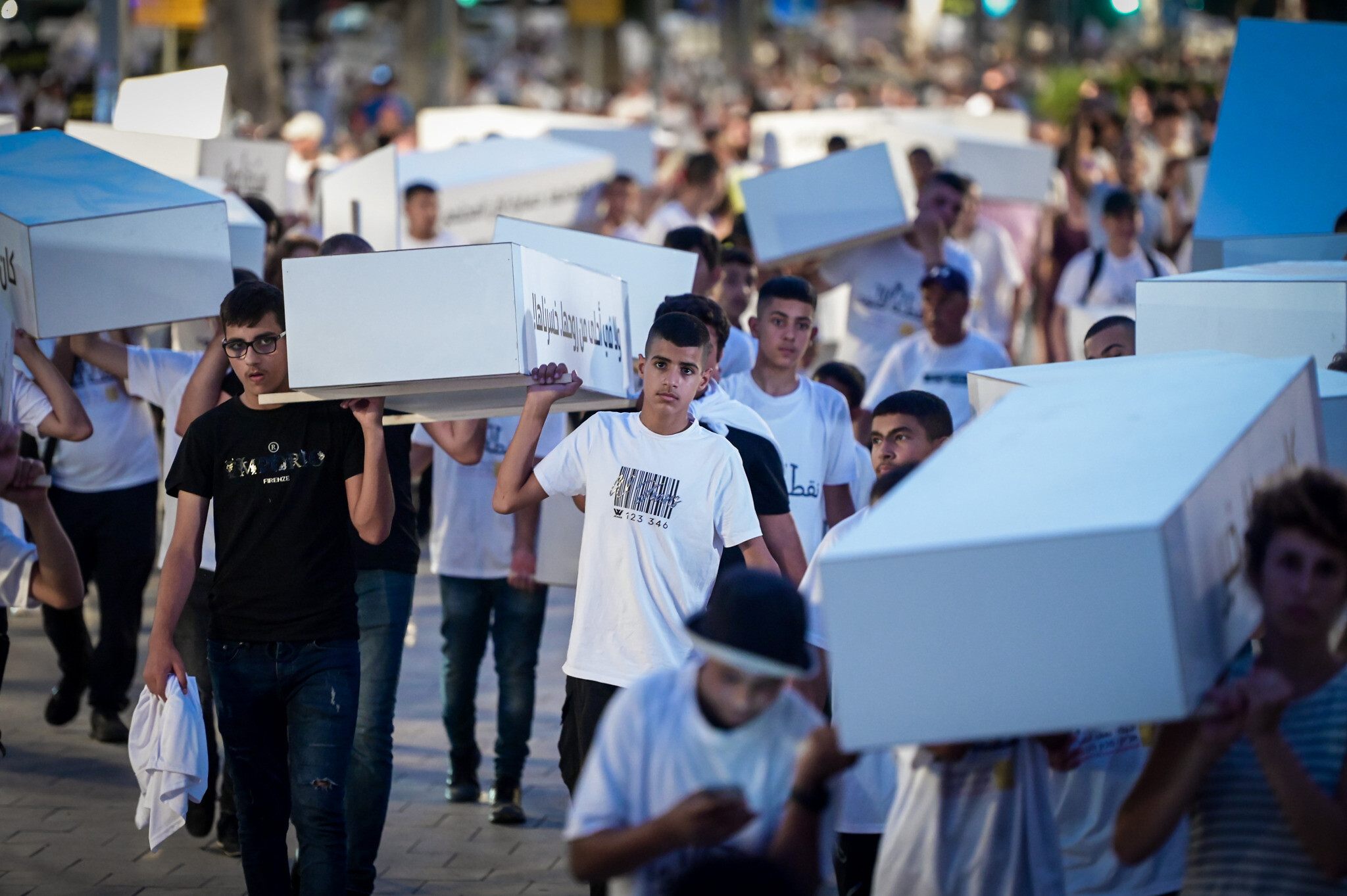
Many feel that authorities aren’t just failing to quell violent crime in their towns, but are pursuing a policy of intentional neglect. The sense of complete abandonment has become particularly prevalent since Ben Gvir took office some three years ago.
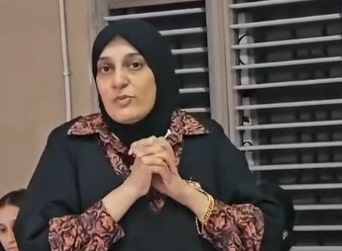
“The government wants us to kill and slaughter each other, so that we will forget the important and major issues,” Nidal’s sister Kifaa Masadeh said in a eulogy. “But we must not accept this. Instead, we should support one another, love each other and stand together.”
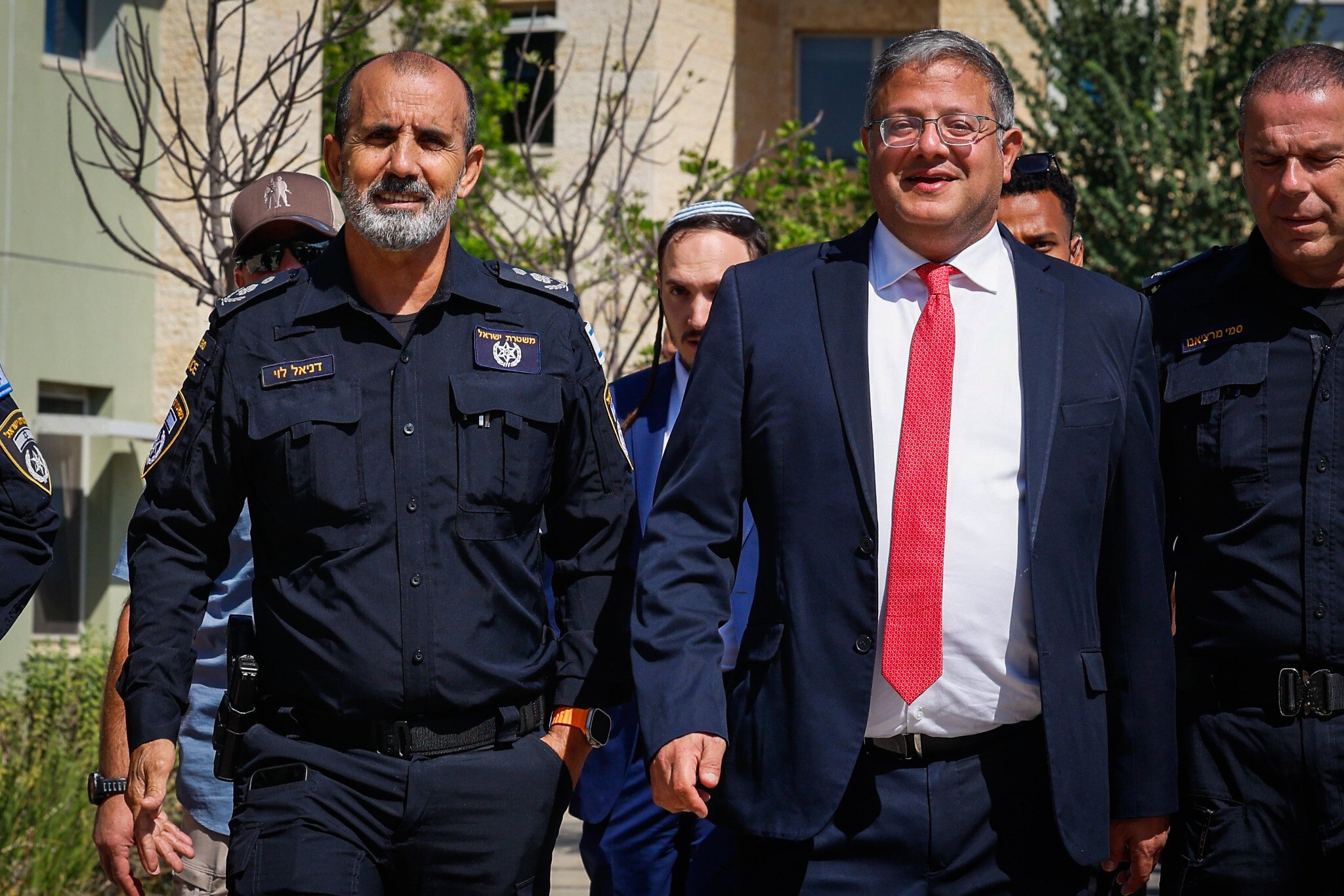
Ben Gvir, though he often speaks about crime among Arabs, has made it clear that the most important items on his agenda are cracking down on nationalist incitement against Jews, limiting use of mosque loudspeakers, preventing gunfire at Arab weddings, and ramping up demolitions of illegally built Arab homes. When briefing lawmakers on how his ministry’s budget was being used in October, these were the issues he spoke most about.
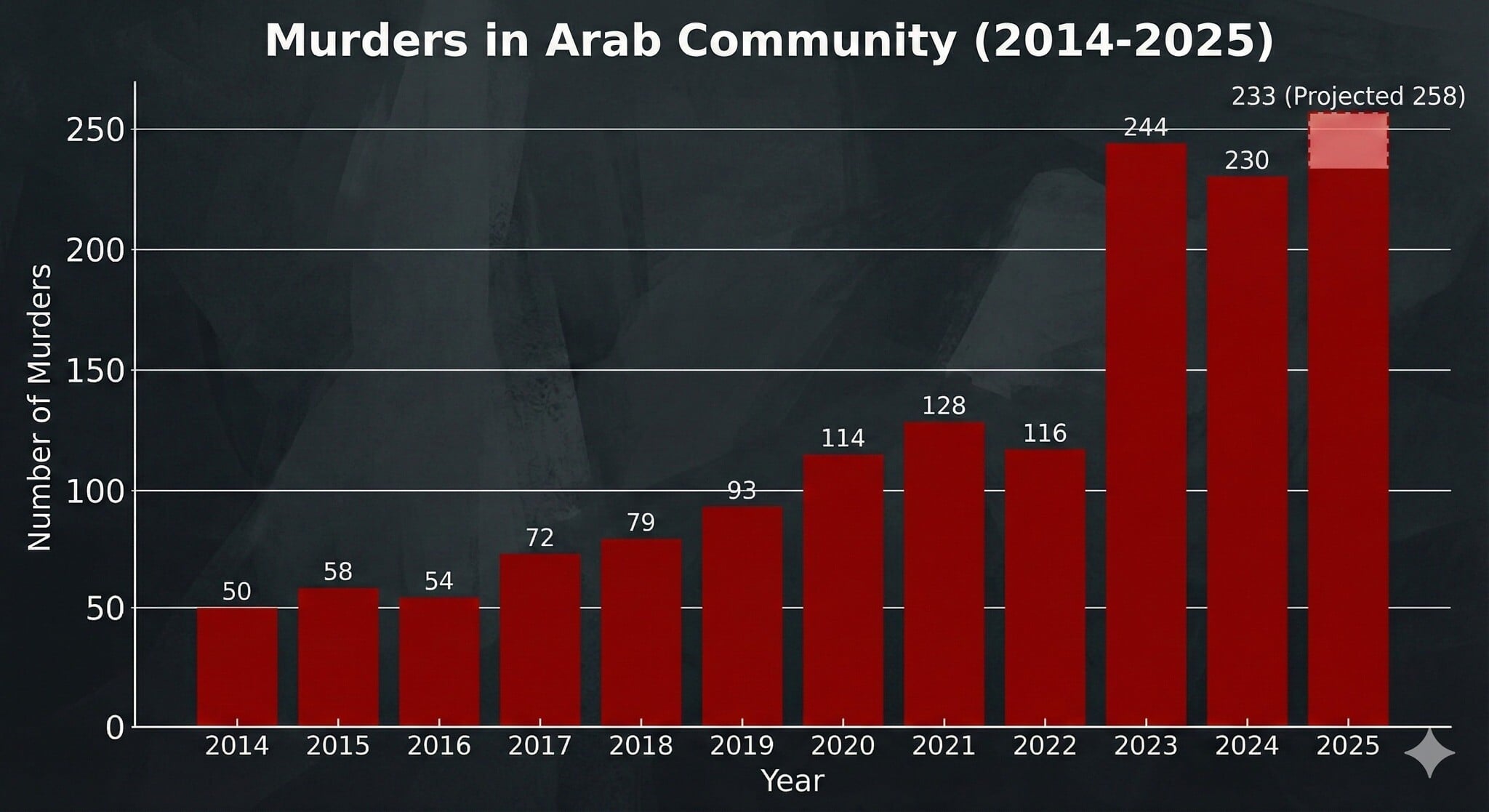
The number of murders in the Arab community has more than doubled since he took over the police in 2023, though rates were already on the rise for years before.
In 2022, the Abraham Initiatives organization, which tracks homicide victims in Arab society, recorded 116 homicides, up from 50 in 2014. In 2023, that figure jumped to 244, then fell slightly to 230 in 2024. As of November 25, there have been 233 homicides in 2025, putting the community on pace for an until-recently unthinkable 258 murders this year.
Police “are not working efficiently as they used to” before 2023, said Lama Yassin, a researcher for the Abraham Initiatives.
“Fewer crimes have been solved during Ben Gvir’s time,” she said, noting that in 2022, police solved 15% of homicides in Arab society, while the most recent data for this year, through June, puts the percentage of solved cases at just 10%.
At the same time, the number of Arab citizens fatally shot by police has surged to 11 from just one last year, driving a larger wedge between law enforcement and Israel’s Arab minority.
Burgeoning violent crime has garnered attention from lawmakers, including those in Ben Gvir’s party. However, nationalists have treated the issue as a national security threat rather than as a threat to the citizens living amid the violence, calling for tougher law enforcement to assert “sovereignty” in Arab towns.
In October, the Ministerial Committee for Legislation greenlit a bill proposed by Otzma Yehudit MK Zvika Fogel that would allow the national security minister to designate certain crime syndicates as terror organizations, allowing for police to broaden their enforcement methods against suspected criminals.
Critics have called the bill symbolic at best, insisting that before bestowing more power on police, they must be given funding for personnel in Arab locales. Some fear that law enforcement will abuse the power, with the prospect of terror-fighting tactics being deployed to battle crime evoking the martial law imposed on Arab Israelis during the early years of the state.
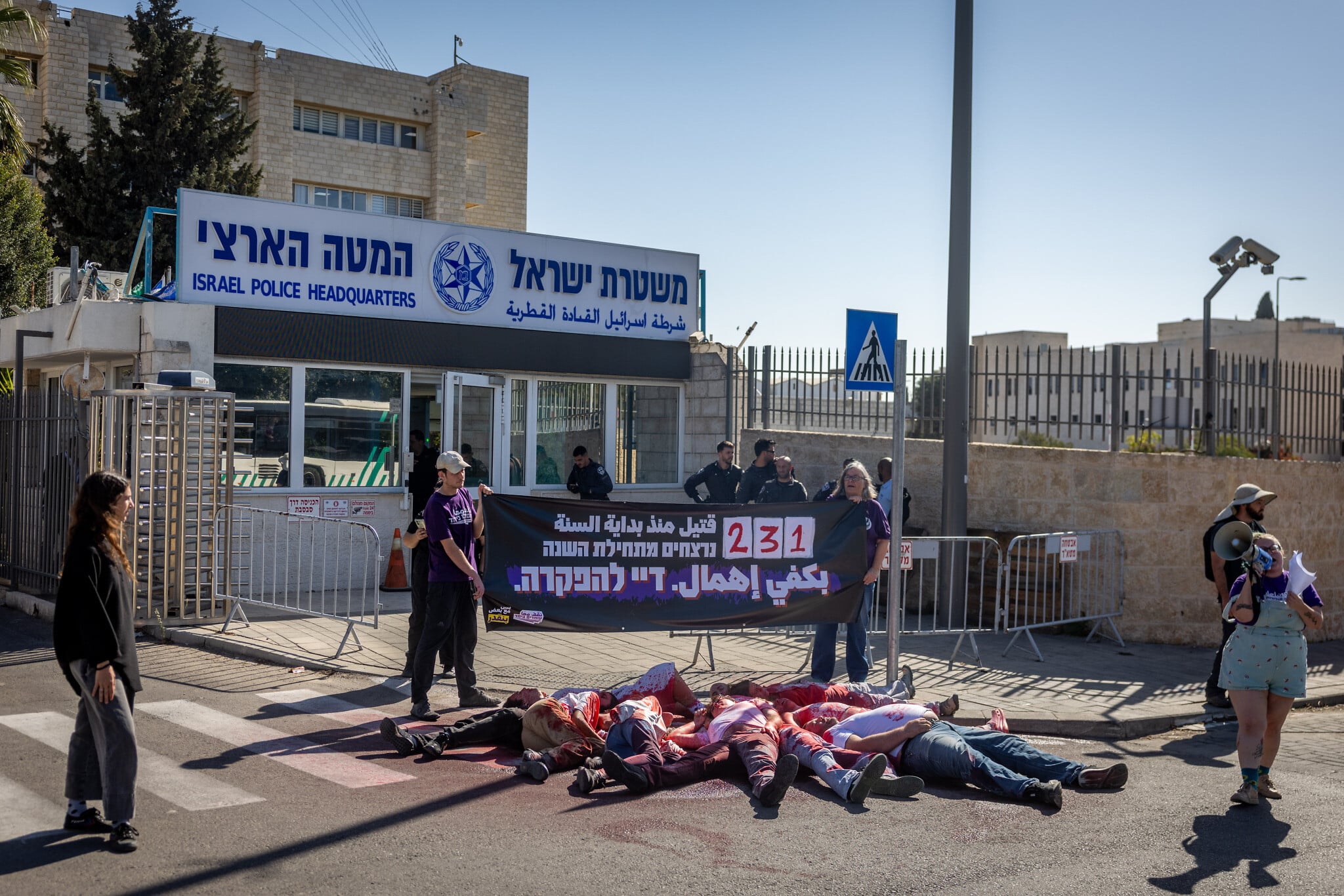
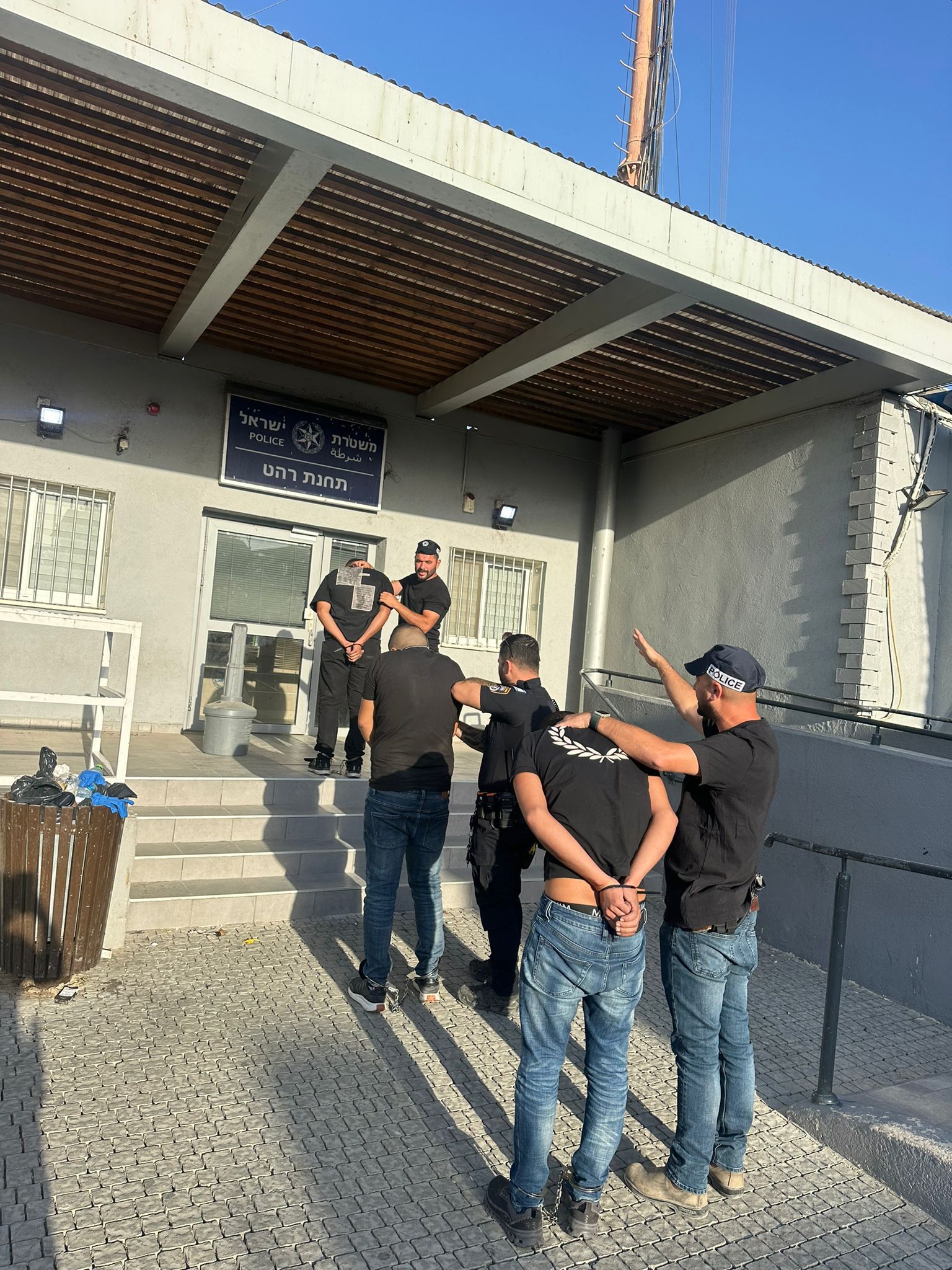
Police, for their part, have largely bucked criticism of their handling of crime in Arab locales, acknowledging the scourge but insisting that officers are doing all they can to combat the violence. In response to a protest held outside the Knesset against the government’s handling of Arab crime, police issued a statement stressing that forces have seized hundreds of illegal weapons.
They added that intimidation of residents by criminals has hampered their efforts to combat violence in Arab areas. Indeed, underworld syndicates have become so insidious that many fear going to the police will make them a target of the criminal organizations that have come to dominate their neighborhoods.
Nonetheless, police insisted that residents must cooperate for law enforcement to succeed.
“Violent crime cannot be defeated by police forces alone,” the statement said, calling on the community to “report violent offenders, provide information and stand firmly against those who terrorize their own neighborhoods.”
In her eulogy, Kifaa Masadeh also noted that the onus of fighting crime goes beyond enforcement. “The hand of treachery has reached us all,” she said, calling on parents to raise their kids “with good morals and noble qualities.”
“We must act for the sake of our children, raising them and educating them,” she added. “Yes, the government is doing wrong, but the family and the household also have a role. We must intensify consciousness-raising activities.”
Yassin stressed that it was on police to build trust with communities by actually arresting murder suspects, which would bring more witnesses out of the woodwork.
“The moment that the police start solving more murders, Arab citizens will start cooperating more with the police,” she said.







The Times of Israel Community.