

IDF says troops located tunnel in southern Gaza that was used to hold hostages
Military announces death of reservist soldier in battle, raising ground operation’s death toll to 186; security cabinet set to meet to discuss postwar Gaza plans
 Add ToI as a Preferred Source on Google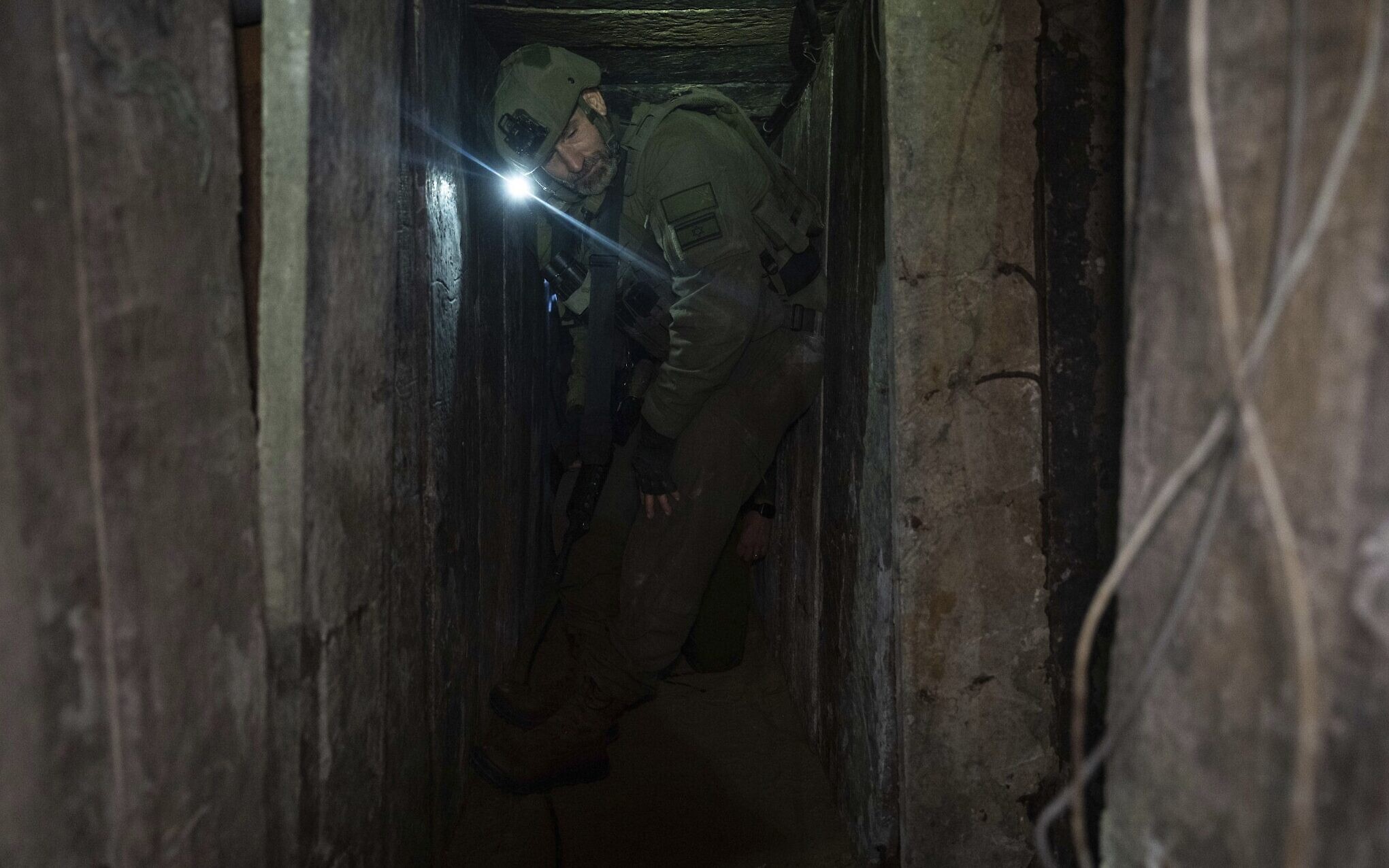
The Israel Defense Forces announced Wednesday that troops operating in the Khan Younis area of southern Gaza located a tunnel where hostages had been held by Hamas.
The military showed the tunnel to journalists who were escorted into a neighborhood near the ruins of destroyed homes and streets. A corrugated tin hut covered the tunnel’s entrance in a residential yard.
A makeshift ladder led to the narrow underground pathway, about 2.5 meters (8 feet) below. The tunnel was hot and humid, with walls lined with concrete and electrical wires. Farther inside was a bathroom, where the military said it found evidence that hostages had been there, including their DNA.
“Hostages were held here in this tunnel system,” said Rear Adm. Daniel Hagari, the army’s chief spokesman.
Hagari offered no details on what exactly was found in the tunnel, nor did he say when the hostages were there or identify them. He did not say if they were known to be dead or alive.
“We are continuing to operate with determination, above and below ground in Khan Younis. The forces found a tunnel there, where hostages resided in difficult conditions under the ground,” Hagari added in a later statement to the media.
The IDF reveals footage of Hamas tunnel in southern Gaza's Khan Younis, where it believes hostages were previously held by the terror group.
The tunnel was located by the Commando Brigade, elite Yahalom combat engineering unit, and other special forces, and connects to a wide… pic.twitter.com/8dSK7slRcI
— Emanuel (Mannie) Fabian (@manniefabian) January 11, 2024
Several hostages freed in a ceasefire deal in late November described being held inside tunnels, which Hamas has laid throughout the Gaza Strip and which Israel says have long been used to smuggle weapons and fighters throughout the enclave.

The tunnel was found in a part of the city that appears to have endured heavy fighting. The nearby residence was badly damaged.
In another building, the walls were blasted out of several apartments. Large mounds of dirt surrounded the area, apparently from Israeli bulldozers searching for buried explosives. A tank was parked outside an empty school, where an Israeli flag was hung from the exterior walls. The sound of what appeared to be a drone buzzed overhead, and gunfire could be heard in the distance.
The military says Hamas is operating from inside the tunnels, and military officials have made the destruction of the tunnel system a top goal.
Brig. Gen. Dan Goldfus, commander of the IDF’s 98th Division, described the tunnels as posing “a 720-degree threat.”
“It’s not 360, but it’s 720, underground and over ground,” Goldfus said.
Israel also believes that Hamas leader Yehya Sinwar is hiding in a tunnel somewhere in Khan Younis.
The beleaguered city, Gaza’s second-largest, has become the focus of Israel’s campaign against Hamas in recent weeks. On Wednesday’s tour for journalists, no residents appeared to be in the area. Israel has ordered residents to evacuate portions of the city as it proceeds with the offensive.
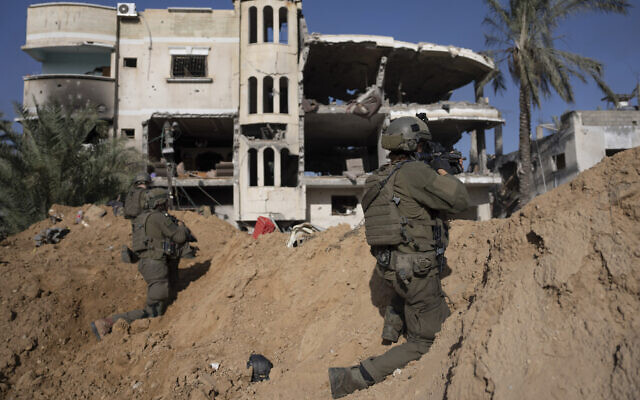
The revelation of the tunnel came after the IDF said Wednesday that more than 150 Hamas targets were hit over the past day in Khan Younis and Gaza’s central Maghazi region, as troops continued to battle the ruling terror group in the Palestinian enclave, over three months into the war triggered by Hamas’s murderous October 7 onslaught on southern Israel.
In Maghazi, the IDF said troops from the Golani Brigade directed airstrikes on numerous Hamas operatives and uncovered 15 tunnel shafts. During a raid on a Hamas site in the area, the IDF said the Golani soldiers found rocket launchers, rockets, drones and explosives.
In Khan Younis, the 98th Division directed airstrikes on more than 10 Hamas operatives in their area of operations, the IDF said.
Dozens more Hamas gunmen were killed by the 98th Division’s units over the past day, according to the military.
Also in Khan Younis, reservists of the Kiryati Brigade identified a Hamas gunman planting an explosive device near a road used by troops. The soldiers called in an airstrike, killing him, the IDF said.
The IDF announced Tuesday that it was expanding ground operations in Khan Younis and its surrounding area, fighting Hamas deep within the southern Gaza city. Some 40 Hamas operatives were killed over the previous day, the army said, and troops uncovered “a wide range” of weapons and “significant” tunnel shafts.
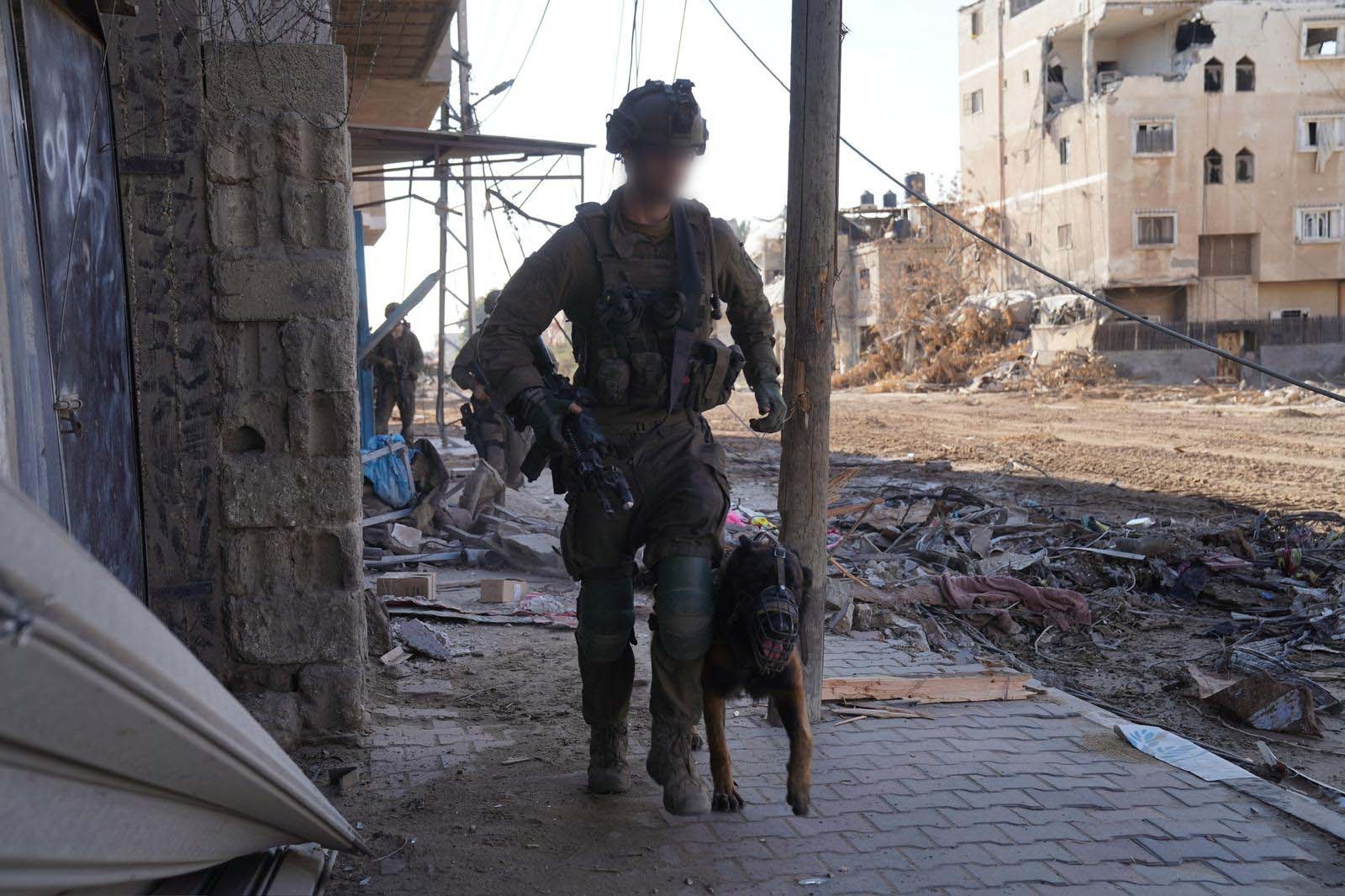
Later Wednesday, the IDF said it had completed operations in southern Gaza’s Khuza’a, on the outskirts of Khan Younis, where troops of the 5th Reserve Brigade killed numerous Hamas gunmen and destroyed the terror group’s infrastructure in the area.
According to the IDF, the 5th Brigade demolished hundreds of Hamas sites in Khuza’a, including rocket launchers, observation posts, caches of weapons, around 40 tunnel shafts and major underground networks. It said much of the Hamas infrastructure in Khuza’a was hidden inside schools and other public buildings, much like in other areas.
Dozens of Hamas operatives were killed by troops of the 5th Brigade during the fighting in Khuza’a over the past two weeks.
In late December, the IDF announced an offensive on Khuza’a targeting Hamas terrorists who attacked the Israeli border community of Kibbutz Nir Oz on October 7, where dozens of Israelis were killed and taken hostage.
The war in Gaza against Hamas has claimed the lives of 186 Israeli soldiers since Israel launched a ground operation in late October to eliminate the Strip’s Hamas rulers and free hostages abducted during the terror group’s October 7 rampage.
The latest fatality, announced Wednesday morning, was Sgt. First Class (res.) Elkana Newlander, 24, a combat medic in the 99th Division from the West Bank settlement of Efrat, who was killed fighting in the central Gaza Strip Tuesday. A reservist from the Yiftach Brigade was seriously wounded in the same battle.

The security cabinet was expected to convene Wednesday night to continue discussions on plans for the Strip after the war.
A previous meeting on the subject was called off after the discussions degenerated into a shouting match last week, as ministers attacked IDF Chief of Staff Herzi Halevi over his plans to immediately start probing the military failures that led to the October 7 assault by Hamas, rather than wait until the end of the war. The attack saw thousands of terrorists invade Israel by land, sea and air, killing 1,200 people, mostly civilians, and taking 240 hostages.
The meeting will come a day after US Secretary of State Antony Blinken met with Israeli leaders Tuesday as part of his Mideast tour aimed at heading off a broader conflagration on Israel’s northern border, where Israel has been battling Iranian proxy Hezbollah amid intensifying skirmishes since October 8 when the Lebanese terror group launched attacks in Israel to support its ally Hamas.
Blinken’s visit was also part of a US push for Israel to scale back high-intensity fighting in Gaza, increase humanitarian aid to the civilian population and consider its postwar plans.
Blinken said he secured commitments from multiple countries in the region to assist with rebuilding and governing Gaza after Israel’s war against Hamas, and that wider Israeli-Arab normalization is still possible, but only if there is “a pathway to a Palestinian state.”

However, Prime Minister Benjamin Netanyahu’s hardline government is adamantly opposed to the creation of a Palestinian state alongside Israel, and the autocratic, Western-backed Palestinian Authority leadership, whose forces were driven from Gaza when terrorist organization Hamas took over in 2007, lacks legitimacy in the eyes of many Palestinians.
Blinken’s one-on-one meeting with Netanyahu Tuesday was reported to be tense, and the Prime Minister’s Office did not release a readout of the sit-down, pointing to possible discord.
The top US diplomat also met with Defense Minister Yoav Gallant, whose office released a readout saying that Gallant told Blinken Israel would continue fighting in Gaza’s Khan Younis area until Hamas leadership is found and the remaining Israeli hostages are freed.
Blinken met on Wednesday with Palestinian Authority President Mahmoud Abbas in Ramallah — in a meeting that was also reported to be uneasy — amid his ongoing efforts to rally the region behind postwar plans that include governance reforms and moves toward a Palestinian state.
Blinken began his Mideast tour in Turkey, Jordan and Qatar, setting off for the United Arab Emirates next, before his stop in Israel Tuesday. After Ramallah, he is expected to visit Bahrain and then Egypt.
On Wednesday, reports circulated that an Israeli delegation arrived in Cairo for a new round of talks on a possible swap of hostages held by Hamas for Palestinian security prisoners in Israel.
It is believed that 132 hostages abducted by Hamas on October 7 remain in Gaza — not all of them alive — after 105 civilians were released from Hamas captivity during a weeklong truce in late November. Four hostages were released prior to that, and one was rescued by troops. The bodies of eight hostages have also been recovered and three hostages were mistakenly killed by the military. The Israel Defense Forces has confirmed the deaths of 25 of those still held by Hamas, citing new intelligence and findings obtained by troops operating in Gaza.
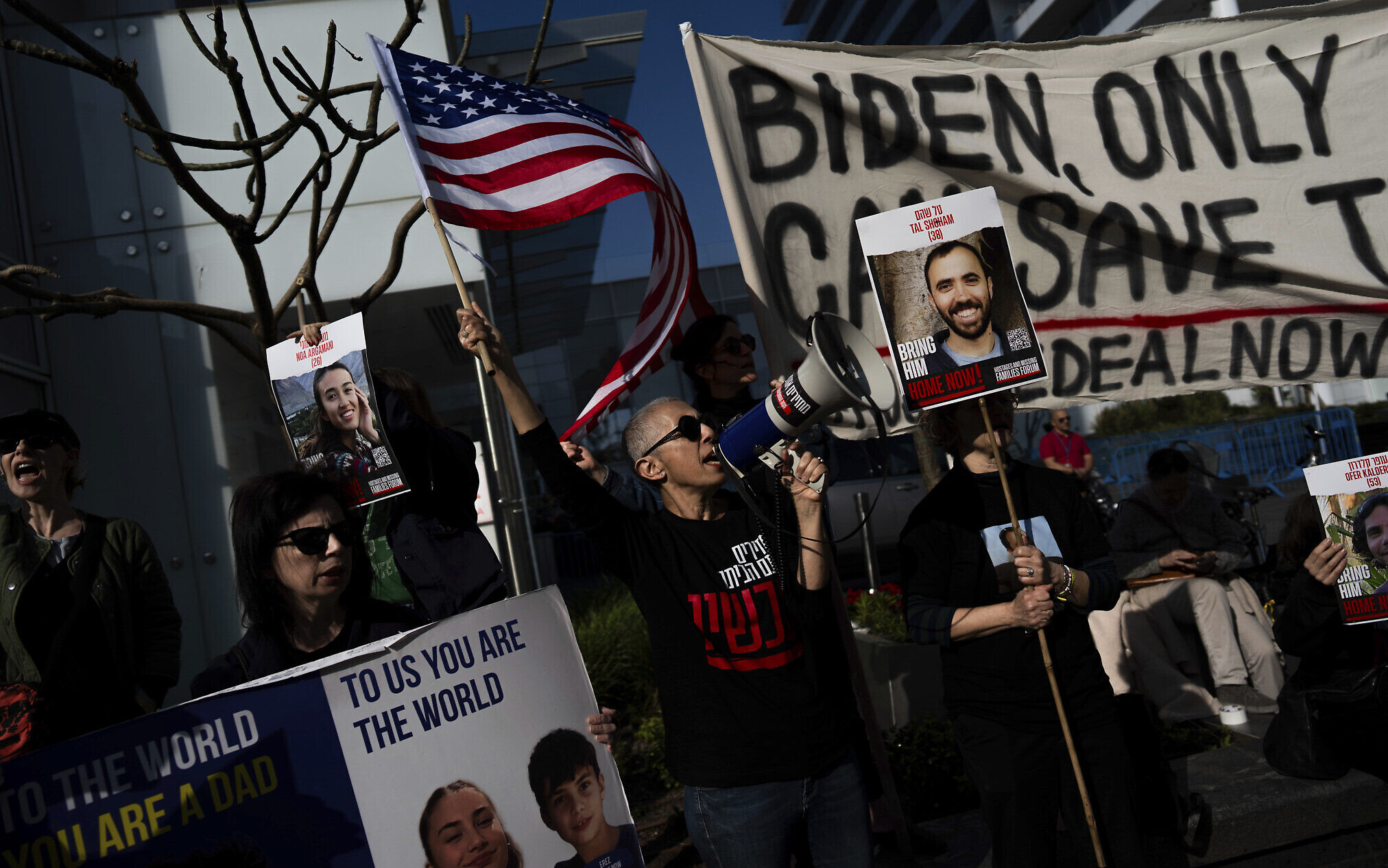
Hamas has also been holding the bodies of fallen IDF soldiers Oron Shaul and Hadar Goldin since 2014, as well as two Israeli civilians, Avera Mengistu and Hisham al-Sayed, who are both thought to be alive after entering the Strip of their own accord in 2014 and 2015 respectively.
While efforts to negotiate another hostage deal were reportedly disrupted by the killing last week of top Hamas terror chief Saleh Al-Arouri in Beirut, widely blamed on Israel, an Egyptian official said that Egypt and Qatar were trying to secure freedom for the civilian hostages held by Hamas and other terror groups in return for a ceasefire, and the release of additional Palestinian prisoners.
Egypt, Qatar and the US have served as mediators between Israel and Hamas.
Hamas has insisted on ending the war before talking about releasing the rest of the hostages, a demand Israel has rejected outright.
“[Israel] will never recover their hostages unless all our prisoners in the occupation prisons are released,” Hamas chief Ismail Haniyeh said Tuesday in Qatar, which hosts Hamas leaders.
Israel has vowed to continue fighting until Hamas is completely dismantled and no longer a threat, and its hostages are returned, with most Israelis opposed to a US-imposed pullback, according to recent polling.
The Hamas-run health ministry in Gaza says over 23,000 people have been killed in the fighting, though these figures cannot be independently verified, and are believed to include both civilians and Hamas members killed in Gaza, including as a consequence of terror groups’ own rocket misfires.
The IDF says it has killed over 8,500 operatives in Gaza, in addition to some 1,000 terrorists inside Israel on October 7.






The Times of Israel Community.