

Live updates (closed)
 Add ToI as a Preferred Source on Google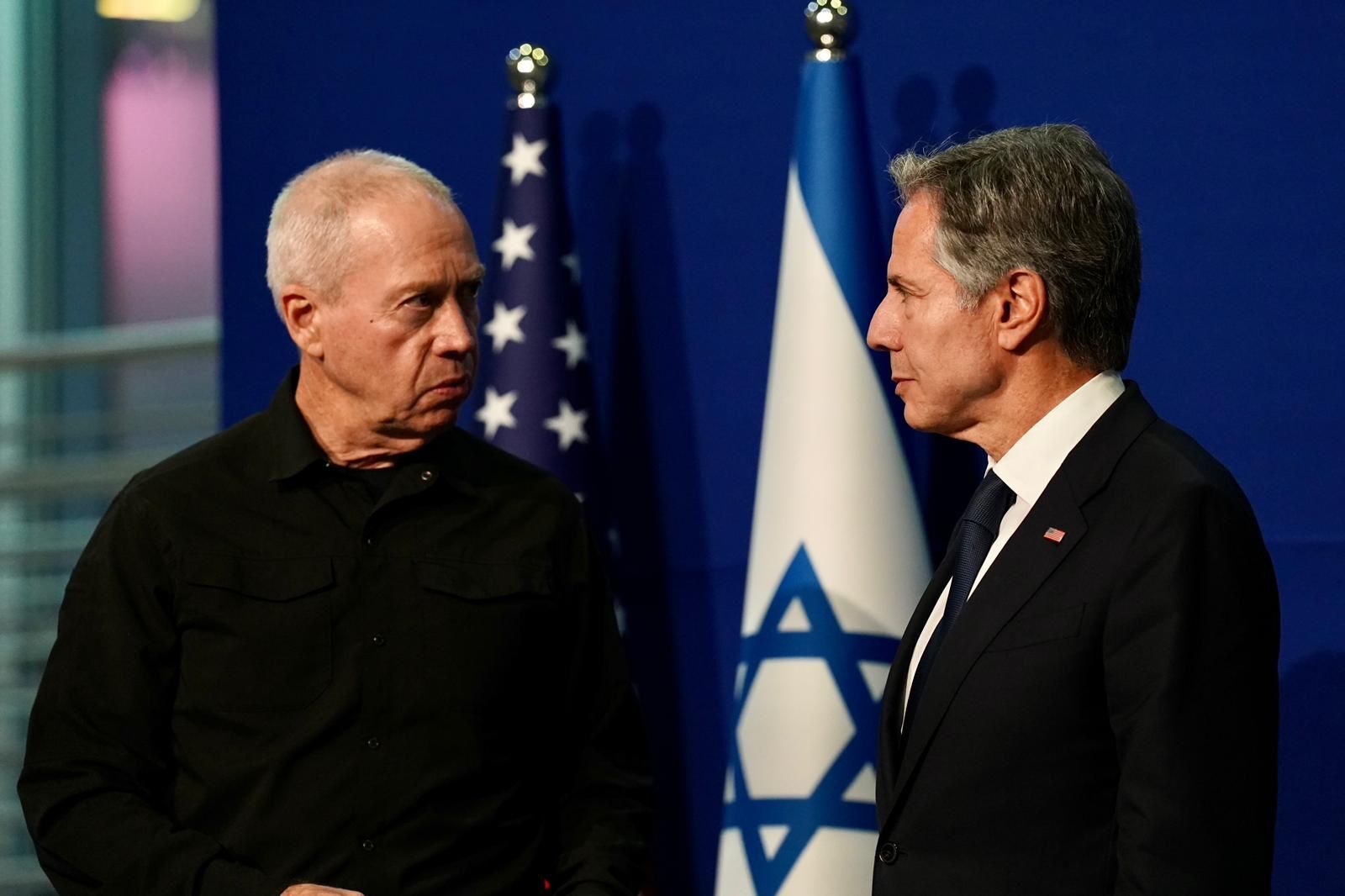
The Times of Israel liveblogged Friday’s events as they happened.
Canada to welcome citizens’ extended families from Gaza
OTTAWA — Canada will take in extended families of Canadians in war-torn Gaza for up to three years, Immigration Minister Marc Miller announces.
The move, which is due to take effect on January 9, will allow Canadians to reunite with spouses or common-law partners, children and grandchildren regardless of age, siblings and their immediate families, as well as parents and grandparents.
Miller says the aim of the policy change is “to get people safe” as the humanitarian crisis has made Gaza “unlivable.”
The government had previously focused on getting more than 600 Canadians, their spouses and children out of Gaza.
Miller estimates that it could see hundreds more resettled in Canada while fighting continues.
He stresses at a news conference, however, that it is “extremely difficult to leave Gaza and may not be possible for everyone.”
“These are situations that are not under our control” and there is a “whole waterfall of scenarios where things could potentially go wrong,” he warns.
Miller says he also ordered immigration officials to prioritize permanent residency applications for Palestinians.
The newcomers will require documentation and security checks including a biometrics screening in Cairo before being allowed to board flights to Canada.
Ahmad Al-Qadi, with the National Council of Canadian Muslims, told a separate news conference in Ottawa that many Canadians who fled Gaza in recent months had to make an “impossible decision to leave parents and siblings behind in a war zone because they don’t have citizenship.”
He thanked the government of Prime Minister Justin Trudeau for expanding the eligibility criteria to Canadians’ extended families.
More than 20 countries join coalition to protect Red Sea shipping, says Pentagon
More than 20 countries have joined the US-led coalition to protect Red Sea shipping from attacks by Yemen’s Houthi rebels, the Pentagon says.
The Iran-backed Houthis have repeatedly targeted vessels in the vital shipping lane with strikes they say are in support of Palestinians in Gaza, where Israel is battling terror group Hamas following its unprecedented attack on Israel on October 7.
“We’ve had over 20 nations now sign on to participate” in the coalition, Pentagon spokesman Major General Pat Ryder tells journalists.
Ryder said the Houthis are “attacking the economic wellbeing and prosperity of nations around the world,” effectively becoming “bandits along the international highway that is the Red Sea.”
Coalition forces will “serve as a highway patrol of sorts, patrolling the Red Sea and the Gulf of Aden to respond to — and assist as necessary — commercial vessels that are transiting this vital international waterway,” he says, calling on the Houthis to cease their attacks.
The latest round of the Israel-Hamas conflict began when the Palestinian terror group carried out a shock cross-border attack on October 7 that killed around 1,200 people in Israel, mostly civilians. Terrorists also abducted some 240 people.
Vowing to destroy Hamas, Israel began a bombardment of targets in Gaza, alongside a ground invasion, which Gaza’s Hamas terror government on Wednesday said has killed at least 20,000 people since October 7, without differentiating between combatants and civilians. That figure cannot be independently verified and includes those killed by failed Palestinian rocket launches. Israeli officials have said over 8,000 of those killed in Gaza are Hamas operatives. The IDF says 137 soldiers have been killed during the ground offensive so far.
The United States announced the multinational Red Sea coalition on Monday, while the Houthis warned two days later that they would strike back if attacked.
UN Security Council vote on Gaza delayed again; US signals support for latest draft

The empty Security Council chamber is pictured at UN headquarters in New York City on December 20, 2023. (Charly Triballeau/AFP)
The United Nations Security Council once again pushed back a vote to later Friday on a much-delayed resolution on the war between Hamas and Israel, diplomatic sources say, as the US has signaled its support for the draft resolution in its current form.
This marks the fourth time the Security Council has delayed a vote this week as diplomatic efforts were being made to get the US on board. The US had earlier vetoed a resolution on December 9 that called for a ceasefire but did not condemn Hamas’s Oct. 7 massacres in Israel in which thousands of terrorists killed about 1,200 people, mostly civilians, and took some 240 hostages. The resolution did not acknowledge Israel’s right to defend itself.
Sources previously indicated one of the key sticking points for the new vote is a proposal for the UN to create a monitoring mechanism for aid going into the Gaza Strip. It appears this demand was dropped, according to the latest draft which calls for “urgent steps to immediately allow safe and unhindered humanitarian access, and also for creating the conditions for a sustainable cessation of hostilities.”
It also demands that all sides “allow and facilitate the use of all… routes to and throughout the entire Gaza Strip, including border crossings… for the provision of humanitarian assistance.”
And it calls for the “immediate and unconditional release of all hostages.”
The postponement to Friday came as the US, which has opposed several proposals during the resolution’s drafting this week, says it is ready to support it in its current form.
The United Arab Emirates is sponsoring the resolution, which was amended in several key areas to secure compromise and US support, according to the draft version seen by AFP.
US Ambassador to the UN, Linda Thomas-Greenfield, says in a briefing: “We have worked hard and diligently over the course of the past week with the Emiratis, with others, with Egypt, to come up with a resolution that we can support. And we do have that resolution now. We’re ready to vote on it.”
She says it’s a resolution “that will bring humanitarian assistance to those in need. It will support the priority that Egypt has in ensuring that we put a mechanism on the ground that will support humanitarian assistance, and we’re ready to move forward.”
Soldier from battalion involved in mistaken killing of escaped hostage Yotam Haim visits his mom
A soldier from the battalion that mistakenly killed three Israeli hostages last week in Gaza, visited the mother of one of the hostages after she posted that she does not blame the military for the tragic incident.
Public broadcaster Kan reports that the soldier, from the Bislamach Brigade’s 17th Battalion, paid a visit to Iris Haim, whose son Yotam Haim, 28, was shot dead together with two other hostages, Alon Shamriz and Samar Talalka, by IDF troops who mistakenly identified them as a threat on December 15. The incident is still under IDF investigation.
The visit came after Haim recorded a message on Wednesday for the soldiers who killed him, telling them that she and her family love them and do not blame them for his death.
“I am Yotam’s mother. I wanted to tell you that I love you very much, and I hug you here from afar. I know that everything that happened is absolutely not your fault, and nobody’s fault except that of Hamas, may their name be wiped out and their memory erased from the earth,” she said.
“We received your message, and since then we are functioning again,” the soldier told Iris Haim, according to Kan. “Before that we were shut down.”
“Amazing, that’s what I wanted,” she responded, according to the report.
IDF announces 2 more soldiers killed in Gaza, bringing ground op toll to 139

Sgt. First Class (res.) Tal Shua, 31, left, and Lt. Shai Ayeli, 21, right, were killed in Gaza fighting, December 21, 2023. (Israel Defense Forces)
The army announces that two more troops were killed fighting Hamas in the Gaza Strip, bringing the death toll in Israel’s ground offensive against the terror group since late October to 139.
The soldiers are named as:
Sgt. First Class (res.) Tal Shua, 31, of the Combat Engineering Corps’ 7071st Battalion, from Beersheba.
Lt. Shai Ayeli, 21, a cadet in the Bahad 1 officers’ school’s Gefen Battalion, previously serving in the Air Force’s Unit 669, from Ashkelon.
In addition, the military says a reserves soldier and two other soldiers were seriously injured in battles in northern and southern Gaza.
Report: Netanyahu sought US pressure on Egypt to take in Gaza refugees, was rebuffed
At the start of the war in Gaza, Prime Minister Benjamin Netanyahu asked US President Joe Biden whether he could pressure Egypt to accept some of the Strip’s population into its territory for the duration of the conflict, The Washington Post reports.
The American leader told Netanyahu that Cairo did not view this as an option, the report says, without citing sources.
Earlier this month Axios reported that Egypt has warned Israel and the US not to allow a situation in which displaced Palestinians flee from the Strip into the Sinai Peninsula. Such an eventuality could cause a “rupture” in Egypt-Israel relations, Cairo was said to warn.
Egypt’s concern, according to the Axios report, was that as the IDF operation expands, Israel will “push Palestinians from Gaza to Egypt — and not allow them to return after the war.”
UN warns of Gaza famine risk as Security Council resolution faces vote
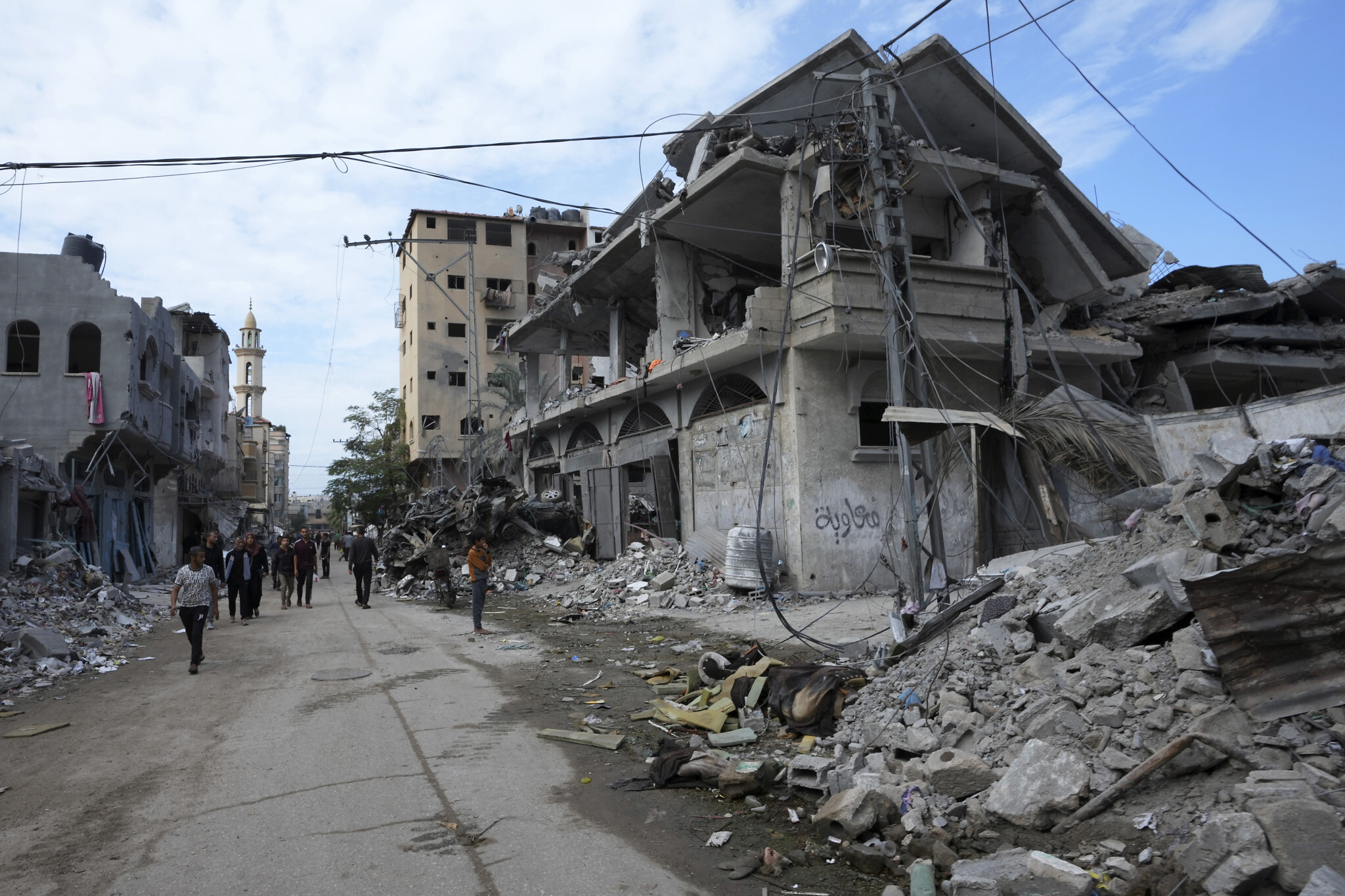
The United Nations warns the Israel-Hamas war is pushing Gaza towards famine, ahead of an expected Security Council vote today on a resolution to boost aid to the Palestinian territory but not call for a ceasefire.
With conditions deteriorating in the territory, the UN Security Council has been locked in negotiations on a resolution that would boost aid deliveries.
The entire population of Gaza faces “an imminent risk of famine,” according to a UN-backed global hunger monitoring system on Thursday, with more than half a million people facing “catastrophic conditions.
“We have been warning for weeks that, with such deprivation and destruction, each day that goes by will only bring more hunger, disease and despair to the people of Gaza,” UN humanitarian chief Martin Griffiths posted on X, formerly Twitter.
This announcement about the risk of famine in Gaza is sobering but not surprising.
We have been warning for weeks that, with such deprivation and destruction, each day that goes by will only bring more hunger, disease and despair to the people of Gaza.
The war must end. https://t.co/YqIeqoAR08— Tom Fletcher (@UNReliefChief) December 22, 2023
IDF forces capture weaponry in Gaza, hit tunnels and terror cells
The IDF says troops of the 646th Reserve Paratroopers Brigade operating in central Gaza’s Juhor ad-Dik located a cache of weapons and long-range rocket launchers used in recent attacks on Israel.
The rocket launchers were later destroyed in an airstrike, the IDF says.
The 7th Armored Brigade operating in southern Gaza’s Khan Younis located weapons inside residential homes, according to the IDF.
In Gaza City’s Shati, the IDF says the 14th Reserve Armored Brigade raided a school and also located weapons.
And the 179th Reserve Armored Brigade operating south of Gaza City, found further caches of weapons in homes, along with a rocket launcher, the IDF says.
Separately, the IDF says combat engineers operating with the Kiryati Brigade located and destroyed a tunnel shaft from which Hamas operatives fired RPGs at troops.
Meanwhile, the IDF says fighter jets struck a Hamas operative, spotted by the 215th Artillery Regiment, while planting explosive devices to be used against troops.
Several more Hamas cells were targeted across the Strip, according to the IDF.
The IDF says the Navy also carried out strikes over the past day, to aid ground forces.
בפעילות של צוות קרב חטיבה 646 במרחב ג'חר א דיק, איתרו הלוחמים מחסן אמל"ח ובו אמצעי לחימה רבים. במהלך הפעילות איתרו כוחות האיסוף של החטיבה משגרי רקטות לטווח ארוך מהם בוצעו שיגורים לאחרונה לשטח ישראל. המשגרים הושמדו בתקיפה אווירית>> pic.twitter.com/lumaViZorL
— צבא ההגנה לישראל (@idfonline) December 22, 2023
Barrage of rockets targets northern Israel, IDF strikes reported in Lebanon
A barrage of rockets was fired toward northern Israel from Lebanon a short time ago.
Initial reports indicate some 20 rockets or more may have been fired.
There are no reports of injuries or damage so far.
There are also reports of IDF strikes in Lebanon, which the army has not yet confirmed.
IDF calling on residents of central Gaza’s Bureij to evacuate south
The IDF has begun to call on residents of central Gaza’s Bureij town to evacuate south, and head for shelters in Deir al-Balah, as the military’s ground offensive expands.
Lt. Col. Avichay Adraee, the IDF’s Arabic-language spokesman, publishes a map of the zones that need to be evacuated alongside the announcement.
He also says that Gaza’s main north-south highway, Salah ad-Din, in the areas northeast of Khan Younis, still remains a “battle zone.” He says the IDF will facilitate the movement of civilians via a bypass route along the coast.
Additionally, Adraee says the IDF will make “tactical pauses in military activities” in the western neighborhoods of Rafah in southern Gaza, between 10 a.m. and 2 p.m., for “humanitarian purposes.”
#عاجل سكان قطاع غزة وخاصة سكان مخيم البريج جيش الدفاع يعمل بقوة ضد حماس والمنظمات الإرهابية. فيما يلي عدة تعليمات عاجلة:
⭕️الى سكان مخيم البريج وأحياء بدر والساحل الشمالي والنزهة والزهراء والبراق والروضة والصفاء في المناطق جنوب وادي غزة: من أجل سلامتكم عليكم الانتقال بشكل فوري… pic.twitter.com/jEvvwzG5Ts
— افيخاي ادرعي (@AvichayAdraee) December 22, 2023
IDF says air force carried out strikes against Hezbollah sites in Lebanon
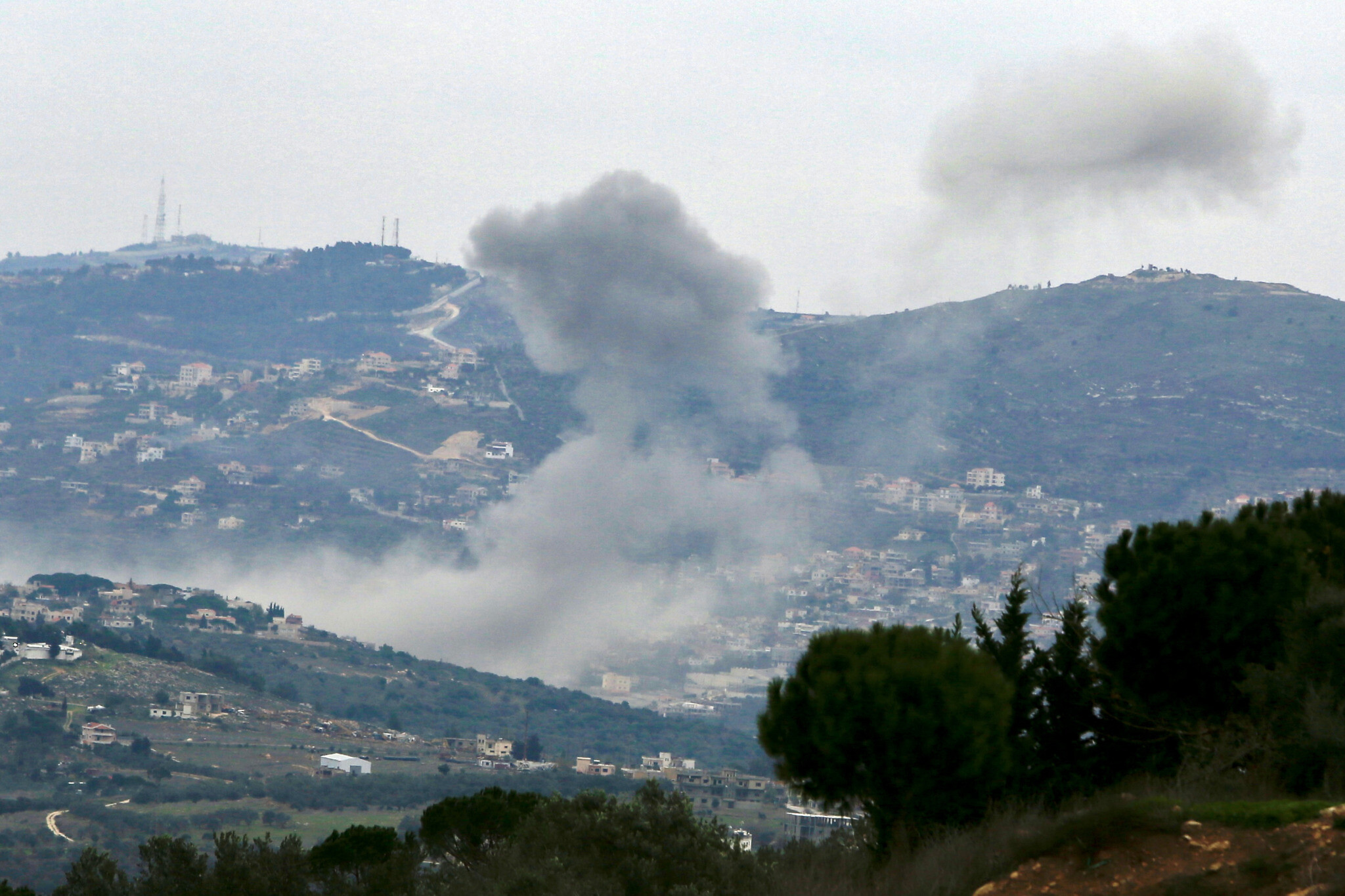
The IDF says fighter jets carried out airstrikes against a series of Hezbollah sites in Lebanon in response to rocket fire on northern Israel this morning.
It says the sites include military compounds where Hezbollah members operated, and other infrastructure belonging to the terror group.
Some 20 rockets were fired from Lebanon at the Shomera area in northern Israel with additional rocket fire on other areas along the border.
The IDF has not immediately published information on potential casualties in the attacks.
The army says it shelled the launch sites with artillery. Hezbollah claimed responsibility for the rocket fire on Shomera.
Police seek motive in Prague mass shooting

Well wishers light candles in memory of the victims outside the Charles University in central Prague, on December 22, 2023, as police investigators kept working on the campus the day after a deadly mass shooting (Michal Cizek / AFP)
Czech authorities seeking a motive in a student’s gun attack that killed 14 people at a Prague university, where tearful mourners have left a sea of candles to grieve for the dead.
The gunfire yesterday at the Charles University’s Faculty of Arts sparked frantic scenes of students running from the attack that was the Czech Republic’s worst shooting in decades.
A makeshift memorial of hundreds of candles flickers outside the university as police pursued the investigation at the campus in Prague’s historic center.
The gunman, a 24-year-old student, died during the attack, after shooting dead 14 people and wounding 25 others.
“Thirteen out of the 14 victims of this insane massacre have been identified,” Interior Minister Vit Rakusan tells Czech Radio.
All the victims were killed inside the building, and at least some were the gunman’s fellow students.
Hezbollah says 121 members killed since it started attacks on Israel
Hezbollah has announced that 121 of the terror group’s operatives have been killed since it began its attacks on Israel’s north in October.
Israel has been exchanging fire with gunmen and conducting strikes on terror targets in Lebanon as the attacks on communities and army posts continue.
Labor MK Gilad Kariv says left must offer country a clear post-war vision

Labor MK Gilad Kariv speaks at a Peace Now conference in Tel Aviv, December 22, 2023 (Peace Now)
Labor MK Gilad Kariv says at a Peace Now conference that once the war with Hamas in Gaza is over a diplomatic process involving the Palestinian Authority, with the goal of creating a “sovereign Palestinian framework,” must be established.
“We must insist that the final goal that will guarantee the future of the State of Israel is the separation between the Palestinians and us and the establishment of a sovereign, viable Palestinian framework in [the West Bank] and Gaza, alongside a Jewish and democratic State of Israel, while maintaining the necessary security arrangements,” says Kariv at the conference in Tel Aviv.
He says the Israeli left, “in the face of a [political] center that is silent on the [right-wing] vision of settlements in the heart of Gaza,” must build a new unified movement that will offer a fresh, clear vision for the country — a process he argues must begin immediately.
Kibbutz Nir Oz announces hostage Gadi Haggai, 73, is dead; body held in Gaza

New Yorker and Canadian citizen Judih Weinstein and her husband, Gad Haggai, have been missing from Kibbutz Nir Oz since October 7, 2023 (Courtesy)
Kibbutz Nir Oz announces that 73-year-old resident Gadi Haggai, abducted on October 7, is dead.
It does not say how it received the information, but adds that Haggai’s body remains in the hands of Gaza terrorists. Haggai was a father of four and grandfather of seven.
His wife Judith remains captive and is believed to have been wounded during the attacks.
The two were out on a morning walk in the kibbutz fields when the October 7 attacks began. According to the Hostages and Missing Families Forum, before they were taken, Judith had time to notify friends by phone that the two were shot and that Gadi was seriously wounded.
Putin tells Abbas he’ll continue sending aid to Gaza, urges end to war
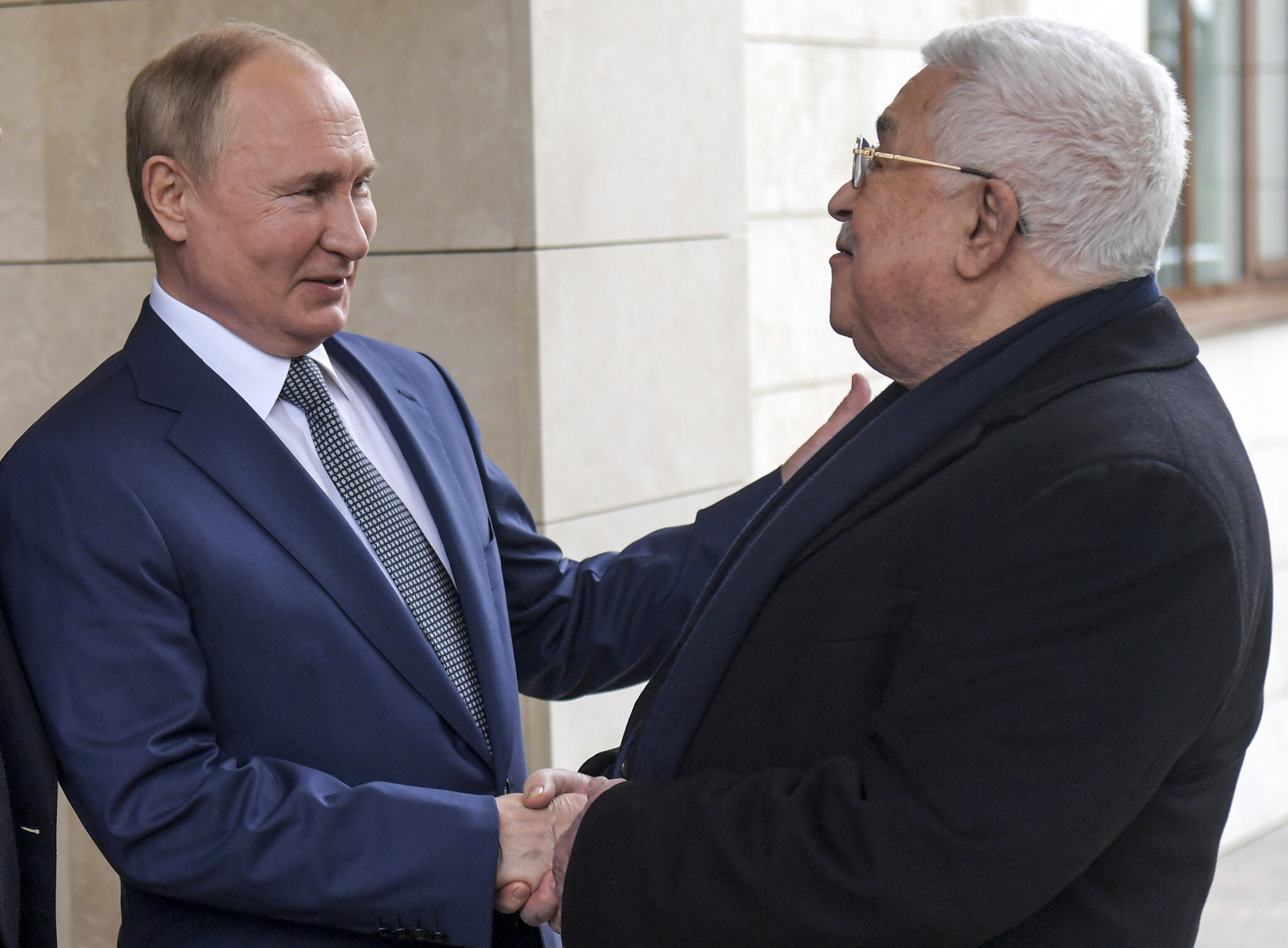
Russian President Vladimir Putin, left, and Palestinian President Mahmoud Abbas speak to each other during their meeting in the Bocharov Ruchei residence in the Black Sea resort of Sochi, Russia, Tuesday, Nov. 23, 2021. (Yevgeny Biyatov, Sputnik, Kremlin Pool Photo via AP)
Russian President Vladimir Putin promises to continue to supply the Gaza Strip with humanitarian aid and urges a peaceful resolution to fighting between Israel and Hamas.
“Russia will continue to supply the Gaza Strip with essential goods, including medicines and medical equipment,” Putin tells Palestinian Authority President Mahmoud Abbas during a telephone call, the Kremlin says, adding that Putin stresses the “importance of a quick cessation of the bloodshed and the resumption of the political process.”
Hamas bodycam footage shows gunmen preparing roadside bomb against IDF
The IDF reveals footage obtained from the body camera of a Hamas operative in the Gaza Strip, showing gunmen preparing a roadside bomb to be used against Israeli troops.
The camera was found following a recent battle in northern Gaza, during which troops of the Nahal Infantry Brigade’s 931st Battalion encountered a group of Hamas gunmen hiding on the third floor of a building.
The IDF says the gunmen hurled grenades from the building at the troops, who engaged them inside the structure and used tanks to shell the top floor where they were holed up.
After scanning the building, the soldiers found the camera on the body of one of the gunmen, with footage showing they had placed explosive devices in the area.
https://twitter.com/manniefabian/status/1738174986777502017?s=20
Red Cross taps controversial former UNRWA commissioner as director-general

Pierre Krahenbuhl, head of the United Nations Relief and Works Agency for Palestinian refugees, is interviewed in Jerusalem on January 19, 2018. (AFP Photo/Thomas Coex)
The Red Cross says it has appointed Pierre Krahenbuhl, a controversial former head of the UN agency for Palestinian refugees, as its director-general.
The Swiss national, with more than 30 years of experience in the humanitarian sector, will take over in April, when current chief Robert Mardini completes his four-year term.
“The Assembly of the International Committee of the Red Cross (ICRC) has appointed Pierre Krahenbuhl as the organization’s next director-general,” it says in a statement.
Krahenbuhl, 57, has spent 25 years in prominent roles at the ICRC and is currently serving as secretary-general to the ICRC assembly.
In 2014, Krahenbuhl was appointed commissioner-general of the United Nations agency that supports Palestinian refugees (UNRWA). He resigned from that position in 2019 amid an internal probe into alleged mismanagement and ethical abuses at the organization.
In the end, he was largely cleared of the allegations.
Israel accuses the agency of perpetuating the Israeli-Palestinian conflict by extending refugee status to millions of descendants of Palestinians who fled or were forced out of homes in today’s Israel at the time of the establishment of the Jewish state in 1948, rather than limiting refugee status only to the original refugees, as is the norm with most refugee populations worldwide.
Israel and other groups have also long argued that UNRWA school materials glorify terrorism and anti-Israel incitement.
The Foreign Ministry previously charged that under Krahenbuhl, UNWRA became more politicized.
Man arrested on suspicion of assaulting wife, setting apartment on fire
A man has been arrested in Netanya on suspicion of battery and arson after he allegedly assaulted his wife, and then set their apartment on fire when police arrived.
Three people in the building were hurt from smoke inhalation.
Media reports indicate the wife and an unspecified number of children were taking refuge in another apartment when police arrived on the scene. The man locked himself in the couple’s home and set it on fire, before being arrested. Firefighters put out the blaze.
Lebanon PM: Ready to implement UN measure for Hezbollah to disarm if Israel leaves disputed areas
BEIRUT — Lebanon is ready to implement a UN resolution that would help end Hezbollah’s cross-border attacks on Israel if Israel also complies and withdraws from disputed territory, Lebanon’s prime minister says.
The frontier between Lebanon and Israel has seen escalating exchanges of fire, mainly between the IDF and the Iran-backed Hezbollah terror group, since the Israel-Hamas war began on October 7 with the Gaza-ruling terror organization’s devastating onslaught, raising fears of a broader conflagration.
UN Security Council Resolution 1701, which ended a 2006 war between Israel and Hezbollah, called for the removal of armed personnel south of Lebanon’s Litani River, except for UN peacekeepers and the Lebanese army and state security forces.
The solution to the current cross-border hostilities “is the implementation of international resolutions,” including Resolution 1701, Prime Minister Najib Mikati says in a statement.
“We are totally ready to commit to their implementation, on condition the Israeli side does the same, and withdraws — according to the international laws and resolutions — from occupied territory,” he adds, which his office says refers to Mount Dov — also known as Shebaa Farms — the Kfar Chouba hills and the Lebanese side of the village of Ghajar.
IDF says fighter jet downed drone headed from Lebanon toward Israel last week

Illustrative: An Israeli Air Force fighter jet flies over the border area with south Lebanon, in northern Israel on December 20, 2023. (Jalaa Marey/AFP)
The IDF announces that on December 15, an Israeli Air Force fighter jet shot down a drone over the sea near Lebanon.
According to the IDF, the drone was heading toward Israel but did not enter Israeli airspace.
It adds that the interception was carried out in cooperation with the Navy.
The IDF does not elaborate further on where the drone was launched from, or why it published the incident a week after it happened.
The Israeli military announces that on December 15, an IAF fighter jet shot down a drone launched from Lebanon, over the sea. According to the IDF, the drone was heading toward Israel but did not enter Israeli airspace. pic.twitter.com/crgbrcGqa8
— Emanuel (Mannie) Fabian (@manniefabian) December 22, 2023
Iranian spy ship said helping Yemen’s Houthis launch attacks on ships in Red Sea

A Houthi forces helicopter approaching the cargo ship Galaxy Leader on November 19, 2023, in the Red Sea. (Houthi Media Center via AP, File)
Iranian paramilitary forces are providing tracking information that the Houthi rebels in Yemen are using to launch drone and missile attacks on commercial ships passing through the Red Sea, according to a report in The Wall Street Journal.
Citing Western and regional security officials, the report says the intelligence is being gathered by an Iranian vessel in the Red Sea and then transferred to the Houthis, allowing the Iran-backed rebel group to target ships that have switched their transponders off.
“The Houthis don’t have the radar technology to target the ships,” an unnamed Western security official tells the newspaper. “They need Iranian assistance. Without it, the missiles would just drop in the water.”
The Western officials quoted in the report say the intelligence-gathering vessel replaced an Iranian spy ship that was struck in a 2021 attack reportedly carried by Israel.
“Iran is giving them weapons, and Iran could stop it,” a senior Israeli official says. “We need to work to put pressure on Iran, so they will stop.”
Gallant says Hamas chief Sinwar will soon ‘meet the barrels of our guns’
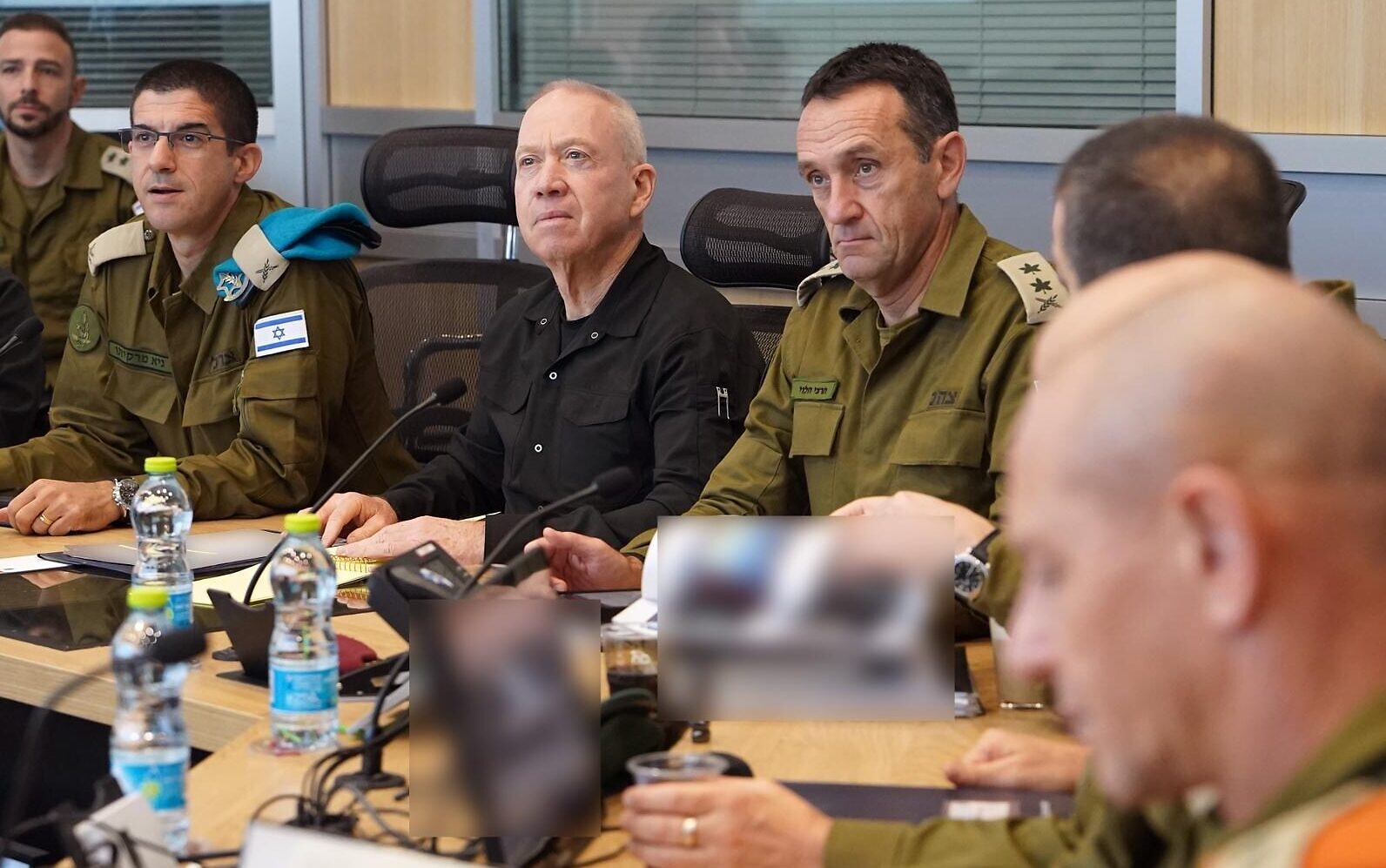
File - Defense Minister Yoav Gallant (center) meets with IDF Chief of Staff Lt. Gen. Herzi Halevi (right) and other defense officials during an assessment, December 22, 2023. (Ariel Hermoni/Defense Ministry)
Defense Minister Yoav Gallant issues a new threat against Yahya Sinwar, saying the Hamas leader will soon “meet the barrels of our guns.”
“The IDF and defense establishment’s activity continues. In the north of the Gaza Strip, the operation is gradually completing the goals we set, the dismantling of the Hamas battalions and the elimination of its underground capabilities,” Gallant says following an assessment with the IDF chief, head of the Shin Bet, Mossad officials and other defense officials.
“We are also operating in the Khan Younis area and the south of the Gaza Strip, and we will operate in other places in the future,” he says.
“One thing is clear, Yahya Sinwar now hears the IDF [tank treads] above him, the Air Force bombs and the IDF’s operations. He will also meet the barrels of our guns soon,” Gallant adds.
Sinwar is believed by the IDF to be hiding underground in southern Gaza.
IDF soldier killed, another seriously hurt in Hezbollah rocket attack this morning

Sgt. Amit Hod Ziv (Israel Defense Forces)
The IDF announces that a soldier was killed and another was seriously wounded in a Hezbollah rocket attack this morning from Lebanon on the Shtula area in northern Israel.
The slain soldier is named as Sgt. Amit Hod Ziv, 19, of the 188th Armored Brigade’s 71st Battalion, from Rosh Haayin.
The other soldier, of the same unit, is hospitalized in serious condition, the IDF says.
IDF says fighter jets striking Hezbollah sites in Lebanon after cross-border attacks
The IDF says fighter jets carried out further strikes against Hezbollah sites in southern Lebanon in response to attacks on the border today.
It says several rockets were fired from Lebanon at Menara, setting off sirens in the community, and a number of mortars were fired at Metula a short while ago.
The IDF adds that it is shelling the launch sites with artillery.
UN to momentarily vote on resolution urging days-long pause on fighting in Gaza
After many delays, the UN Security Council is slated to momentarily vote on a resolution urging a days-long pause to the fighting in Gaza between Israel and Hamas, and to increase the amount of aid entering the Strip.
The vote was called after the US signaled it was ready to back the measure, the wording of which is vaguer than previous drafts and doesn’t include a call for an immediate end to the war. The resolution also urges the immediate release of all hostages captured during the Hamas-led terror onslaught on October 7.
The text “demands that all parties comply with their obligations under international law, notably with regard to the protection of civilians, calls for urgent and extended humanitarian pauses and corridors throughout the Gaza Strip for a sufficient number of days to enable full, rapid, safe, and unhindered humanitarian access and to enable urgent rescue and recovery efforts, and calls for the immediate and unconditional release of all hostages, as well as ensuring immediate humanitarian access.”
The motion also calls for “the provision of humanitarian supplies in the Gaza Strip needs to be sufficient to alleviate the massive humanitarian needs of the Palestinian civilian population throughout the Gaza Strip.”
It’s unclear whether the resolution will be adopted. One council diplomat, speaking on condition of anonymity because discussions are private, says Russia — which wants the resolution to include a call for “the urgent suspension of hostilities” — holds the key.
UN Security Council passes resolution calling to boost aid for Gaza, free all hostages
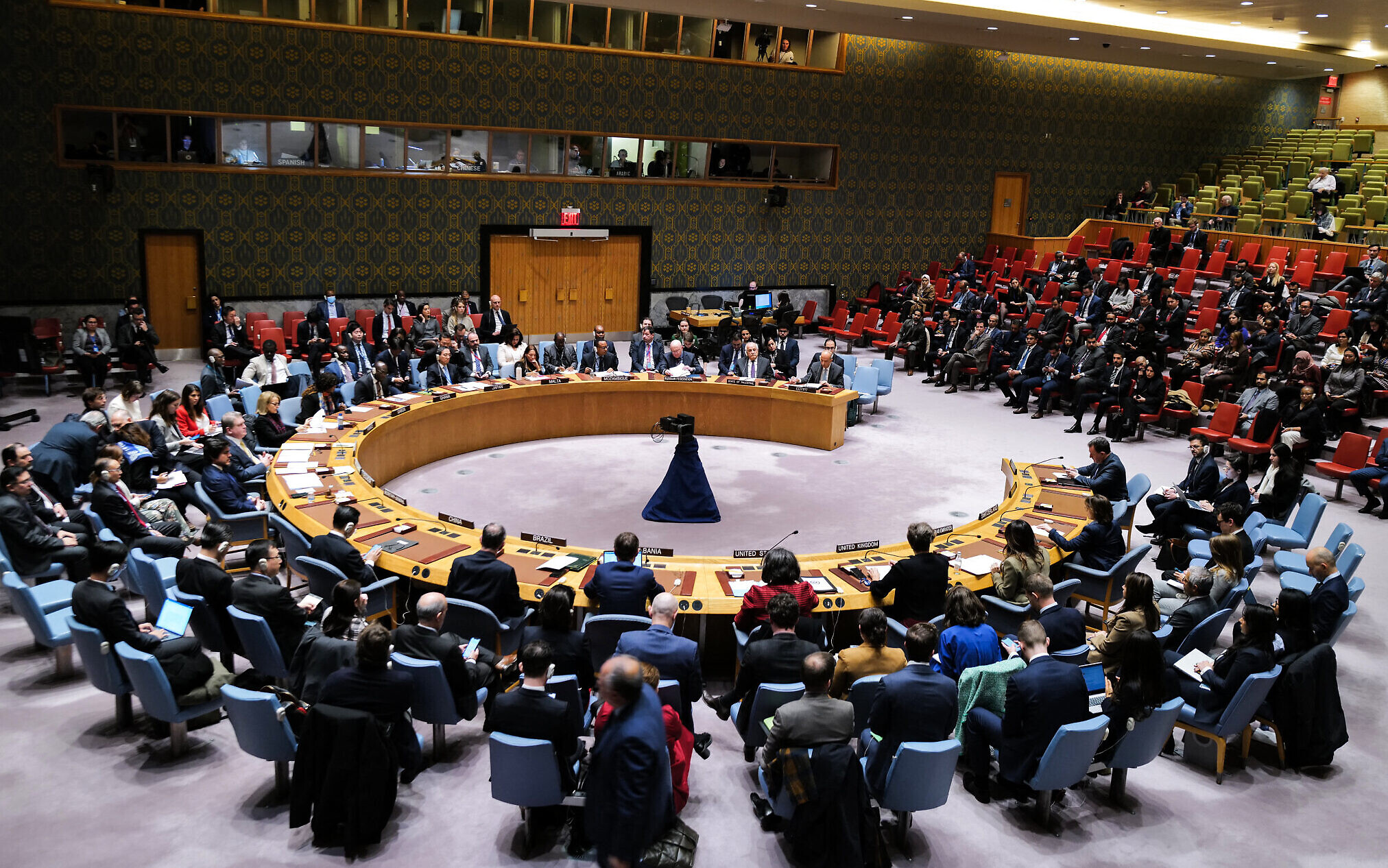
The UN Security Council meets about the situation in the Middle East at UN headquarters in New York on December 22, 2023. (Charly Ttriballeau/AFP)
The UN Security Council passes a resolution calling for speeding up procedures to enable the influx of increased aid into the Hamas-ruled enclave, and for the immediate release of hostages kidnapped during the October 7 atrocities in southern Israel.
The full text of the resolution is here.
The vote was 13 in favor and zero against. Both the United States and Russia abstained.
Before the vote, the US blocked a Russian amendment demanding “an urgent and sustainable cessation of hostilities.” This went further than the resolution itself, which “calls for urgent steps to immediately allow safe, unhindered and expanded humanitarian access and to create the conditions for a sustainable cessation of hostilities.”
This is the first time since the war that the council has passed a resolution including language regarding a “cessation of hostilities,” but it still stops short of demanding an immediate and permanent ceasefire, which both the US and Israel oppose.
Earlier texts of the resolution, which was negotiated throughout the week, had demanded an immediate ceasefire and proposed a new UN mechanism for aid entering Gaza without Israeli inspection.
The exclusion of these demands from the final text was among the factors that led the US not to utilize its veto.
US ‘appalled’ that Security Council resolution doesn’t condemn Hamas for October 7
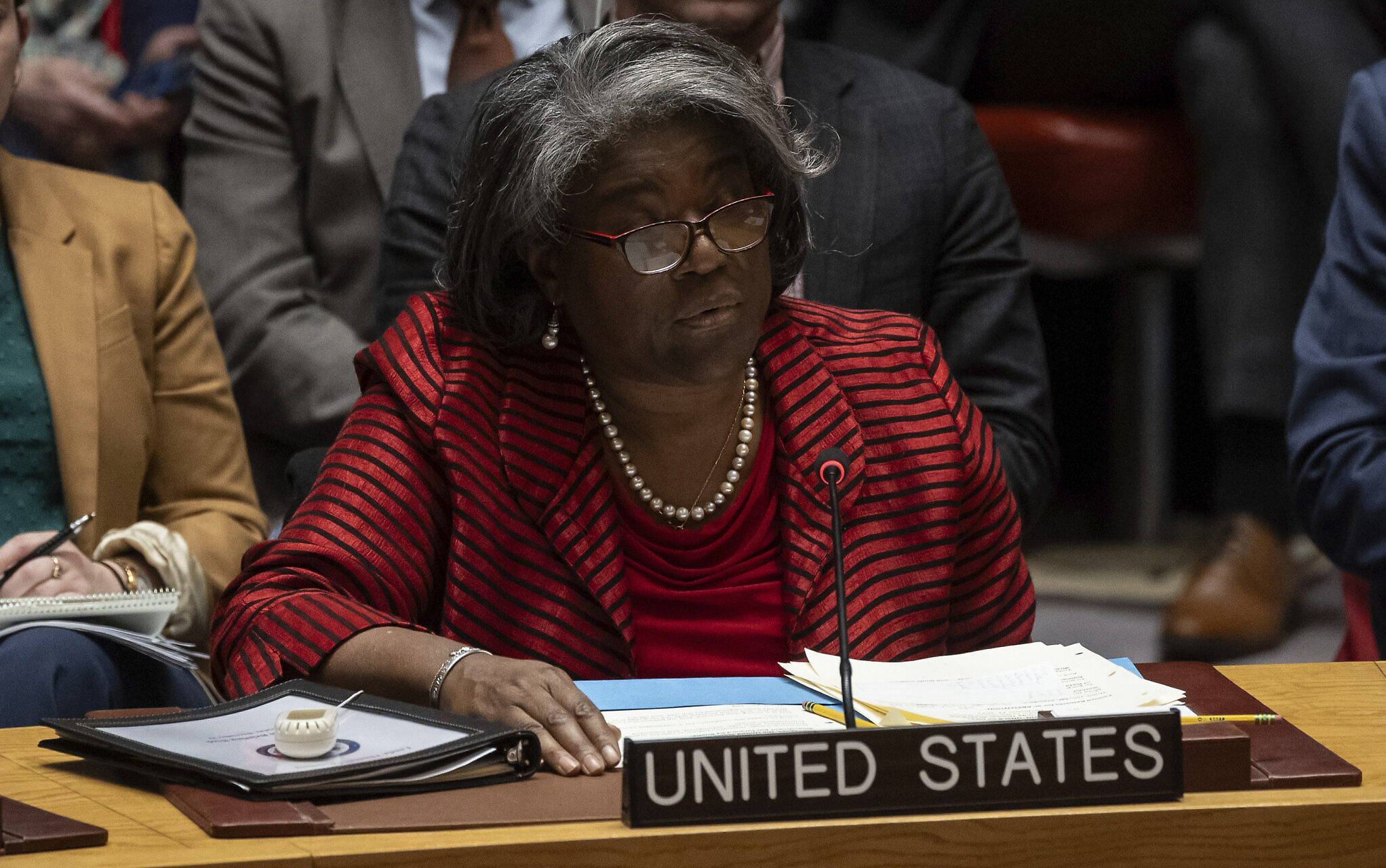
US Ambassador to the UN Linda Thomas-Greenfield speaks during the Security Council meeting at United Nations headquarters, December 22, 2023. (AP Photo/Yuki Iwamura)
US Ambassador Linda Thomas-Greenfield laments that the resolution passed by the UN Security Council does not denounce Hamas over the October 7 atrocities.
“Ultimately, while we are encouraged that the council spoke out on this humanitarian crisis we’re deeply disappointed — appalled, actually — that once again, the council was not able to condemn Hamas for the horrific terrorist attack [it perpetrated] on October 7,” the American envoy says.
“I can’t understand why — why some council members are standing in the way and why they refuse to condemn these evils unequivocally,” she continues.
“Why is it so hard to condemn Hamas for slaughtering young people at a concert, for butchering families alive, for the reports of widespread sexual violence? I will never understand why some council members have remained silent in the face of such evil.”
UN chief: Israeli offensive ‘the real problem’ in Gaza aid deliveries

United Nations Secretary-General Antonio Guterres speaks during a news conference at the COP28 UN Climate Summit, Monday, December 11, 2023, in Dubai, United Arab Emirates. (AP Photo/Kamran Jebreili)
UNITED NATIONS — UN Secretary-General Antonio Guterres says following a Security Council vote demanding aid deliveries at scale that Israel’s offensive is the “real problem… creating massive obstacles” to humanitarian shipments.
“The real problem is that the way Israel is conducting this offensive is creating massive obstacles to the distribution of humanitarian aid inside Gaza,” he says. “A humanitarian ceasefire is the only way to begin to meet the desperate needs of people in Gaza and end their ongoing nightmare.”
IDF reveals another major Hamas tunnel network under Gaza City

This illustration published by the IDF on December 22, 2023, shows a map of a Hamas tunnel network under the southern part of Gaza City. (Israel Defense Forces)
The IDF reveals that it has uncovered another large Hamas tunnel network in the southern part of Gaza City, publishing footage showing a dog from the Oketz canine unit scanning the underground passages.
According to the IDF, the network is hundreds of meters long and includes command rooms, storage and large resting areas with electricity, communication lines and water.
The tunnel was found by the IDF after troops of the Yiftah Brigade and combat engineers battled Hamas operatives at a main compound belonging to the terror group in Gaza City, near the al-Quds Hospital.
https://twitter.com/manniefabian/status/1738257832128946328
The IDF says the soldiers killed several Hamas gunmen during the fighting, and later troops of the Paratroopers Brigade operating in the same area located several tunnel shafts leading to the major underground network.
The elite Yahalom combat engineering unit and Oketz then arrived to investigate the tunnels beneath the Hamas compound, which following scans were revealed to have multiple levels.
The tunnels were later destroyed by combat engineers and the 99th Division.
The elite Yahalom combat engineering unit and Oketz then arrived to investigate the tunnels beneath the Hamas compound, which were revealed to have multiple levels.
The tunnels were later destroyed by combat engineers and the 99th Division. pic.twitter.com/qTJlHMMULA
— Emanuel (Mannie) Fabian (@manniefabian) December 22, 2023
Israel thanks US for support in talks prior to UN vote; FM says Israel to keep checking all aid into Gaza
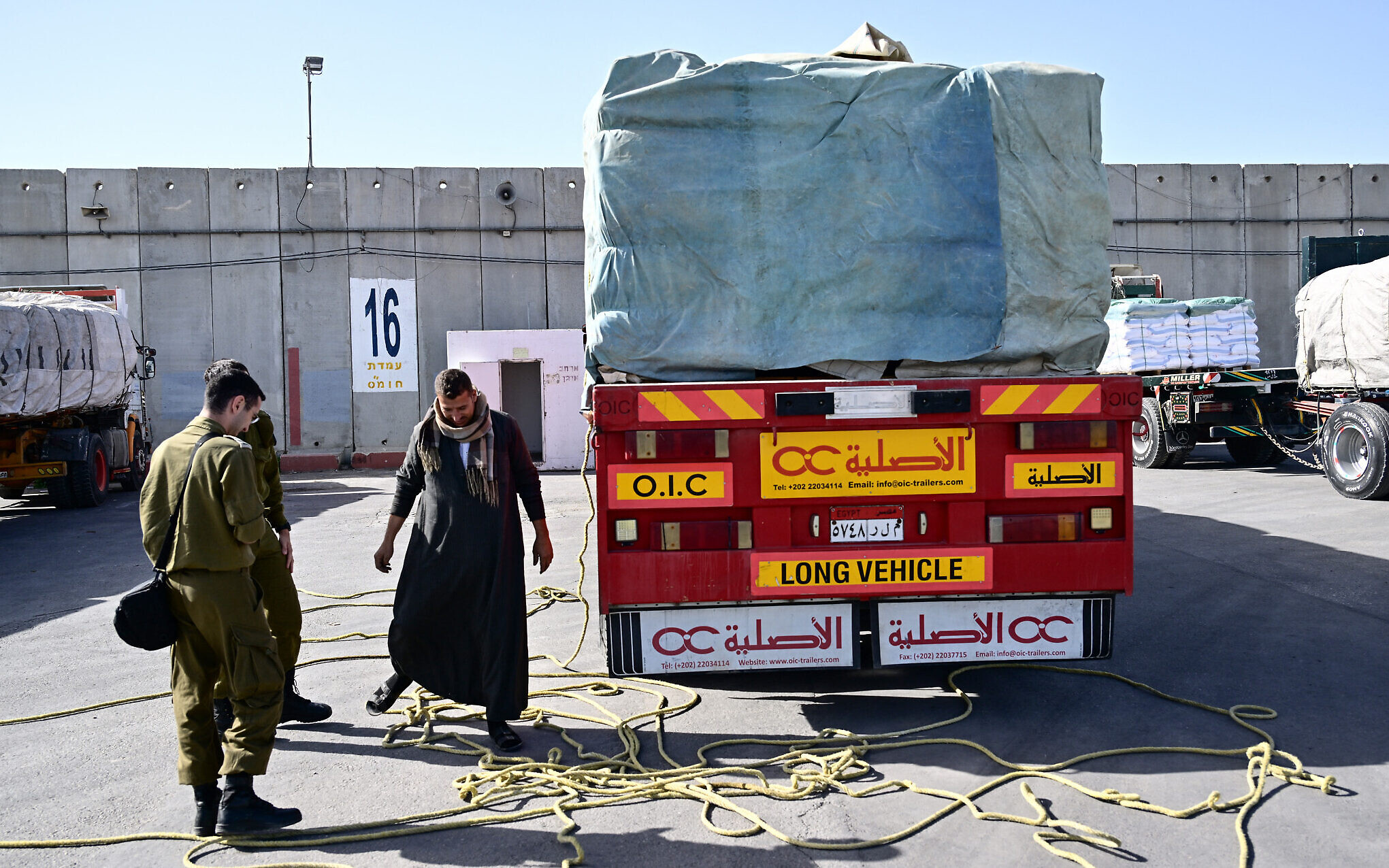
Israeli soldiers inspect humanitarian aid trucks arriving from Egypt on the Israeli side of the Kerem Shalom border crossing with the southern Gaza Strip, on December 22, 2023, amid the ongoing war between Israel and the Palestinian terror group Hamas. (Alberto Pizzoli/AFP)
Israel will continue to inspect humanitarian assistance to the Gaza Strip, Foreign Minister Eli Cohen says after the UN Security Council approves a resolution demanding increased aid deliveries amid the Israel-Hamas war.
“Israel will continue to inspect, for security reasons, all humanitarian assistance to Gaza,” Cohen says in a statement.
Also following the vote, in which the US abstained after negotiating language that did not require an immediate ceasefire or other demands opposed by Israel, the Israeli envoy to the UN thanks the US and President Joe Biden for “standing on Israel’s side throughout the negotiations” and “maintaining defined red lines.”
I thank @POTUS, @USAmbUN, and @USUN for standing on Israel's side throughout the negotiations on the UN Security Council resolution and maintaining defined red lines. The resolution maintains Israel's security authority to monitor and inspect aid entering Gaza.
It must not be…
— Gilad Erdan גלעד ארדן (@giladerdan1) December 22, 2023
“The decision maintains Israel’s security authority to supervise and inspect the aid that enters Gaza,” Ambassador Gilad Erdan notes in a statement.
Erdan also slams the resolution for not condemning the Hamas-led massacres on October 7, when Palestinian terrorists killed some 1,200 people and took around 240 hostage.
“This is a disgrace that exposes the irrelevance of the UN regarding the war in Gaza,” he charges. “The UN’s focus on only the aid mechanisms for Gaza is unnecessary and disconnected from reality… The UN needs to focus on the humanitarian crisis of the hostages.”
Adds Erdan: “The failures of the UN in the last 17 years have allowed Hamas to dig terror tunnels and manufacture missiles and rockets. It is clear that the UN cannot be trusted to monitor the incoming aid to the Gaza Strip.”
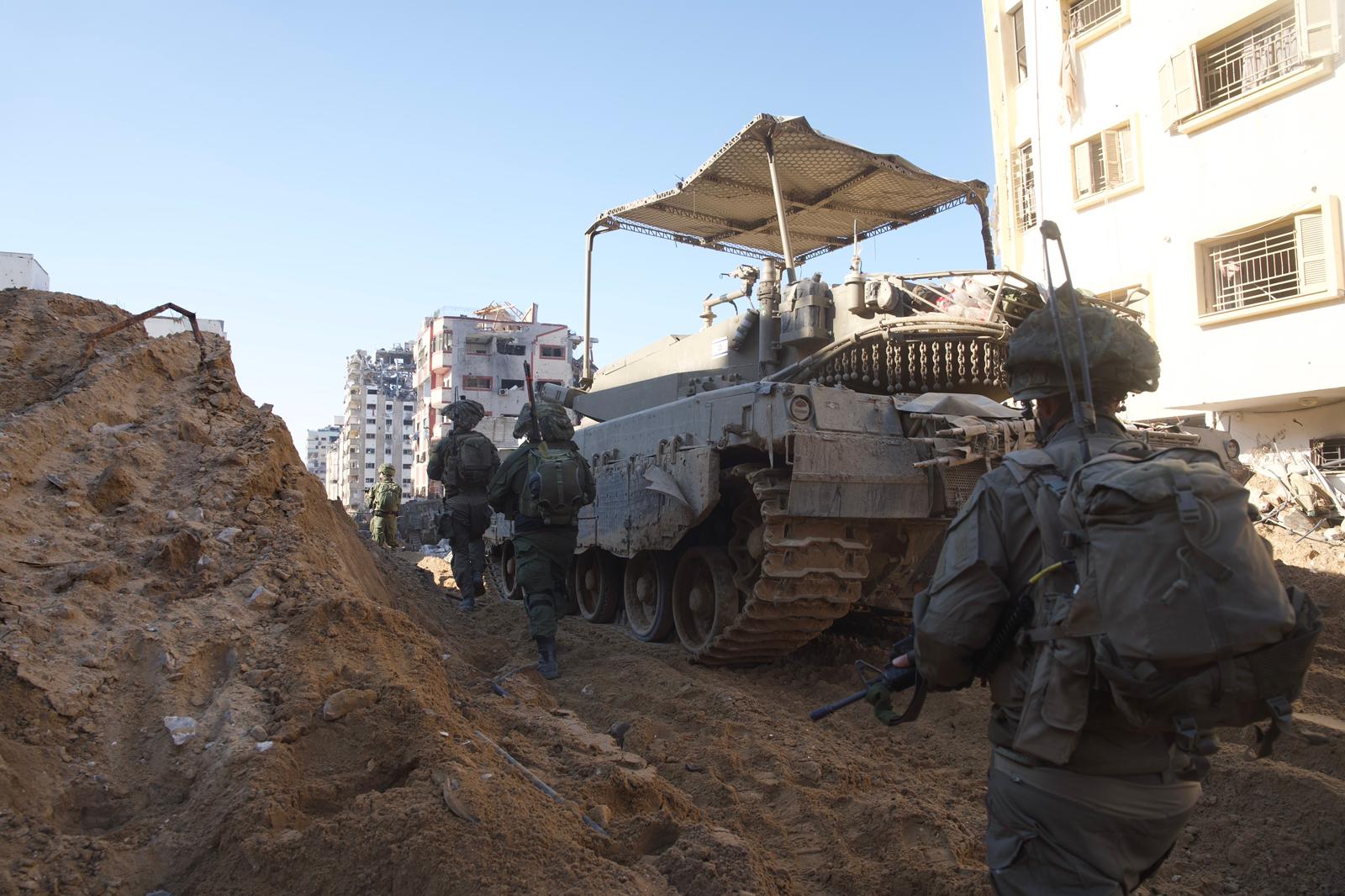
IDF close to securing ‘full operational control’ in northern Gaza, readying to expand in south
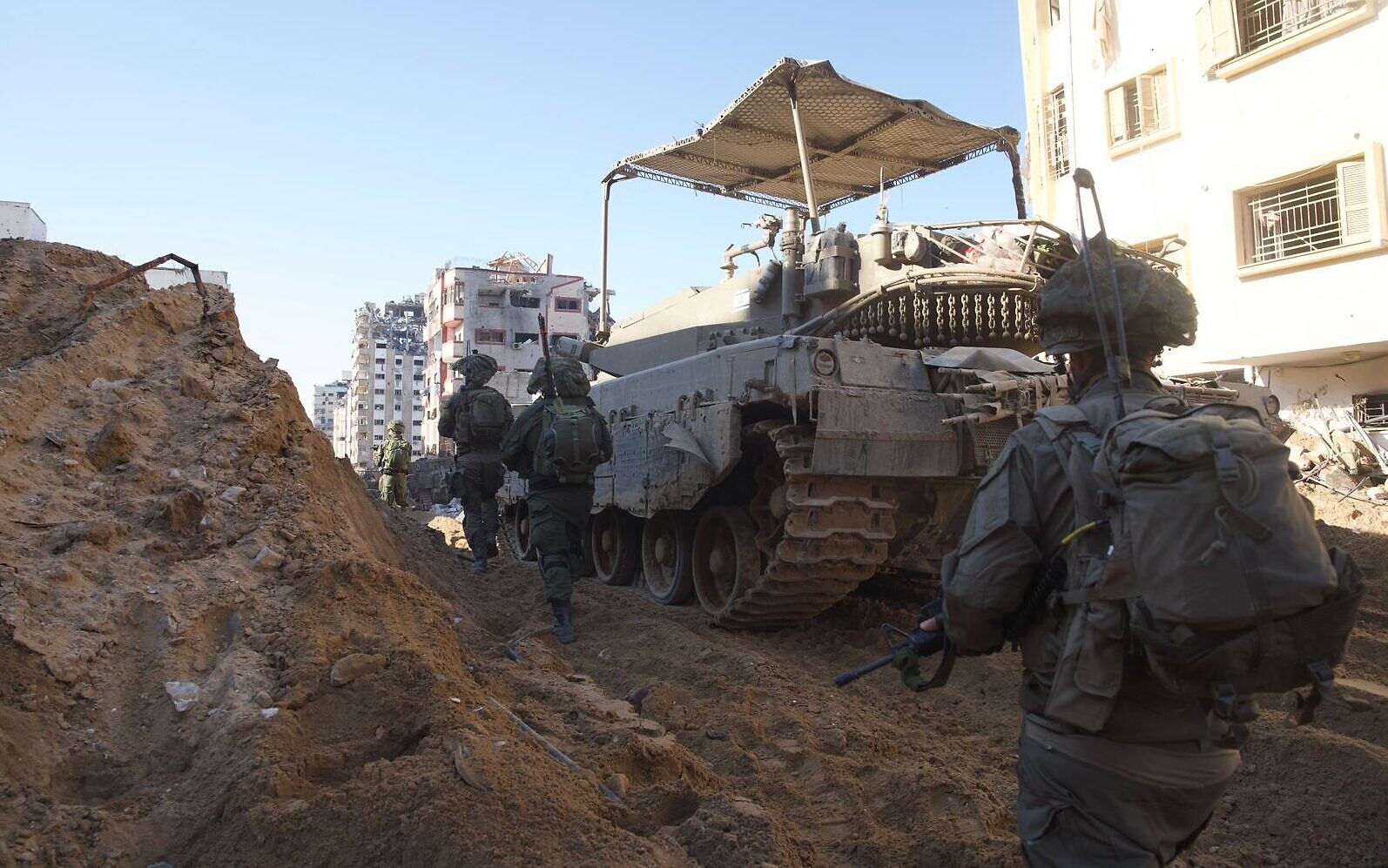
In this photo distributed by the Israel Defense Forces on December 22, 2023, Israeli troops are seen in the Gaza Strip amid the ongoing war against the Hamas terror group. (Israel Defense Forces)
IDF Spokesman Rear Adm. Daniel Hagari says the military is nearing complete “operational control” of northern Gaza, as it further expands operations in the southern part of the Strip.
“IDF troops are continuing ground operations in Khan Younis, and at the same time are preparing to expand the activity to additional areas of the Strip, with an emphasis on its south,” Hagari says in a press conference.
He says this comes as the IDF is at “the final stages of operational control” in northern Gaza, with troops battling the last standing Hamas battalion, in the Daraj and Tuffah neighborhoods of Gaza City.
Hagari says the military is still fighting Hamas in other areas of northern Gaza, albeit at a “lower intensity.”
“We are almost at full operational control in the north” of the Gaza Strip, he says.
PA envoy says UN resolution ‘a step in the right direction,’ again calls for immediate ceasefire
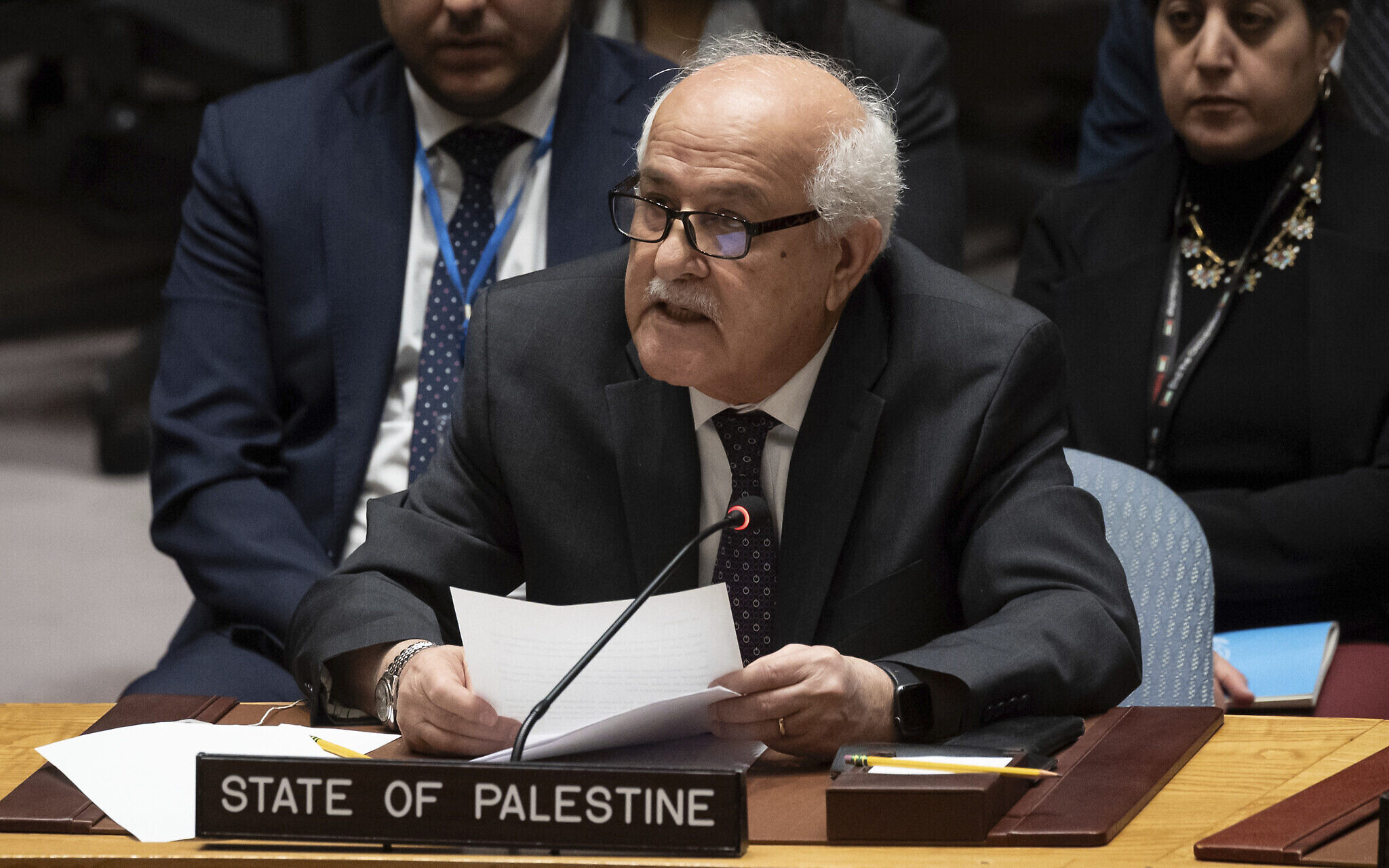
Palestinian Ambassador to the UN Riyad Mansour speaks during the Security Council meeting at United Nations headquarters, December 22, 2023. (AP Photo/Yuki Iwamura)
UNITED NATIONS — The Palestinian Authority’s representative to the UN calls the Security Council resolution demanding more aid deliveries to Gaza “a step in the right direction,” but reiterates calls for an immediate ceasefire.
“This resolution is a step in the right direction — it must be implemented and must be accompanied by massive pressure for an immediate ceasefire. I repeat, immediate ceasefire,” says Riyad Mansour.
British FM hails UN resolution urging more aid for Gaza as ‘good news’
LONDON — A UN Security Council resolution calling for the immediate acceleration of aid to Gaza is “good news,” the UK government says.
“It is good news that the UN has come together to back a resolution to get more humanitarian aid into Gaza,” UK Foreign Secretary David Cameron says.
Iran-backed militias in Iraq claim to have targeted Israeli gas rig in Mediterranean

Energean's floating production system (FPSO) at the Karish gas field in the Mediterranean Sea. (Energean)
The Islamic Resistance in Iraq, a coalition of Iran-backed militias, claims to have struck a “vital target” in the Mediterranean Sea several days ago.
A source in the group tells Al Jazeera that the target was the Karish gas rig off Israel’s northern coast.
The claims from the Islamic Resistance in Iraq — which cannot be verified — come after the IDF announced it downed a drone last week over the sea near Lebanon as it approached Israeli airspace.
Hamas calls UN Security Council resolution ‘insufficient’
Hamas brands as “insufficient” a UN Security Council vote demanding aid deliveries at scale into the Gaza Strip, amid the ongoing Israeli ground offensive against the Palestinian terror group.
Hamas, which has ruled Gaza since 2007, says in a statement that it considers the resolution “an insufficient measure that does not respond to the catastrophic situation created by the Zionist [Israeli] war machine.”
White House: Iran ‘deeply involved’ in planning Houthi attacks on Red Sea shipping
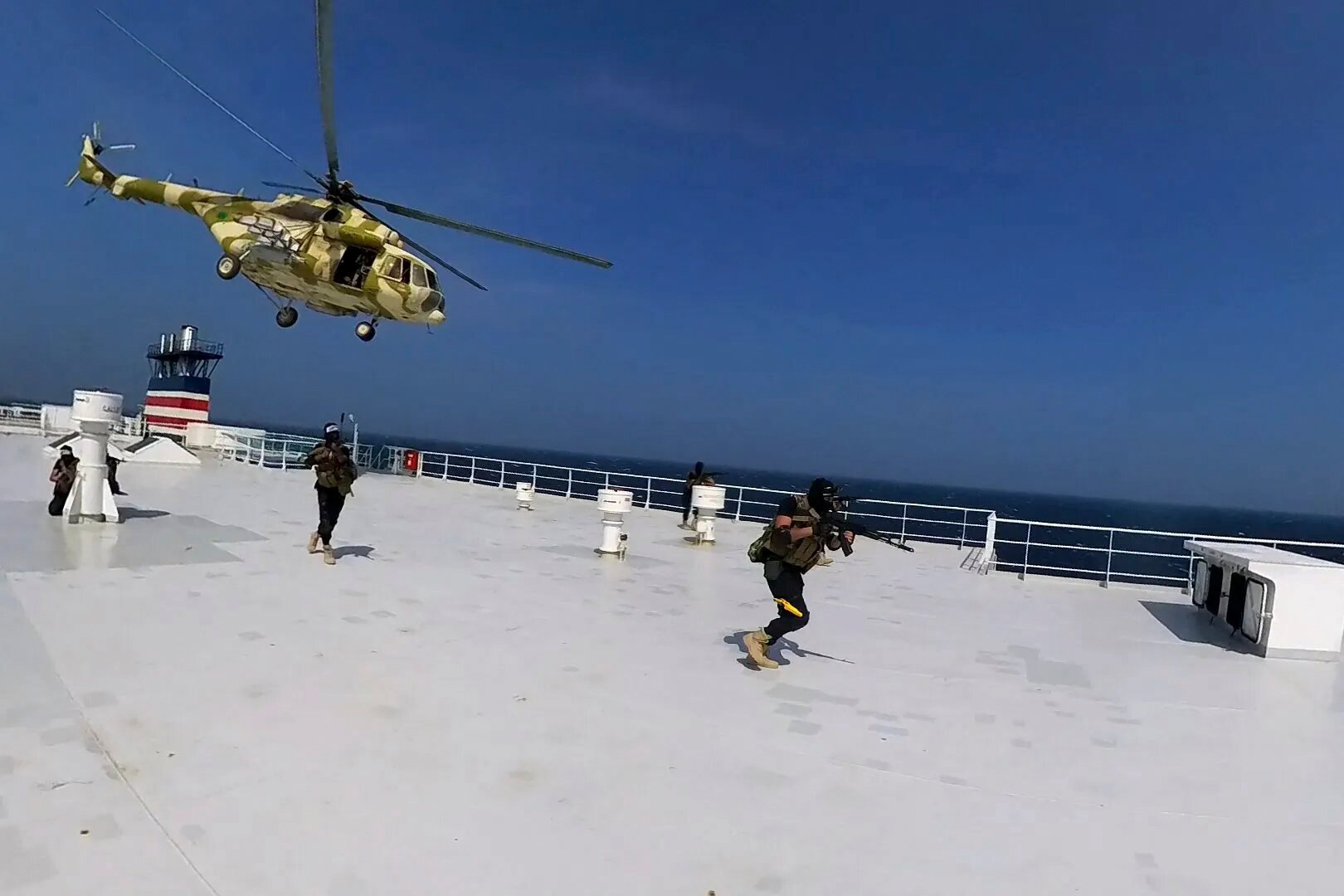
This photo released by the Houthi Media Center shows Houthi forces boarding the cargo ship Galaxy Leader on Sunday, November 19, 2023. (Houthi Media Center via AP)
Iran has been “deeply involved” in the planning of attacks by Yemen’s Houthi rebels against commercial vessels in the Red Sea, providing weapons, funding, training and “tactical intelligence” to enable the strikes along a critical sea corridor, US National Security Council spokesperson Adrienne Watson says in a statement.
Citing newly declassified American intelligence, Watson says “Iranian support throughout the Gaza crisis has enabled the Houthis to launch attacks against Israel and maritime targets, though Iran has often deferred operational decision-making authority to the Houthis.”
“Since 2015, Iran has transferred advanced weapons systems to the Houthis, including Unmanned Aerial Systems, Land Attack Cruise Missiles, and ballistic missiles that have been used in attacks against maritime vessels, including commercial vessels with no known links to Israel, and in attacks against Israel since October,” Watson says.
Without ongoing Iranian support, “the Houthis would struggle to effectively track and strike commercial vessels,” Watson says.
Iran, which has long backed the Yemeni rebels, has provided unmanned aerial systems, cruise missiles and ballistic missiles to the Houthis, including those used in recent strikes on commercial and military vessels and attempted attacks on Israel, according to the US assessment.
“We have no reason to believe that Iran is trying to dissuade the Houthis from this reckless behavior,” Watson says.
The Houthi campaign has prompted a growing list of companies to halt operations in the major trade route.
The US has established a naval coalition to protect the Red Sea global shipping lane. However, the Biden administration has not yet taken the step to reverse its decision to declassify the Houthis as a terror organization. US officials say that Washington is still considering the move.
US says Blinken and Gallant discussed ‘active efforts’ to free hostages, deliver more aid to Gaza

Defense Minister Yoav Gallant (R) and US Secretary of State Antony Blinken shake hands before meeting in Tel Aviv on November 30, 2023. (Saul Loeb/Pool/AFP)
US Secretary of State Antony Blinken held a relatively rare call with Defense Minister Yoav Gallant yesterday to discuss “active efforts” to secure the release of the hostages in Gaza and facilitate the entry of more humanitarian aid into the Strip, the State Department says.
Blinken hasn’t made a call to Gallant since October 16, according to the State Department, as Pentagon chief Lloyd Austin is the administration’s normal conduit to the Israeli defense minister.
Blinken has spoken more often with war cabinet minister Benny Gantz, but increasing humanitarian aid into Gaza is high on the US agenda and Gallant’s ministry has more authority over this effort.
The rest of the US readout includes the usual talking points regarding the US effort to prevent the conflict from spreading; steps to de-escalate tensions in the West Bank and the Lebanon border; the importance of Israel protecting civilians and the US commitment to establishing a Palestinian state.
Even if a particular talking point is not mentioned in a call, governments often include them in press readouts in an attempt to get messages across publicly.
Spain says still deliberating whether to join US-led naval mission in Red Sea
MADRID — Spain’s Socialist government says it has still not decided whether it will take part in an international coalition led by the United States to quell Houthi attacks on ships transiting the Red Sea.
“Spain will never participate in an operation from a unilateral point of view. All decisions will always be taken under the umbrella of the European Union and NATO,” government spokeswoman Pilar Alegria tells a news conference.
The United States on Monday announced a 10-nation coalition to quell the Houthi missile and drone attacks on ships transiting the Red Sea, with Britain, France, Bahrain and Italy among the countries joining the “multinational security initiative.”
US Defense Secretary Lloyd Austin said the security coalition also included the United States, Canada, Netherlands, Norway, Seychelles and Spain.
But Spain’s defense ministry said Tuesday the country “depends on the decisions of the European Union and NATO and, therefore, will not participate unilaterally.”
The head of Spain’s conservative opposition Popular Party, Alberto Nunez Feijoo, told a separate news conference that Spanish Prime Minister Pedro Sanchez had told him that Madrid had “decided not to intervene, at least not intervene in the conditions requested by the United States.” He did not elaborate.


read more: