

Matti Caspi, singer and composer who helped mold Israeli culture, dead at 76
Caspi, who performed and wrote some of the country’s most enduring tunes, succumbs to cancer; Herzog mourns loss of ‘one of the greatest Israeli composers of our generation’
 Add ToI as a Preferred Source on Google
Jessica Steinberg, The Times of Israel's culture and lifestyles editor, covers the Sabra scene from south to north and back to the center

Matti Caspi, a composer, singer, and lyricist who produced some 1,000 songs, including many of Israel’s most beloved tunes, died overnight between Saturday and Sunday. He was 76 and had suffered from cancer in recent years.
Among his most famous works are “Brit Olam” (Eternal Covenant), “Ekh Ze SheKochav” (How Is It That a Star), “Hine Hine” (Here Here), “Lo Yadati SheTelchi Mimeni” (I Didn’t Know You Would Leave Me) and “Shir HaYonah” (The Song of the Dove).
As a musician and as an Israeli, Caspi was deeply connected to his local audience. When he developed metastases from cancer last May, he informed his followers on social media, letting fans know he was canceling his upcoming performances to focus on his health. He launched and completed a $1.5 million crowdfunding and media campaign to raise money for experimental treatments that were not included under the national healthcare system.
“I’ll fight in every way possible, I’ll be stubborn to the end,” Caspi said in July, by when his illness prevented him from playing the piano or the guitar.
His family announced his death in a statement on Sunday morning.
“With a heavy heart and deep sadness, we announce the passing of our beloved husband and father. The light in our lives has gone out,” the family said. “His love and the creative work he left behind will forever be a part of us.”
Caspi is survived by his wife Raquel and his four children.
Caspi released dozens of albums during his decades of work, often serving as both musician and producer, with a unique ability to compose singable harmonies and lyrics.
He was known for his collaborations, working with Leonard Cohen, Ehud Manor, Yehudit Ravitz, Shlomo Gronich, Shalom Hanoch, Hava Alberstein, Netanela, Nurit Galron, Danny Robas, Gali Atari, Arik Sinai, Meir Banai, Erez Halevi, Shoshana Damari, and many more.

Caspi was born in 1949 in Kibbutz Hanita, in northern Israel. During his mandatory army service in the Southern Command Troupe, Caspi formed his first musical band, a trio with two friends, Gadi Oron and Ya’akov Noy, called The Three Fat Men, and released his first big hit, “Ani Met” (I Am Dying).
His professional career began days after he was discharged from the army, when he received a call from Arik Einstein, a pioneer of Israeli rock music. It was during an afternoon spent playing music at Einstein’s home that Caspi realized he could sing as well.
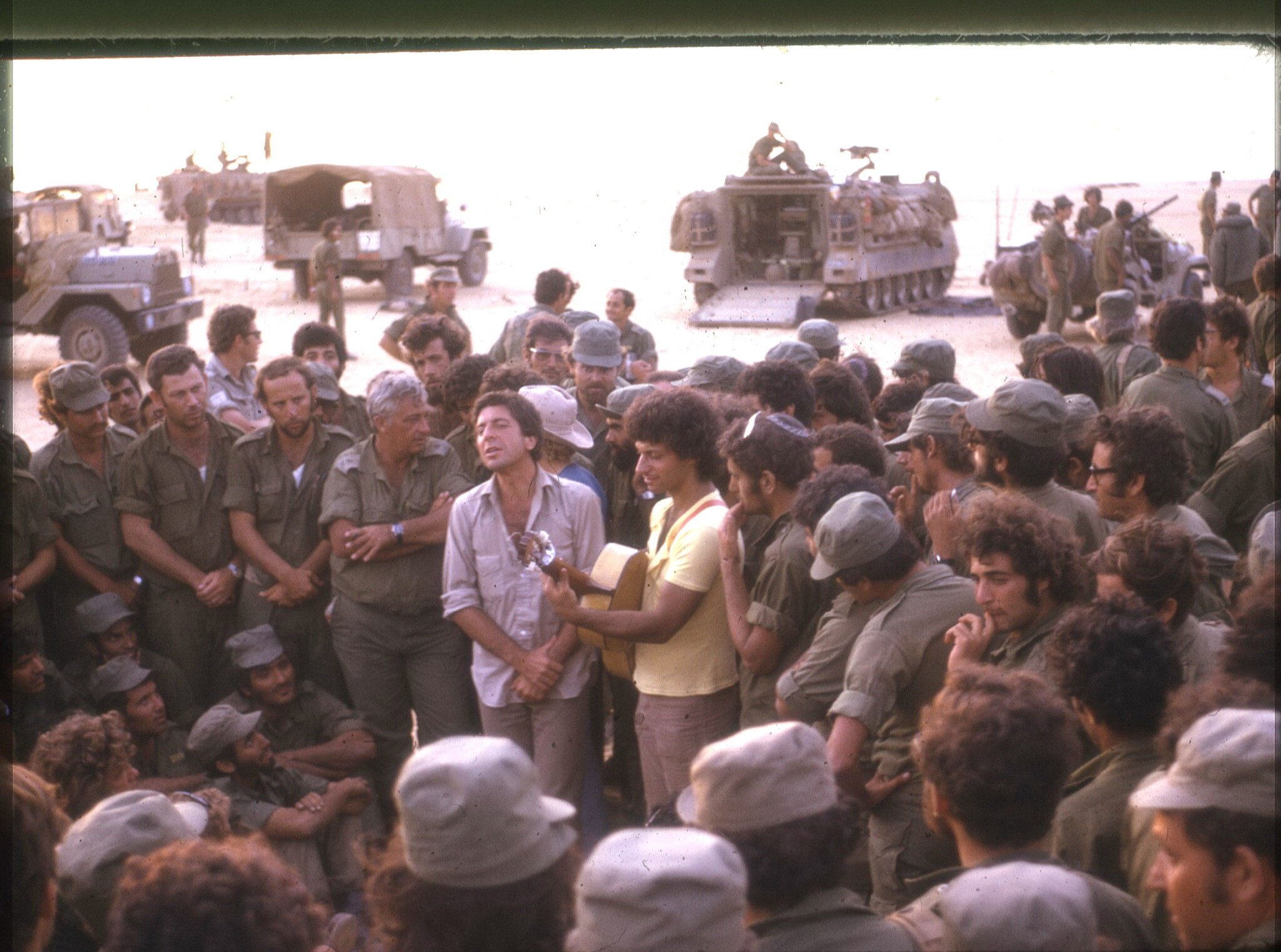
In 1973, when Canadian singer Leonard Cohen arrived in Israel during the Yom Kippur War, Caspi joined him on guitar and performed for troops across the Sinai Peninsula. He recalled performing with Cohen next to a Sinai landing strip as C-130 Hercules planes landed, releasing soldiers from their belly. As platoons landed, heading for the Suez Canal, Cohen sang his song “Like a Bird on a Wire” for them, accompanied by Caspi, repeating it for each unit of arriving soldiers.
At the end of that day, Cohen and Caspi joined one of the trucks to help carry wounded soldiers to helicopters — the same soldiers they had performed for earlier.
A musical renaissance man
It was the start of several prolific decades for Caspi, as he worked closely with musicians including singer and lyricist Ehud Manor and released some of his most popular songs.
More than one reviewer has noted that Caspi was something of a musical renaissance man, a great harmonist who revered Israeli folk traditions and had the ability to create complex musical compositions that wholly related to the Israeli cultural experience.
Caspi loved his birthplace of Hanita in the western Galilee, a place he remained connected to throughout his life. He described himself as a happy child who spent hours stomping out rhythms and singing songs.
He learned how to play the recorder as a small child, and it was his introduction to Shmuel Gogol, a Polish-born Israeli musician who played the harmonica, that awakened his desire to learn musical instruments.
Gogol, who received his first harmonica from Janusz Korczak — the renowned Polish doctor who ran an orphanage for Jewish children during the Holocaust — survived Auschwitz and came to Israel, where he founded the Ramat Gan harmonica band and would perform at a local nursing home near Caspi’s kibbutz.
The famed harmonica player told Caspi when he was still young that he would gift him his harmonica if Caspi learned to play piano.
Caspi’s parents pushed the kibbutz for lessons, and he studied piano at the nearby Nahariya conservatory with a Romanian-born pianist, Raphael Dragan, practicing the instrument at the nursing home. Caspi’s father would sit with him at lessons to translate Dragan’s Romanian into Hebrew for his son.

After receiving Gogol’s harmonica, Caspi added it to his instrument repertoire, eventually composing works for it.
He wrote his first musical arrangement as a teenager, competing with other young talents, and was accepted into the Southern Command Troupe for his army service, performing as a singer, composer, and musical producer.
Caspi noted that he didn’t write songs on commission, but would hand over melodies if he thought they were better suited to another singer. He loved performing live, where he said he was loose and unabashed, at ease with the audience.
Caspi married Galia Superstein soon after the army, but they divorced less than a year later. In 1972, he met actress (Patty) Doreen Lubetzky, and they married and had two children, Brit (born 1981) and Bar (born 1985). After Caspi and Lubetzky separated, he met Raquel Wenger in 1990, and they emigrated to Canada, married in 1994 in California and had two children, Suyan (born 1992) and Sean (born 1995).
In 1997, Caspi returned to Israel and in 2002, a Tel Aviv court determined that he was still legally married to Doreen at the time he’d married Raquel in 1994, and found him guilty of bigamy. The court imposed a six-month suspended sentence and a small fine. An appeal failed, and in 2004 the original sentence was upheld.
With his return to Israel in 1997, Caspi was received warmly by Israeli audiences.
He continued producing albums and performing around the country. In 2014, during Operation Protective Edge in Gaza, Caspi drove down south and performed for the kibbutz communities there with a litany of old favorites and crowd requests for locals stuck in safe rooms.
In July 2021, amid government restrictions during the coronavirus pandemic, Caspi criticized Prime Minister Benjamin Netanyahu for what he called “fascist” measures and canceled a series of concerts after entry limitations were reinstated for large events.
He and Shalom Hanoch dedicated a new album in December 2023 to soundman Guy Illouz, who was taken hostage during the Hamas terrorist assault of October 7, 2023, and killed in captivity.
He continued touring and performing until June 2025, when his cancer caused paralysis in his left hand, preventing him from playing guitar and piano.
Caspi was “one of the greatest Israeli composers of our generation,” President Isaac Herzog said in a statement upon news of his death. “We are left with his masterful works, with the melodies that graced wonderful texts and gave them eternal life, with the compositions that shaped Israeli music for decades, with the arrangements in which his unique touch was so evident.”
“Matti Caspi is gone,” the president said, “but his contribution to Israeli music and our lives is so present, and will continue to accompany the cultural world for generations.”





The Times of Israel Community.