

NY artist watches his language at the Jewish Museum
The raw sensory meaning of words is explored in new exhibit, ‘Mel Bochner: Strong Language’
 Add ToI as a Preferred Source on Google
Reporter at The Times of Israel
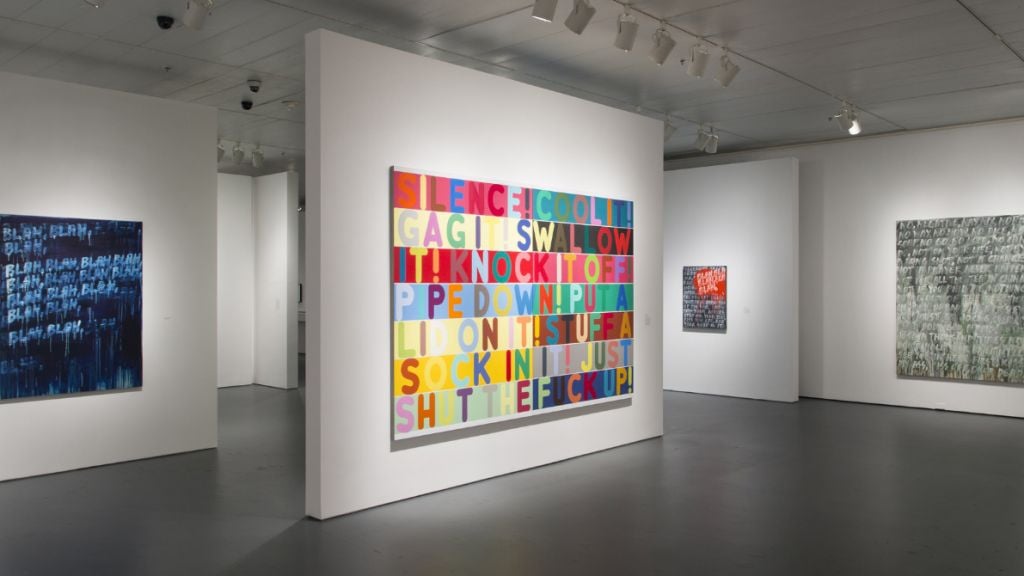
NEW YORK — Awesome! Heart-stopping! Gaga! Meshugga! They’re just words. Or not. The Jewish Museum’s exhibit “Mel Bochner: Strong Language” explores the meaning of words. More than 70 works fill the first floor gallery space. Each one explores the tension between the visual and the verbal through the words themselves and the colors Bochner chose to paint them.
“It looks at the way your brain processes language,” said Norman Kleeblatt, the Susan and Elihu Rose Chief Curator of The Jewish Museum.
Born in 1940, Bochner is considered a pioneer of incorporating language into visual art. Growing up in an observant Jewish household, Jewish thought, wordplay and the way in which text can be manipulated have long intrigued Bochner. For Bochner, the thesaurus is a “warehouse of words.”
Kleeblatt said.
The Jewish Museum decided on an exhibition of Bochner’s work some years ago. Kleeblatt, who curated “Strong Language,” was working on acquiring a Bochner for the museum.
“And I thought, wouldn’t it be fabulous if we could have a show of Mel’s work in his hometown? His work hadn’t been exhibited in New York City in years,” Kleeblatt said.
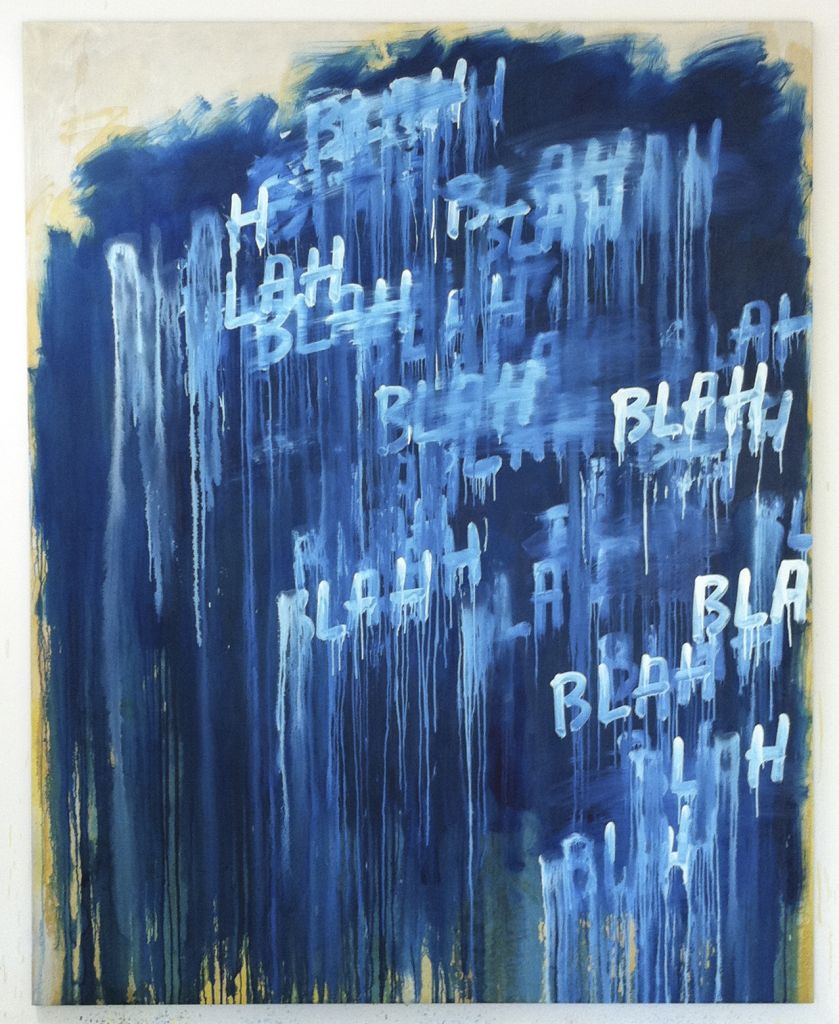
Visitors to the Fifth Avenue museum don’t have to wait to enter the exhibit space to see Bochner’s work. An L shaped canvas titled “Blah. Blah. Blah. Blah” hangs in the museum’s marble lobby. The words, painted in bold, thick, rainbow hues jump from the black canvas.
“It’s about the meaninglessness of language and the profusion of language,” Kleebatt said of the work.
In his essay “Politics and the English Language,” George Orwell wrote that the meaning should choose the word, rather than the reverse. Bochner plays with that concept in the way he uses color and words – where the colors themselves have meaning.
“The tone of these paintings has a lot to do with devolution of contemporary language, its corruption in public and political discourse in ways that even George Orwell could not have imagined,” Bochner said in museum literature.
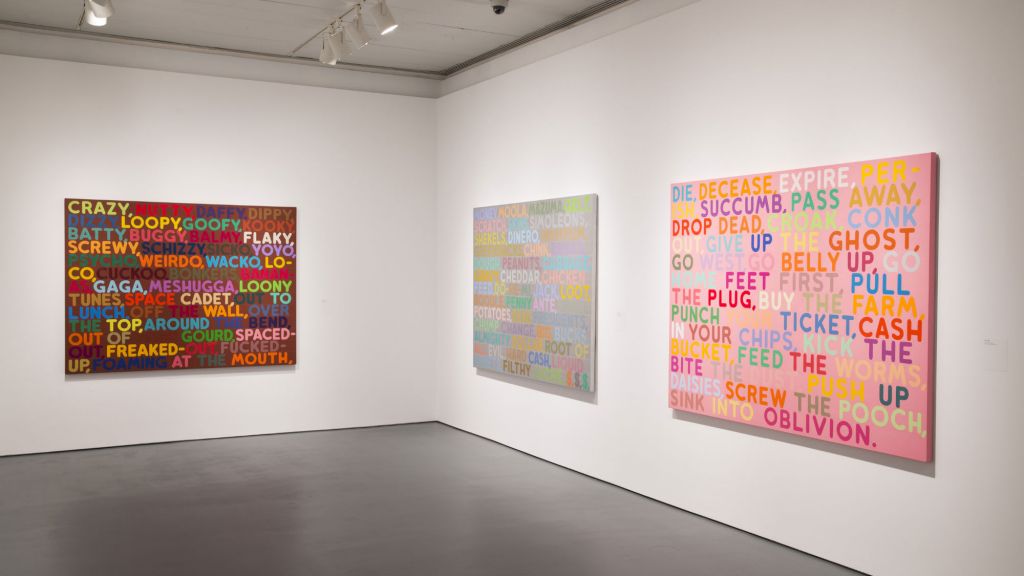
In “Die” (2005), Fruit Loop colored words jump off the Bubble-gum pink background. “Die. Give up the Ghost. Bit the Dust.” Here, the colors seem to be the opposite of the meaning. Then there’s “Obscene” (2006) where words such as “Racy. Randy. Hard Core” are painted in pastel hues against a cream colored background.
But it is perhaps “Jew” (2008), which commands the most attention. The list of derogatory words includes “Hebrew. Kike. Jewboy. Hook nose.” Each one is painted in yellow on black background, evoking the yellow stars the Jews were forced to wear under the Nazi regime.
Bochner painted it after stumbling on a racist Internet site. He explained that anti-Semitism thrives in the dark but that “by shining a light on it, I intend to expose how pervasive it remains and how inextricably it is tied to language.”
Words are weapons, wrote Bochner, and the abuse of power necessarily entails the abuse of language.
Kleeblatt said he recalls hanging “Jew” right after last spring’s shooting outside a Jewish center in Kansas City. With the rise of virulent anti-Semitism in Europe, he said the painting “is sadly still so pertinent.”
The exhibit runs through Sept. 21 at The Jewish Museum. Norman L. Kleeblatt, the Susan and Elihu Rose Chief Curator of The Jewish Museum, organized the show together with Stephen Brown, Assistant Curator at The Jewish Museum.










The Times of Israel Community.