

Peres: Netanyahu now has more faith in Obama
US will use force if all else fails to stop Iran, president tells The Times of Israel in a Yom Ha’atzmaut interview

 Add ToI as a Preferred Source on Google
David Horovitz is the founding editor of The Times of Israel. He is the author of "Still Life with Bombers" (2004) and "A Little Too Close to God" (2000), and co-author of "Shalom Friend: The Life and Legacy of Yitzhak Rabin" (1996). He previously edited The Jerusalem Post (2004-2011) and The Jerusalem Report (1998-2004).
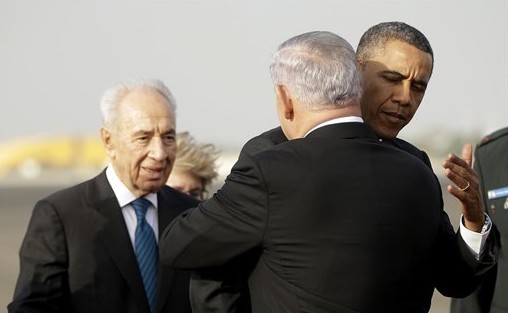
President Barack Obama’s visit to Israel not only dramatically raised Israelis’ faith and trust in him, but also made a positive impact on Prime Minister Benjamin Netanyahu, President Shimon Peres said.
Interviewed by The Times of Israel ahead of Israel’s 65th Yom Ha’atzmaut (Independence Day), Peres answered with a firm “yes” when asked whether he thought Netanyahu now has “more faith” in the US president. “I can’t tell you how much. I cannot measure it. And nobody can measure it,” Peres elaborated. But “it had an impact” on Netanyahu. “And I think the Israelis have more faith. The trust in Obama was raised by 20%. I personally believe that he is a friend, a profound friend.”
Reiterating his confidence that Obama will thwart Iran’s nuclear weapons drive, Peres said, “You never start by shooting. People will say, ‘Are you crazy?’ You have to show your own people, before you turn to the shooting game, that you tried. [You have] to create a coalition; Obama worked for a coalition. So it won’t be America alone. [You have] to use nonmilitary means — like sanctions or pressure. [You have] to help legitimate the estimation of international bodies — so nobody will say you are fighting for a narrow American interest. And [you have to] be patient — try to negotiate, time and again.”
If all of that fails, however, in “the last resort, the [Americans] are not freiers [suckers], as we say. They’ll have to use force.”
Ultimately, the president said firmly, “The present government in Iran doesn’t have a future. The problem of Iran is timing, not verdict. It’s a government that doesn’t have a message — not only for humanity, but for its own people.”
Peres said he believed Obama was “100 percent” committed to advancing Israeli-Palestinian peace efforts, and that there were opportunities for substantive and rapid progress. “Whoever says there’s no chance is really demonstrating his ignorance, I can tell you… If somebody would have stood up after the Holocaust in May 1945, and said in three years there will be a Jewish state — tell me, who really forecast that?” Peres asked. “Who can claim that he knew? And now, when modern communication shortens the time, you can change minds almost overnight.”
As for the specifics of Obama’s approach, he noted, “There’s a famous saying. ‘If you have a hammer in your hand, you think that every problem is a nail.’ You don’t solve problems with hammers. It’s much more varied and sophisticated. You have to have patience and understanding. You have to have the double capacity: to be patient, and, from time to time, to be decisive. I find that Obama has the two [capacities].”
Asked about disputes and frictions in the relationship between Israel and Diaspora Jewry, including regarding the Orthodox monopoly over religious practices in Israel, Peres noted that “Judaism is made of variations” and that “it’s un-Jewish to adopt [just] one of them… We cannot dictate to everybody how to pray or how to behave. They won’t listen to us.”
He said Israel has to reach a three-part “common denominator” with the Diaspora. Respect for the Ten Commandments, exemplifying that “values are more important than assets”; the prioritizing of “the pursuit of knowledge”; and an emphasis on the need “to pursue peace.”
On these three principles, Peres said, “we can unite, and we should unite, voluntarily.”
As for worrying trends in Israeli society, including hostility to migrants, societal violence and extremist attacks, the president noted that “a nation is not made of laws, but also of culture. Clearly you have to have stronger courts and better police,” he said, but you also have to emphasize education. “We put too much emphasis on teaching information, instead of educating on how to behave.”




The Times of Israel Community.