

Tale of Jews in WWII Polish zoo aims to open minds
Teacher and author Antony Lishak inspires Jerusalem high school students to write the narratives they’re not being taught
 Add ToI as a Preferred Source on Google
Deputy Editor Amanda Borschel-Dan is the host of The Times of Israel's Daily Briefing, What Matters Now and The Reel Schmooze podcasts, and heads up The Times of Israel's features.

It is every lecturer’s nightmare: Right in the middle of a crucial PowerPoint presentation — blip! The computer has a temper tantrum.
But for Antony Lishak, standing in front of an English class at Jerusalem’s “Leyada” Hebrew University High School, it is another opportunity to engage.
“You’re the storyteller, mate,” he proclaims in a thick British accent, pointing to an unsuspecting student. “You tell me why the computer isn’t rebooting!”
The pupil, with remnants of Russian in his student English, jumps at the challenge and says it’s because of KGB informers. Taking up the gauntlet, Lishak and the class begin to embroider a tale of spies and informers while he sorts out his technology.
The inveterate veteran educator is in Israel ostensibly wearing his author’s hat. He’s written some 30 volumes in the past three decades, from children’s literacy aids to novels. Back home in London, though, he is known for his elementary school creative writing workshops, and on a quick trip to Jerusalem he just couldn’t resist giving a handful of presentations to high school classes about his new book, “Stars.”
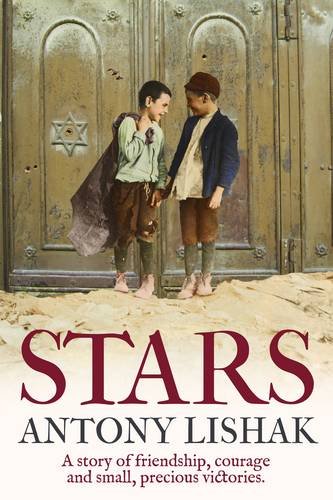
“Stars,” the story of two 12-year-old boys’ survival in 1939 Warsaw, is based on the true tale of Righteous Among the Nations Jan and Antonina Jabinski who turned their zoo into a refuge for some 300 Jews fleeing the ghetto. But like most of Lishak’s projects, the book is really a jumping-off point to educate.
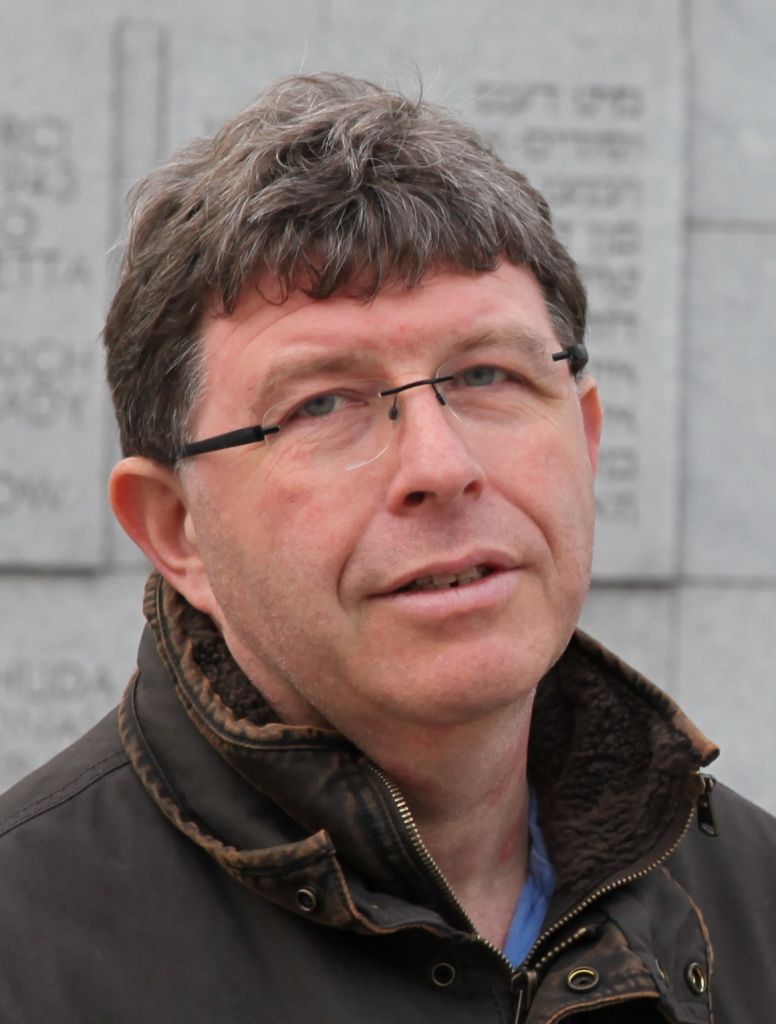
This Jerusalem group of 15-year-old students is more knowledgeable than Lishak’s usual crowd of British pupils. Exuding energy and speaking a mile a minute, he skips from teen to teen, subject to subject, asking questions and being asked.
“I love,” he says, praising a quasi-comatose student who met Lishak’s challenge, “when someone who is calmly listening suddenly explodes and says something important.”
The student grins sheepishly.
Like a surfer riding the students’ rising and falling waves of interest Lishak improvises and steers the presentation, making it appear a conversation.
“When is doing nothing actually not doing nothing?” he asks, segueing the students into a debate about mass psychology. Flipping to a slide of screaming English soccer fans, Lishak — an avowed Arsenal supporter — says, “We behave differently in groups,” and launches into a story to illustrate his point.
Often, Lishak’s point is stories.
After 16 years of formal primary school teaching, Lishak left the classroom to concentrate on writing. But the author says, “I had to leave teaching to realize I was a teacher, like it or not.”
His teaching career began in 1981 with a focus on grade school literacy. But in his free time he wrote continuously. Eventually he forged a relationship with a few editors who began giving him feedback on his submissions.
His first book, “Coming Round,” was accepted in 1988, at which point Lishak says he began debating whether he was “a teacher that wrote or an author that taught.” Finally, in 1996 he took the plunge and left his full-time teaching position to concentrate on writing — and spreading his love for the craft. Since 1996 he’s visited over 2,000 schools and, he estimates, spoken to almost 350,000 pupils.
As a guest lecturer giving writing workshops, he feels he has the luxury of being accountable only to the children.
Education today, Lishak laments, is all about pleasing inspectors and teaching toward high marks on assessment tests. He says many teachers are now like model airplanes — perfect on the outside, but hollow within. His workshops free him from these pressures.
Until his recent book “Stars,” most of his writing and workshops have been unconnected to Jewish themes. But as a Jew he occasionally finds himself in the position of quasi-diplomat to Britain’s secular school system.
Lishak tells of fixing the direction of Torah scrolls or Hebrew signs in well-intentioned interfaith showcases in public schools. And once he went into a classroom and was stunned to see a wall covered in striped shirts with yellow Stars of David sewn on them, embroidered with pupils’ names.
The classroom teacher had been teaching the controversial book “The Boy in the Striped Pajamas” and come across material similar to that found in concentrations camps. She thought having the pupils make their own camp shirt would be the perfect hands-on activity for her 10- to 11-year-olds.
‘In the UK, the Holocaust is being taught like the Tudors and the Stuarts’
“In the UK, the Holocaust is being taught like the Tudors and the Stuarts,” Lishak says.
He is hopeful to slowly change that, and will soon have a chance through Jewish Book Week-sponsored creative writing workshops tied to “Stars” in schools in January and February. The culmination will be public performances of the pupils’ work.
Also, this summer he will participate in an initiative launched by the Spiro Institute, called Spiro Ark. In it, a cross-generational group will use “Stars” as a starting point to explore Warsaw on a five-day tour in which they will experience Poland’s Jewish life today and meet Polish Jews. Lishak says for him, a highlight will be an inspirational meeting with Polish Righteous Among the Nations.
“Stars” was an eight-year long pregnancy for Lishak, whose own family comes from Poland, and he repeatedly visited the country during its gestation. Lishak is passionate about educating Jews, especially Israelis, about the rebirth of a vibrant living Judaism in Poland, a country considered by most in the Diaspora to be a huge Jewish graveyard.
Lishak is among those who are engaged in educating the Poles about their Jewish past, too. In January 2014, when the book was first published, Lishak led a series of visits to sites used in his book for pupils in Warsaw’s English-speaking schools. Today in Poland, says Lishak, Jewish Studies courses are bursting, attended in the majority by non-Jews.
He concedes that there is still an ineffable (and mostly in rural areas) ongoing “affectionate” Polish anti-Semitism in which Poles refer to “their Jews.” But Lishak wants Israeli pupils to know about the 6,454 Poles who are currently counted as Righteous Among the Nations by Yad Vashem, Israel’s preeminent Holocaust museum and research center.

Lishak says Jews need to remember that over three million Poles were also murdered in the Holocaust. He wants Israeli students, destined to complete the “rite of passage” called March of the Living during high school, to understand that some 17,000 Jews lived out the war on the Aryan side of the Warsaw Ghetto. Experts estimate, he says, that it took on average four non-Jews to aid every Jew in hiding, adding up to tens of thousands anonymous Poles who helped Jews in the Warsaw area alone.
“This stuff needs to be known!” says Lishak. He tells his “Stars” workshop groups in Israel, “Hopefully some of this stuff will lurk in your heads when you’re there.”
Tens of thousands of anonymous Poles helped Jews in the Warsaw area alone
His Jerusalem workshops are already bearing fruit. Roy from the capital’s Boyar High School wrote Lishak an email thanking him for the presentation and a copy of “Stars.”
“You see,” writes Roy, “this book wasn’t just well written and interesting, it made me think about my life in a different way and show me a set of heroes which I didn’t know until I read this book.”
This, for Lishak, is highest praise. Education, he says, is a journey of discovery centered around the “joy of finding out.”
“It does feel a bit pompous to say, ‘Hey, this stuff is interesting!'” he says. And adds with an audible wink, “but it’s really important as well.”








The Times of Israel Community.