

The artist whose life began with Elijah
Eric Bokobza tells the story of his life in ‘United Colors of Judaica,’ a new exhibit at Beit Hatfutsot
 Add ToI as a Preferred Source on Google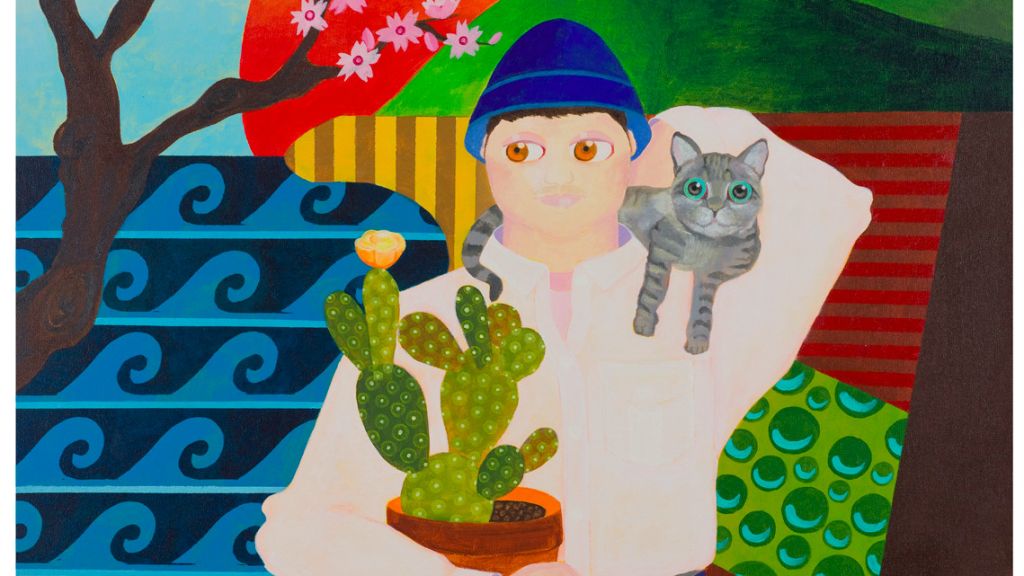
For much of his childhood, artist Eliyahou Eric Bokobza, now 52, was told he was a gift from the prophet Elijah. The unusual story is the foundation of Bokobza’s new exhibit, “United Colors of Judaica,” which recently opened at Tel Aviv University’s Beit HaTfutsot: The Museum of the Jewish People.
It begins with Bokobza’s Tunisian, secular parents, who traveled from France to Israel to pray for a child. At Elijah’s Cave on Mount Carmel — where Jewish women throughout history have gone to pray for children — the couple met a white-haired, blue-eyed stranger who predicted they would have a son the following year, to be named Eliyahou. He wrote his address down in Hebrew—the couple couldn’t read Hebrew — and they promised to visit if his prediction were to come true.
The Bokobzas returned to Israel a year later with their new son, and found out that the man had written: “Kol Yisrael haverim” (“All the people of Israel are friends”) a well-known saying, rather than an address. Still, the Bokobzas’ relatives and friends came to believe the stranger was Elijah the Prophet, and Bokobza a “miracle child,” he said.
Over a decade later, after moving to Israel, Bokobza’s father took a wrong turn in Tel Aviv, where he spotted the stranger from the cave — on a street called “Kaf-Yud-Het,” the Hebrew letter abbreviation of kol Yisrael haverim. The legend of Bokobza’s birth may have been debunked by the sighting, but it continued to trouble and define his life and work.
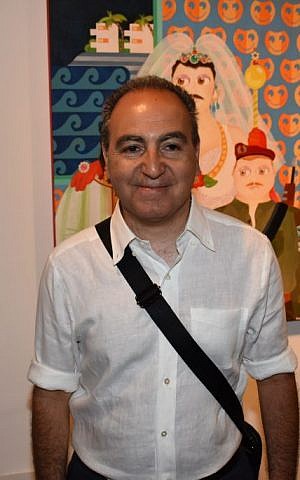
Bokobza grapples with the weighty concept of kol Yisrael haverim and the contrasting elements of what he calls his “mixed identity”—his Tunisian-French-Israeli heritage, Oriental and Occidental cultures, his experience with religion and mysticism as a secular Jew— in “United Colors.”
The exhibit is modeled after traditional museum exhibitions of Judaica, said Bokobza, which typically divide Jewish ritual objects into Jewish holiday and life cycle sections. He’s adjusted those designations by adding reimagined self-portraits of his alter-ego childhood self, “Eliyahou” (Bokobza goes by his French name “Eric”), alongside corresponding traditional religious objects, and by creating a third section, Famiglia, which sits at the intersection between the other two.
The Holidays section of the exhibit features paintings of the young Eliyahou celebrating Jewish festivals.
“In each painting, I’m showing what my secular experience as a Jew in Israel was like” he said.
There’s a combination of imagery in some of these paintings, articulating the artist’s struggle for self-definition.
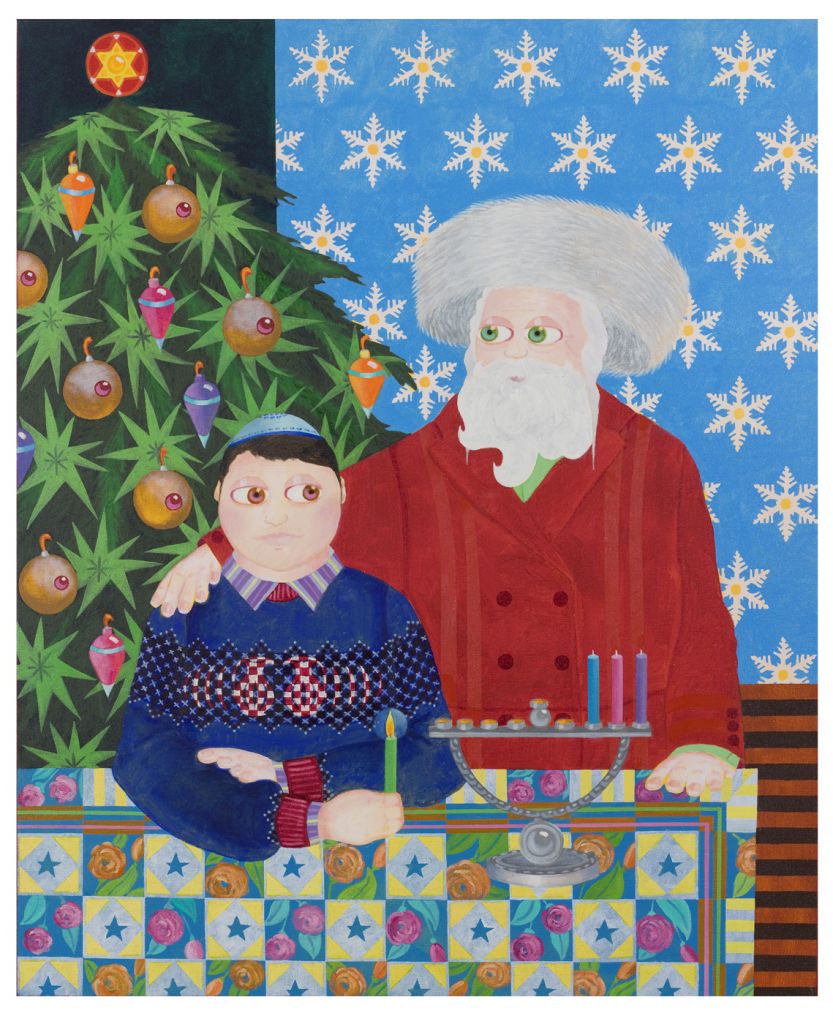
In “Hanukkah,” Eliyahou and an older, bearded, streimel-wearing man light a menorah. Eliyahou wears a Christmas-like sweater embroidered with oil jugs; the old man wears a traditional ultra-Orthodox coat but in red, rather than the traditional black. The snowflake pattern on the wallpaper is Jewish-star-shaped; and the Christmas tree is ornamented with jelly doughnuts and dreidels.
Bokobza explained that religion involved a sort of charade for him, exemplified by the fact that, in all of the paintings, Eliyahou is wearing a yarmulke, which the artist says he never wears in reality.
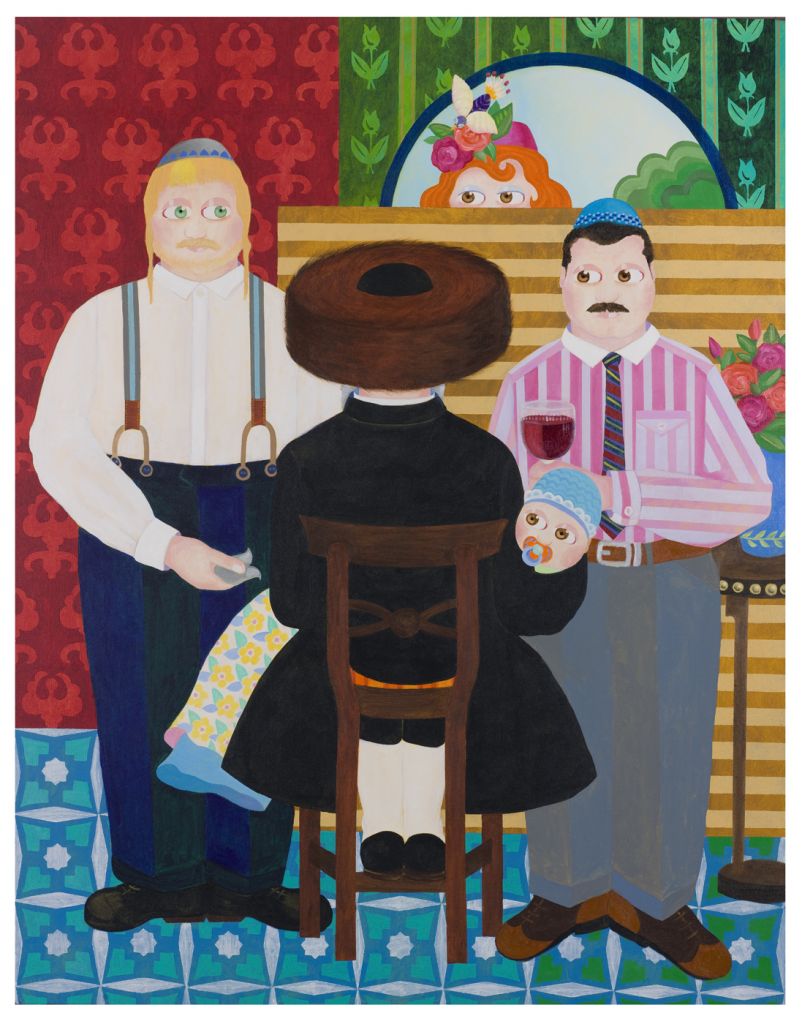
In the Events section, Eliyahou is shown participating in his own circumcision in “Brit Milah,” next to a corresponding biblical scene of “The Sacrifice of Isaac,” in which biblical father Isaac, slung over Abraham’s shoulders, points a knife at his father.
In the diptych “Wedding,” one half depicts Adam with an ultra-Orthodox groom, the other Eve with a bride. The pair of women might be read as a bride and maid of honor, and the men as a groom and best man, said Bokobza, who embedded the exhibition with his own story, and since he is gay, allows for the painting “to be read also as alternative couples.”
Famiglia, the third and central section of the exhibit, is an installation of a traditional Seder or Shabbat table using furniture and dishware from Bokobza’s parents’ home. Reupholstered chairs passed down from his maternal grandmother surround a table set with his paternal grandmother’s fine China plates, on which Bokobza painted images of Jews from various historical times.
Bokobza said the section’s title is the Italian word for “family”— which, in most languages has very positive associations. In reality, his parents’ families did not get along with one another. Here he brings them — along with other Jewish figures — together, echoing and challenging the message of kol Yisrael haverim.
Throughout his work are striking backgrounds, which are composed of painted patches of repetitive, wallpaper-like prints, which Bokobza says are “anchored in patch-working and quilting.” Many of the prints are abstract designs, while others contain icons characteristic of Israel (like Bauhaus buildings with single palm trees or stars of David). Often—as in the “Independence Day” painting—the swatches are collaged to form a loose map of Israel.
In some ways, the show is all about using patchwork—bringing together disparate parts and imagining them as whole—to test the boundaries of kol Yisrael haverim.
“United Colors of Judaica” will be on display at Beit HaTfutsot from July 17, 2015 through January 28, 2016.








The Times of Israel Community.