

The attack that Israel’s French-born Jews saw coming
Among the flood of immigrants, not one drop of surprise at Friday’s bloodshed
 Add ToI as a Preferred Source on Google
Debra writes for the JTA, and is a former features writer for The Times of Israel.
Two weeks ago, this reporter – herself an American immigrant to Israel – had to visit the Tel Aviv offices of Israel’s Ministry of Absorption to file some paperwork. In the lobby of the building, waiting patiently for appointments with the government counselors who oversee immigrants’ transition from their home countries into Israel, 10 other people were seated. Nine of them were French.
Seven thousand and eighty-six French Jews made aliyah to Israel last year, more than double the 3,293 who came the year before. That number itself was a massive jump from 2012, when fewer than 2,000 Jews resettled in Israel from France.
Half a million Jews remain, making France the world’s third-largest Jewish community behind Israel and the United States, but the Jewish Agency says it expects record-high immigration numbers this year, as well.
So on Friday afternoon, when one crazed Islamic terrorists burst into a kosher supermarket in Paris and enacted an hours-long standoff that riveted the world, the French Jewish community in Israel was shaken, but not shocked. They had seen it coming, they say. The writing has long been on the wall.
“We’ve all just been waiting for an event like this,” said Maud Gawsewitch, a Paris native who made aliyah in 2005. “We knew it would happen eventually.”
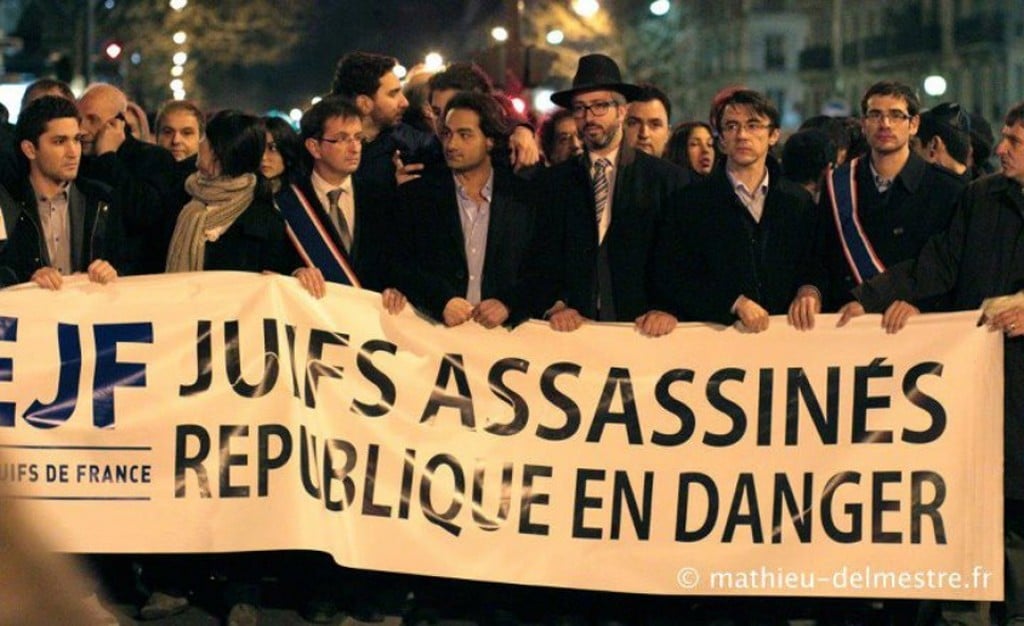
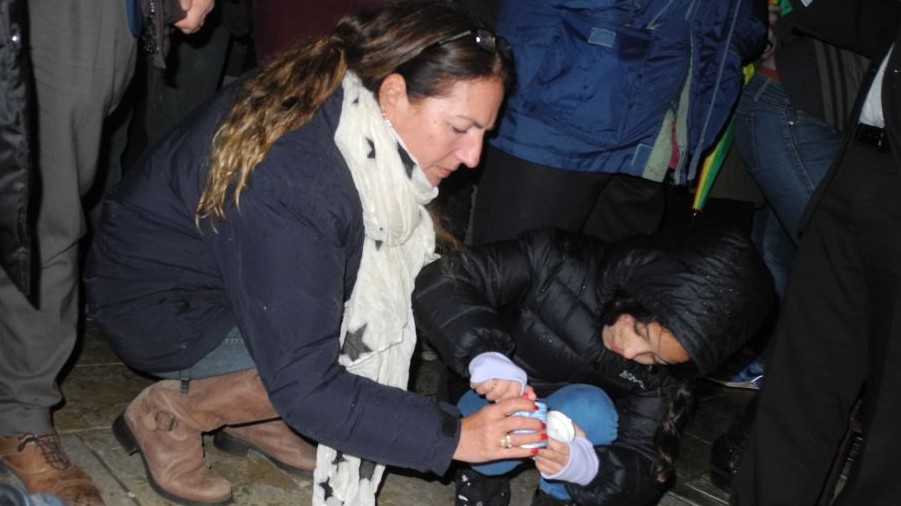
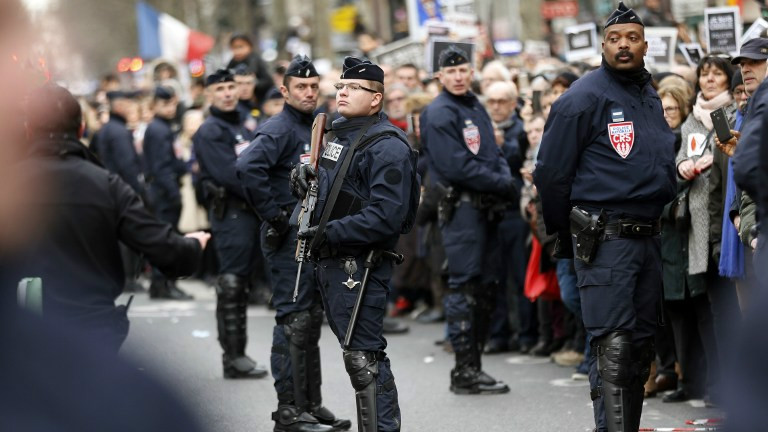
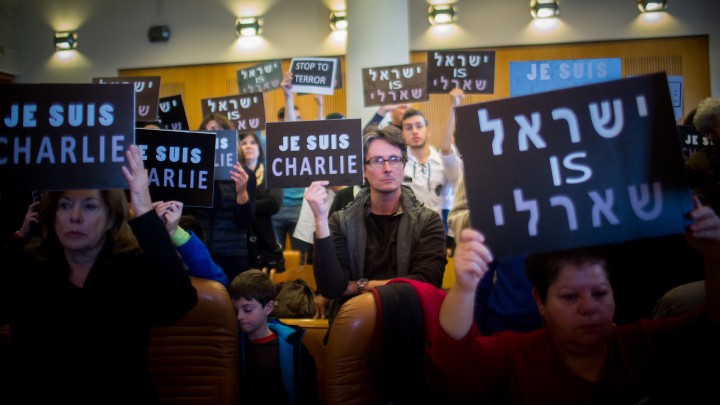
On Sunday, French leaders pledged their unwavering commitment to a united and free France, and hordes of citizens poured into Paris’s iconic cobblestone streets to march against extremism. It had been five days since two armed madmen stormed into the offices of Charlie Hebdo, a satirical newspaper in Paris known for its commitment to pushing the boundaries of free expression, and slaughtered 12 men. It had been two days since those same Islamist terrorists were tracked to a printing warehouse outside of Paris, where they barricaded themselves inside and took a hostage; and another terrorist blazed into a kosher supermarket, killed four Jewish men and held dozens of pre-Shabbat shoppers at gunpoint in a bloody show of solidarity.
But while the world reacted in shock to the string of attacks — which ended Friday afternoon with the killings of the three gunmen by French security forces — and the hashtags of #JeSuisCharlie (I am Charlie) and #JeSuisJuif (I am a Jew) began wildly trending across the twittersphere, French Jewish grief was mixed with bleak resignation. This was a bloody week for Jews in France, yes, but Jews in France have been decrying local anti-Semitism for years.
In 2012, children were slaughtered at a Jewish school in Toulouse. Men with visible yarmulkes are routinely harassed on the subways and on the street. This summer, as Israel waged yet another offensive against Hamas and other Gaza terror groups in an attempt to stop rockets from raining down on its cities and destroy tunnels dug under its border, anti-war rallies across France spiraled into mass orgies of anti-Semitic slogans and hate.
“The sense of insecurity in the French Jewish community is very profound, and the primary motivating factor is obviously the rise of anti-Semitism in recent years, spurred by the Toulouse attack and the attack last year at the museum in Brussels, but also by a more prevalent lower-level sense that people can’t be openly Jewish in the streets of France,” said Avi Mayer, a spokesperson for the Jewish Agency.
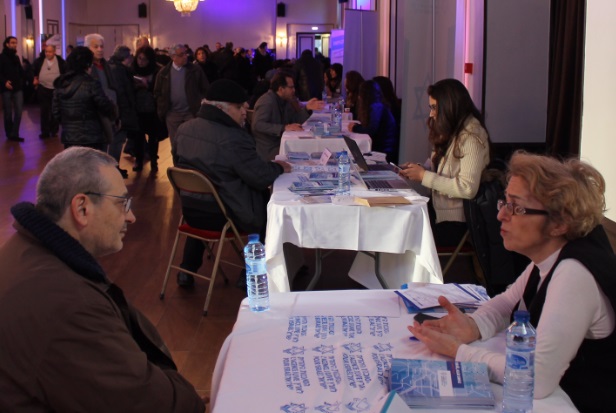
The mood in France, coupled with a slowing economy, has created a tidal wave of interest in immigration to Israel, Mayer says. Aliyah fairs are packed. Call lines to the Jewish Agency are jammed, and French-speaking staffers have been added to handle the volume. An aliyah fair held on Sunday in central Paris, which had been planned weeks ago, saw hundreds of attendants.
At the same time, Mayer points out, the Jewish Agency has established a fund to help ramp up security at Jewish sites around France. The goal, he says – in comments echoed by Jewish Agency Chairman Natan Sharansky earlier Sunday – is not to empty France of its Jews and bring them all to Israel. It is to help the French Jewish community thrive, and also promote Israel as the homeland that is always waiting, should Jews choose to join it.
“This is a principled stance,” he says. “We believe that Jewish communal life should be strong all over the world, and people should come [to Israel] from a position of strength.”
But Stephane Halimi, a 38-year-old who grew up in Paris and made aliyah in 2013 with his 10-year-old son, says it’s too late to talk of positions of strength. He now lives in Netanya and runs an accounting firm, as well as managing several Facebook pages for the French community in Israel. The largest page, “Olim Hadashim Francophone” has 9,000 members.
“The government [of France] has been too lax for too many years, and left the Jews of France in danger with the rise of anti-Semitism from the Muslims,” he says. “The greatest danger is not the far right, but the Muslims. I really hope the Jews of France will open their eyes and see that our future is here in Israel, with a government that protects the people.”
Halimi has almost no family left in France; aside from a cousin that he is encouraging to come to Israel soon, the rest of his family has all also made aliyah. When he heard of the supermarket attack on Friday, he also was not shocked.
“I have known since the school shooting in Toulouse that the Jewish community in France will never be safe,” he says, adding that it was that 2012 attack that prompted him to consider aliyah for the sake of his son. “I was not surprised. The question to be asking is when the next attack will be.”
Mendel Frankel, a 23-year-old marine biology student who lives in Hadera and made aliyah two years ago, doesn’t have the same family support as Halimi. His parents and sister are still in Nice, his hometown, and his sister isn’t interested in moving to Israel. His parents do want to come, but at their age – late 50s, with an established business in France, no knowledge of Hebrew and a strong community of friends and neighbors they are comfortable with – moving to a new country is much more daunting.
Frankel speaks of his high school days in Nice with sadness, describing regular taunts and threats from Arabs on the street, occasional fistfights, and constant uncertainty. The Jews of France must change things, he says. But while he supports those who want to leave and join him in Israel, he also believes some need to stay behind and fight the rising tide of extremism.
“It’s easy to come to Israel and leave the problem,” he says. “But there are people who are Jewish who like France, and want to stay there. They need to change things, but they will need the wider French community to help them.”
Gawsewitch points out that anyone who thinks that Islamic fundamentalism is only a Jewish problem is deluding themselves. “Look at what’s going on,” she urges. “Look at Sydney. Look at all of Europe. It’s not just Jews. We need to fight against these terrorists.”
As for her friends and family that she left behind in France, she says that she, too, would love to see them join her in Israel. But she also supports them staying behind. “We shouldn’t be scared to live in our country. I don’t think that the right solution is to come to Israel because you are afraid of something. You have to be ready to come to Israel, and for the right reasons.”






The Times of Israel Community.