

Pro-Israel Londoners say they overwhelmed anti-Liberman demonstrators
In the Knesset, meanwhile, Anglo-Jewish leaders reject notion that UK is inhospitable to Jews
 Add ToI as a Preferred Source on Google
Raphael Ahren is a former diplomatic correspondent at The Times of Israel.
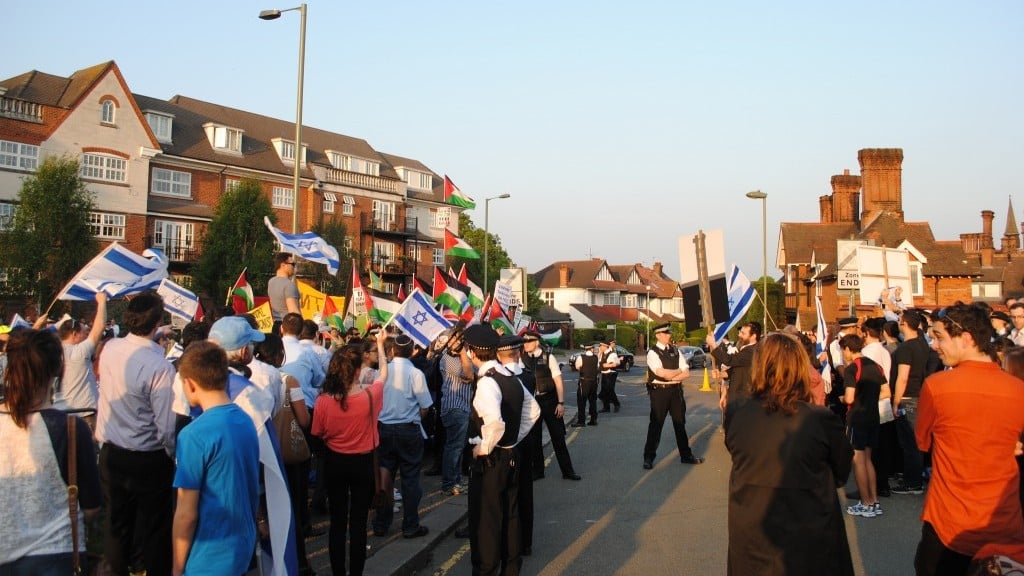
Pro-Israel demonstrators on Tuesday evening say they overwhelmed pro-Palestinian groups who were protesting Israeli Foreign Minister Avigdor Liberman’s visit to London.
Hundreds of Israeli-flag-waving supporters faced off with pro-Palestinian protesters in the British capital’s predominantly Jewish Hendon neighborhood.
Anti-Liberman groups had announced earlier this week that they planned to stage a protest outside his speaking engagement, which led the British Israel Coalition, a two-year-old pro Israel advocacy group, to call for an “emergency” counter-protest.
“At first there were 50 of them and 50 of us, but a few hours later, our numbers had swelled to 200 proud supporters of Israel, including Christians and Muslims,” Hasan Afzal, a spokesperson for British Muslims for Israel, said. “The anti-Israel crowd was actually turned back… The local residents who joined us struck a powerful blow against those who intimidate Jews and supporters of Israel.”
Ari Soffer, the director of the British Israel Coalition, who organized the protest, said the fact that local residents joined their demonstration helped them outnumber the anti-Israel protestors “three-to-one.”
Statements by the pro-Palestinian protestors seem to confirm this account. On the accompanying notes to a video of the demonstration, one activist wrote: “Naturally we went to oppose [Liberman’s visit]. Hundreds of [Israel-friendly] counter protesters were sadly defending ethnic cleansing, chanting ‘IDF! IDF!’ ‘Go back where you came from”… and ‘Pakistan is an apartheid state.’ At the end of the protest, Police wanted us to go back to the Underground station in one group so the counter-protesters couldn’t attack us.”
Liberman himself on Tuesday met with his British counterpart, William Hague. Besides discussing the Iranian threat and other political issues, the foreign minister also asked Hague to help stop anti-Israel activities on UK university campuses.
Meanwhile, on the same day the demonstration took place in London, back in Jerusalem the Knesset discussed the “anti-Israel climate in the UK.”
In a session of the Knesset subcommittee on ties between Israel and the Jewish world, leaders of the British Jewish community tried to dispel the myth that their country has become inhospitable for Jews.
Mick Davis, the chair of the United Jewish Israel Appeal (UJIA) and the Jewish Leadership, for instance, reiterated that, despite all the rumors, there is no actual academic boycott of Israel. He mentioned that a Jew was elected as vice president of the National Student Union and that “Jews do not need to fear walking along the streets of London.” The chief rabbi gets a full 20 minutes for his televised Rosh Hashana address, while the Archbishop of Canterbury gets only 10 minutes and the Queen only five, he said.
Davis also said that three quarters of Jewish children in Britain study in Jewish schools. A survey has shown, he added, that 82% of Jews in the UK feel that Israel plays a “central role” in their identity, 95% have visited Israel and 90% consider Israel as the “land of their forefathers.”
“We are very impressed by the depth of commitment of UK Jews to Israel and to Jewish life,” said sub-committee chair MK Einat Wilf (Independence). “This combination of a committed community and the far from simple challenges turns the UK into a unique laboratory for developing insights on actions that might help in the diplomatic battle. The UK Jewish community has in the past displayed a high level of innovation in responding to difficult challenges and we can assume that this will be repeated in the current diplomatic battle for Israel and the Zionist idea.”








The Times of Israel Community.