

Frenkel says PM insisted he head central bank
Newly appointed governor ready to ‘take up the baton,’ promises Israel has much to show the world
 Add ToI as a Preferred Source on Google
The man appointed to take over as governor of the Bank of Israel said that Benjamin Netanyahu was the driving force behind his decision to accept the post because the prime minister wouldn’t take “no” for an answer.
Speaking at a press conference on Monday at the Knesset, following the Sunday announcement of his appointment, Jacob Frenkel said he wasn’t sure about taking over the post — for a third stint — after current governor Stanley Fischer retires later this week.
“It is no secret that I hesitated a lot, but it is also no secret that when you have a prime minister who is determined and won’t accept any other answer other than the one he is driving for, you must not stand in his way,” he said.
“I am moved, and I really want to give thanks for the great faith that is expressed in this recommendation for my appointment,” Frenkel said as he sat alongside Netanyahu, Finance Minister Yair Lapid, and Fischer.
Netanyahu explained that, together with Lapid, he decided on Frenkel out of a selection of potential candidates because “he is the most exceptional of the exceptional.”
“I think that Frenkel can continue the tradition of monetary stability,” he said.
Lapid, who reportedly preferred a different candidate, said that Fischer’s achievements with the economy are “beyond words,” but now the task passes to Frenkel.
“Part of your job is to be the responsible adult,” he joked, and added that Frenkel is his neighbor — a situation that will make it easier for budget protesters who will be able to demonstrate outside both their homes at the same time.
Frenkel praised recent management by Fischer and noted that Israel’s economy has weathered several crises “and not just because we’re on the right side of the ocean, but because the policies stopped the floods before they overwhelmed the shores.
“Holding back the storms reflected responsible policies in financial matters and also very responsible policies in the Bank of Israel,” he said, and added that he is proud to take up the baton.
“We are very lucky that the sprinter who is passing me the baton made such a large lead that I will have time to learn the material, get some sleep, and then continue with the race,” he added, and promised to show the world some of the “amazing things” that Israel has so far kept to itself.
“I will bring the seven decades of experience that I have, in order to achieve that goal,” he asserted and, in what was apparently a nod to the recently proposed austerity budget, added that success will require harmony, cooperation, and mutual understanding.
Fischer, who will leave the post after eight years, recalled that he first became acquainted with Frenkel when they were both students in Chicago.
“We have someone who has proved himself several times in more than one role and I am sure that he will continue in that way to serve the state of Israel, and guard the Israeli economy,” Fischer said.
After lengthy speculation over who will succeed Fischer, Frenkel was announced Sunday as the next governor of the Bank of Israel, 13 years after leaving the job.
Netanyahu and Lapid chose Frenkel, who headed the Bank of Israel for almost a decade between 1991 and 2000 and who currently heads the prestigious banking firm JPMorgan Chase, as the man to run Israel’s top economic institution.
The appointment will be submitted to the committee headed by Judge Yaakov Turkel for approval and then to the Cabinet.
Educated at the Hebrew University of Jerusalem and the University of Chicago, the 70-year-old economist has held a number of key positions in top international firms, including AIG and Merrill Lynch. He has also worked in leading international finance organizations, including the International Monetary Fund. He won the Israel Prize for economics in 2002.
Fischer, who has held the post since 2005, announced his resignation from the Bank of Israel in January, two years before the scheduled end of his second term. He is set to step down later this month, and Netanyahu was under growing pressure to find a replacement.
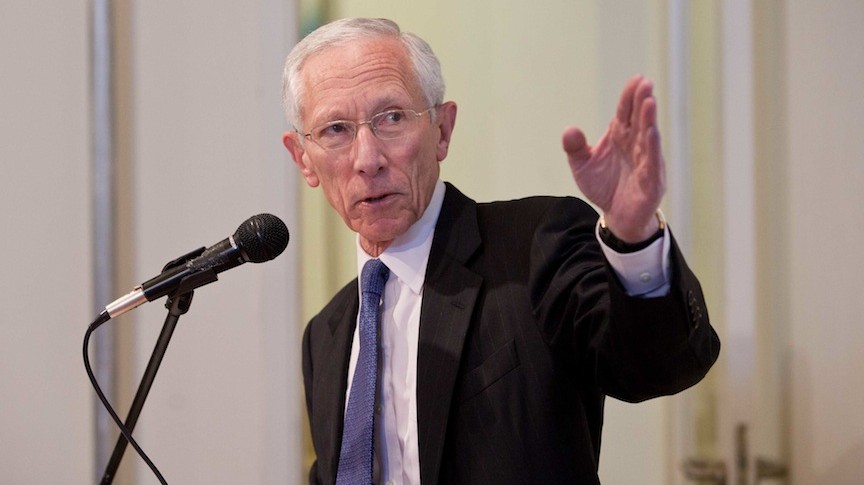
At the time, Yuval Steinitz, then the finance minister, thanked the noted economist for his service as head of the central bank, calling the outgoing governor “an asset not only to Israel’s economy, but also to its international image.”
Fischer, 69, was born in Northern Rhodesia (now Zambia) and lived in Southern Rhodesia (modern Zimbabwe) before his family moved to the United States. He served as the chief economist at the World Bank in the late 1980s and as first deputy managing director of the International Monetary Fund from 1994 to 2001.
Fischer is widely credited with having protected the Israeli economy from the worst of the global financial ravages. Earlier this month, when he took his leave of the Knesset Finance Committee, he won praise from government and opposition MKs.









The Times of Israel Community.