

Iran and Syria struggle for attention
Yemeni president to step down after 33 years in power, and an Al-Jazeera columnist warns of a looming Israeli transfer of Arabs
 Add ToI as a Preferred Source on Google
Elhanan Miller is the former Arab affairs reporter for The Times of Israel
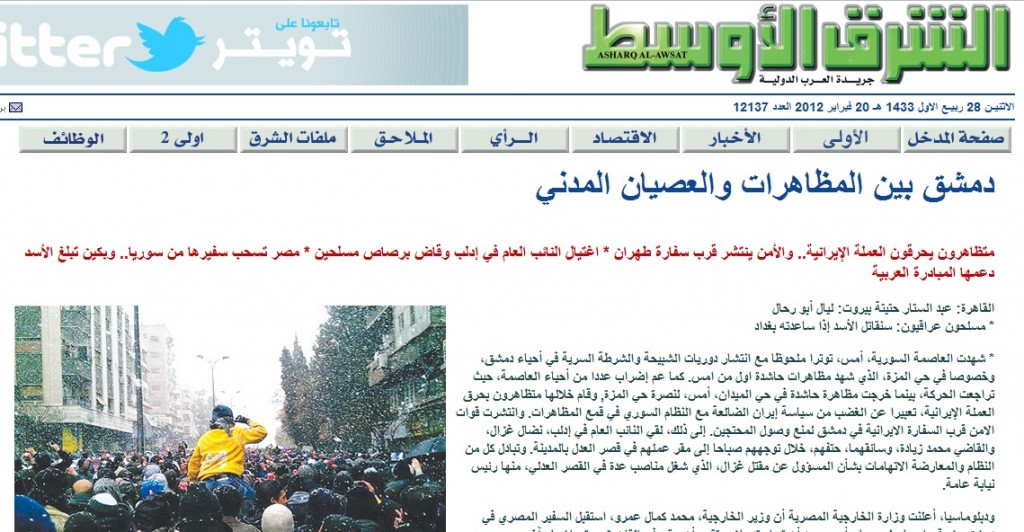
The Arab press is focusing its gaze on Damascus Monday, where demonstrations against the Assad regime are taking place for the first time since the start of protests in Syria 11 months ago.
“Damascus between protests and civil disobedience,” declares the headline of A-Sharq Al-Awsat, a Saudi-owned daily published in London. The report tells of government-backed gangs (called Shabiha in the local dialect) and secret police deploying throughout Damascus. Police forces were placed around the Iranian Embassy to prevent protesters from attacking it. The daily tells of an armed Iraqi group on the Syrian border, the “Army of free Iraqis,” which announced it would fight alongside the Syrian opposition if the Iraqi government were to support the Assad regime.
Meanwhile, Al-Hayat, a liberal daily published in London, warns of a looming “massacre” in Homs, which has been heavily bombarded by government forces for over a week. A spokesman for the Coordinating Group in Damascus told the daily that shops remained closed on Sunday in many parts of the Syrian capital. The daily said that Egypt calling back its ambassador to Damascus could place further political pressure on Syria.
Dubai-based Arabic news channel Al-Arabiya presents an amateur “documentary” by citizens of Idlib on the government crackdown there. The footage, accompanied by commentary, depicts local protests with sniper fire and a victim seconds after being shot dead, blood seeping from his head.
Iran sends two ships to Syria; limits oil export
Iran is the second issue topping Arabic news on Monday. A-Sharq Al-Awsat leads with the Iranian decision to stop exporting crude oil to Britain and France. The daily quotes an anonymous Western diplomat who told the BBC that Iran is preparing to expand its underground nuclear facility in Qom, days before UN inspectors arrive in Tehran.
Al-Hayat is leading with the American attempts to dissuade Israel from attacking Iran unilaterally, defining Iran as a “rational player.” Israel insists, however, on maintaining independence from the US in its decision on a preemptive strike.
Meanwhile, much attention is being given to the two Iranian battleships floating off the Syrian coast. Al-Arabiya reports that the Iranians are both blocking Syrian opposition transmissions and eavesdropping on them through Arab satellites.
Hard-line Arabic daily Al-Quds Al-Arabi published in London says that Israel is closely following the Iranian ships, quoting Israeli Foreign Ministry spokesman Yigal Palmor. The daily reports that the two Iranian ships are the first to cross the Suez Canal since 1979.
Qatar-based news channel Al-Jazeera, a bit more optimistic, leads with Iran’s willingness to enter negotiations on its nuclear program. The channel reports that Iran stopped selling oil to Britain and France as a “warning” to other European countries, such as Greece, Italy and Spain, who took part in a recently announced European oil boycott on Iran.
Yemen says goodbye to Saleh
Yemenis go to the polls Tuesday to vote out Ali Abdullah Saleh, who has ruled the country since 1978.
Al-Hayat notes that Yemen is the first Arab Spring country to witness transfer of power through a political deal such as the one signed by Saleh and the opposition. Saleh is scheduled to return to Yemen Thursday and hand over the reigns of power to his deputy Abd Rabbo Mansour Hadi in what the daily dubs an “unprecedented move.” Hadi is the only candidate nominated to replace Saleh.
Al-Hayat editor Ghassan Charbal writes that Hadi seems unenthusiastic about assuming the role of president after serving as vice president for years, and was not pulling any strings behind the scenes like Iraqi dictator Saddam Hussein did as vice president.
“It is likely that he [Hadi] never thought this moment would arrive,” writes Charbal.
“The question today is no longer about the future of Ali Abdullah Saleh but about the future of Yemen. About its unity and stability. And about its ability to pick up the pieces of the shattered country.”
Al-Jazeera analyst: Israel is preparing for ‘transfer’
Al-Jazeera analyst Nawwaf Zaru argues on Monday that Israel’s political scene is unanimous on questions of Israel’s “Jewishness,” leading Israel to prepare for a mass transfer of Arabs eastward, to what he claims Israelis call “the alternative homeland.”
Zaru argues that this is not a case of opportunistic Israeli media or an attempt to frighten the Jordanians, but rather a “genuine and dangerous” reality.
Zaru quotes a range of Israelis in academia, journalism and the media, such as professor Arnon Soffer, journalist Yaron London and ex-general Shlomo Gazit, all warning of a demographic “time bomb.”
He links these views to a religious, biblical point of view which views the entire promised land of Israel from the Euphrates to the Nile as a feasible political reality.
“We are convinced that Jordanian national unity remains the bastion on which the political and Torah-inspired Zionist agendas will shatter,” writes Zaru.








The Times of Israel Community.