

400 IDF vets give back Gaza war pins over failure to return soldiers’ remains
Soldiers who fought in 2014 operation accuse Netanyahu of abandoning slain servicemen whose bodies are held by Hamas
 Add ToI as a Preferred Source on Google
Judah Ari Gross is The Times of Israel's religions and Diaspora affairs correspondent.
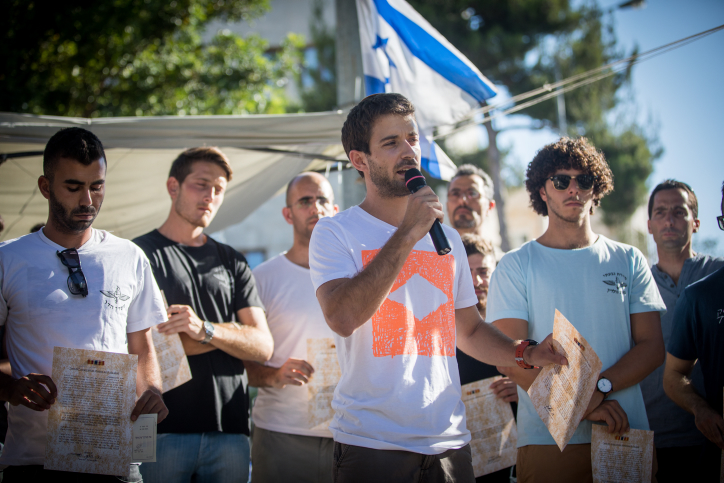
Some 400 Israeli veterans of the 2014 Gaza war returned the pins they received for fighting in the operation to Prime Minister Benjamin Netanyahu on Sunday, in protest of the government’s failure to return the remains of two soldiers, which are being held by the Hamas terrorist group.
“A pin that doesn’t stand for values doesn’t mean anything,” said Staff Sgt. (res.) Or Cohen, one of the organizers of the event, on the street outside the prime minister’s official residence.
“The issue of the missing [soldiers] is a bleeding wound,” Cohen said, reading from a letter that the 400 soldiers signed, in which they detailed their reasons for returning the pins, which were given to everyone who served in the IDF during the time of the war.
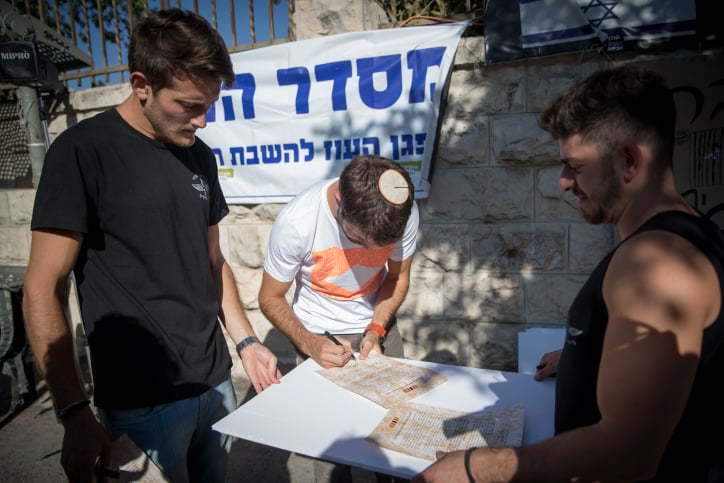
Approximately 20 veterans of the 2014 campaign, known in Israel as Operation Protective Edge, took part in the ceremony, in which they deposited their striped pins outside the entrance to the residence, on Jerusalem’s Balfour Street. The ceremony coincided with the four-year anniversary of the start of the war on July 8, 2014.
“We are here to remind the prime minister and members of the security cabinet that Operation Protective Edge won’t end until Lt. Hadar Goldin and Staff Sgt. Oron Shaul are returned,” the letter read.
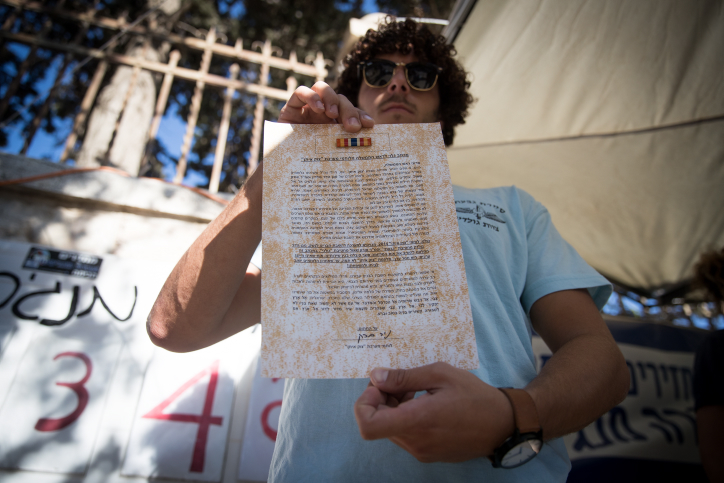
The soldiers’ missive said the government had failed to uphold its obligations to the soldiers it sent to war.
“According to this trust, every soldier who goes to the battlefield by your direct order will return from the front, living or dead,” the letter read.
The soldiers said the government is violating that trust “day after day, time after time.”
Goldin’s twin brother, Tzur, who also fought in the 2014 war, took part in the event, but stressed that he was only representing himself and not the rest of his family.
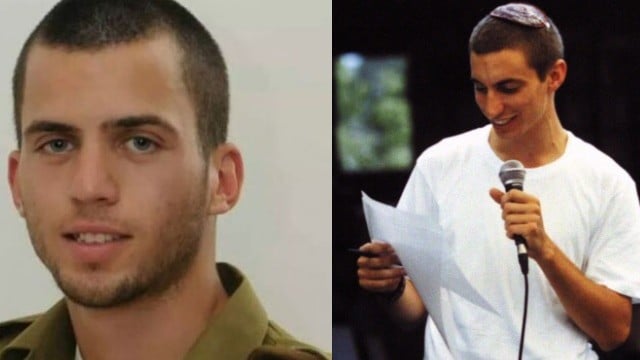
During the 50-day operation, the bodies of the two slain IDF soldiers were taken by Hamas in Gaza, where they remain today.
Shaul was killed on July 20 along with a six other soldiers, in an attack on their armored personnel carrier in the Shejaiya neighborhood of Gaza City. Hamas fighters dragged away Shaul’s body, initially prompting the belief that he was being held alive, but the military later determined that he had been killed in the attack. On August 1, Goldin was killed and captured in the southern Gaza city of Rafah in what would later be dubbed “Black Friday.”
For the past four years, Israel has been attempting to retrieve the remains of Goldin and Shaul, as well as bring back two living Israelis, Avera Mengistu and Hisham al-Sayed, from captivity in Gaza, but negotiation efforts have been to no avail.
The families of the fallen soldiers have been publicly critical of the government’s policies toward Gaza, calling for Israel to make aid deliveries to the beleaguered coastal enclave contingent upon the return of their sons’ remains.
Tzur noted that the world’s attention has again turned to Gaza and its humanitarian crisis, providing an opportunity to put pressure on Hamas to return the bodies of his brother and Shaul in exchange for reconstruction funds.
“There’s an opportunity that we won’t get again,” he said in a speech, stressing that he was not calling for a prisoner exchange, which Israel has done in the past to free captives.
In their letter, the soldiers also called for Israel to make humanitarian assistance dependent on the return of Goldin and Shaul’s remains. “Humanitarianism in exchange for humanitarianism,” they said.




The Times of Israel Community.