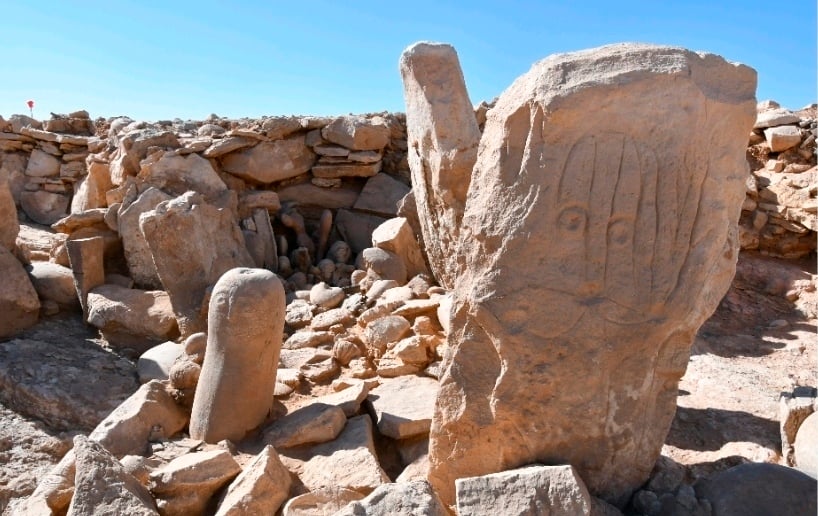
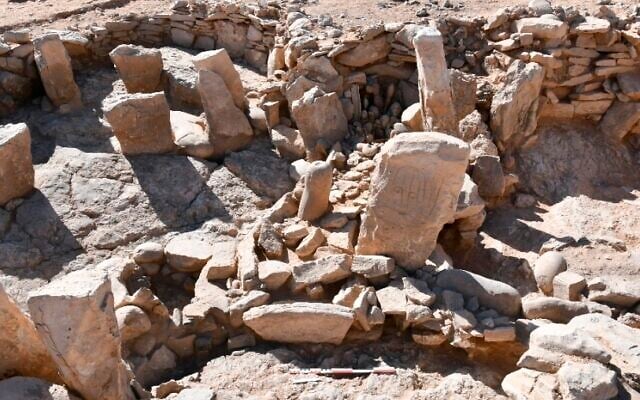
This photo provided by Jordan Tourism Ministry shows two carved standing stones at a remote Neolithic site in Jordan’s eastern desert. A team of Jordanian and French archaeologists said Tuesday, Feb. 22, 2022, that it had found a roughly 9,000-year-old shrine. The ritual complex was found in a Neolithic campsite near large structures known as “desert kites," or mass traps that are believed to have been used to corral wild gazelles for slaughter. (Tourism Ministry via AP)
AMMAN, Jordan (AP) — A team of Jordanian and French archaeologists said Tuesday that it had found a roughly 9,000-year-old shrine at a remote Neolithic site in Jordan’s eastern desert.
The ritual complex was found in a Neolithic campsite near large structures known as “desert kites,” or mass traps that are believed to have been used to corral wild gazelles for slaughter.
Such traps consist of two or more long stone walls converging toward an enclosure and are found scattered across the deserts of the Middle East.
“The site is unique, first because of its preservation state,” said Jordanian archaeologist Wael Abu-Azziza, co-director of the project. “It’s 9,000 years old and everything was almost intact.”
Within the shrine were two carved standing stones bearing anthropomorphic figures, one accompanied by a representation of the “desert kite,” as well as an altar, hearth, marine shells and miniature model of the gazelle trap.
Get The Times of Israel's Daily Editionby email and never miss our top stories
The researchers said in a statement that the shrine “sheds an entire new light on the symbolism, artistic expression as well as spiritual culture of these hitherto unknown Neolithic populations.”
This photo provided by Jordan Tourism Ministry shows two carved standing stones at a remote Neolithic site in Jordan’s eastern desert. A team of Jordanian and French archaeologists said Tuesday, Feb. 22, 2022, that it had found a roughly 9,000-year-old shrine. The ritual complex was found in a Neolithic campsite near large structures known as “desert kites,” or mass traps that are believed to have been used to corral wild gazelles for slaughter. (Tourism Ministry via AP)
The proximity of the site to the traps suggests the inhabitants were specialized hunters and that the traps were “the center of their cultural, economic and even symbolic life in this marginal zone,” the statement said.
The team included archaeologists from Jordan’s Al Hussein Bin Talal University and the French Institute of the Near East. The site was excavated during the most recent digging season in 2021.
Advertisement
Help us report truthfully on social media
As a multimedia journalist, my job is to take the quality, fact-based journalism produced by The Times of Israel newsroom and make it accessible across every platform — from Instagram posts to podcasts to short-form videos.
This is how many, especially young people, consume news these days. But misinformation is rampant on social media. Our team at ToI produces accurate, responsible short-form reporting on Israel and the Jewish world.
If you believe in the importance of factual social media journalism, please consider joining our reader support group, The Times of Israel Community. Your financial support is essential to sustain responsible multimedia reporting.
We’re really pleased that you’ve read X Times of Israel articles in the past month.
That’s why we started the Times of Israel - to provide discerning readers like you with must-read coverage of Israel and the Jewish world.
So now we have a request. Unlike other news outlets, we haven’t put up a paywall. But as the journalism we do is costly, we invite readers for whom The Times of Israel has become important to help support our work by joining The Times of Israel Community.
For as little as $6 a month you can help support our quality journalism while enjoying The Times of Israel AD-FREE, as well as accessing exclusive content available only to Times of Israel Community members.
Thank you, David Horovitz, Founding Editor of The Times of Israel


 Add ToI as a Preferred Source on Google