

Clinton, Sanders in ‘virtual tie’; Cruz sweeps Trump in Iowa race
Getting out youth vote to garner 49 percent, Jewish candidate declares start of ‘political revolution’; Trump concedes caucuses to conservative rival; candidates look toward New Hampshire
 Add ToI as a Preferred Source on Google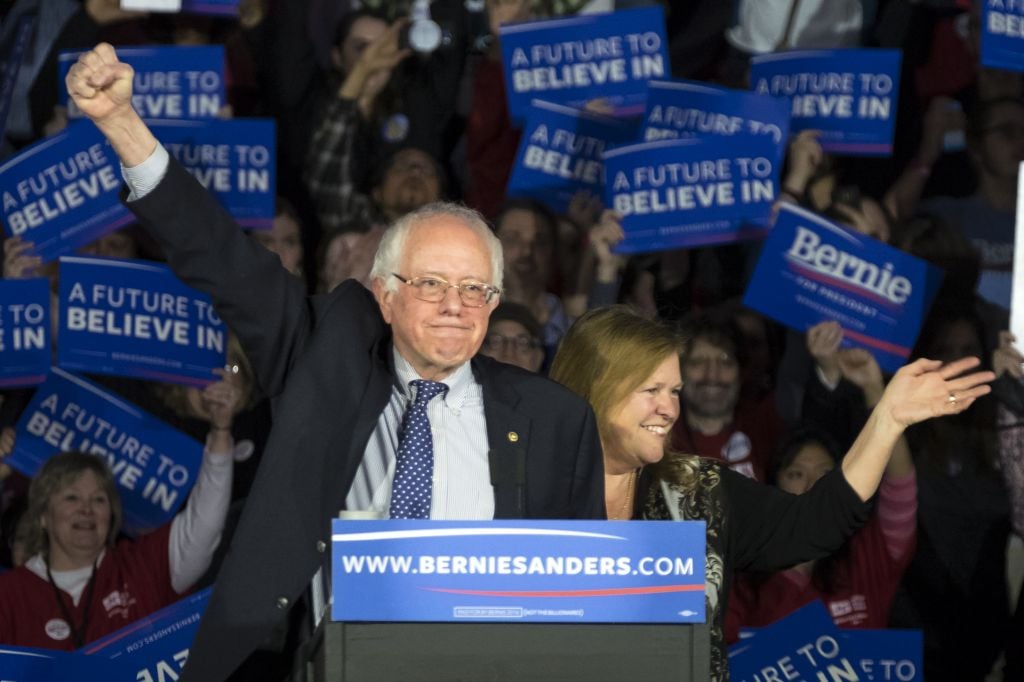
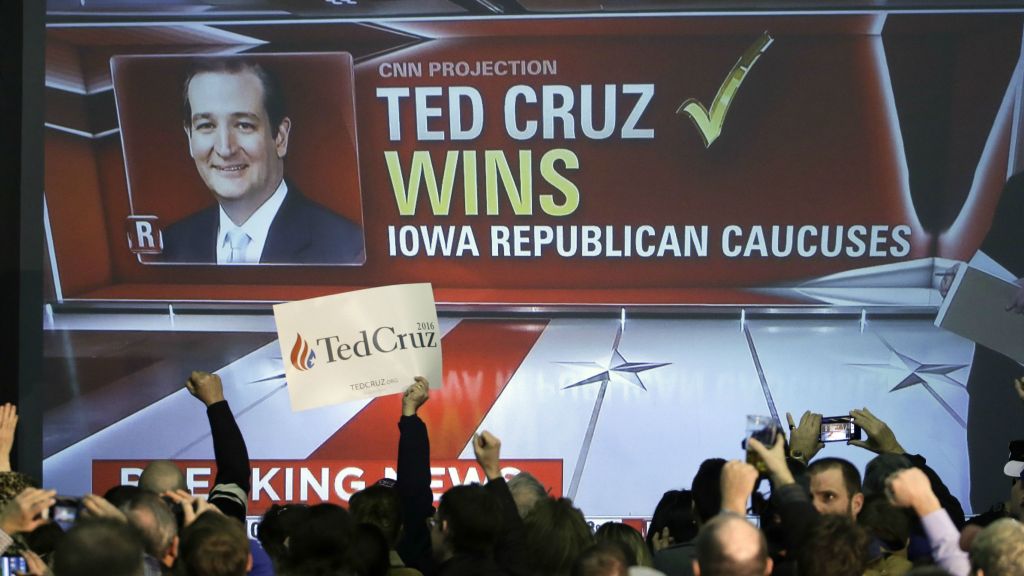
DES MOINES, Iowa — Democratic candidates Hillary Clinton and Bernie Sanders were deadlocked in a tight race as Texas Sen. Ted Cruz swept to victory in Iowa’s Republican caucuses Monday.
“To God be the glory!” exclaimed Cruz, claiming victory with 27.7 percent of the vote and staking his claim to be the new standard bearer of the right.
“Tonight is a victory for courageous conservatives across Iowa and all across this great nation,” he said, clearly pleased that his heavy investment in campaigning in the deeply conservative state had paid off.
For Trump, a modest vote tally — just above 24% — raised deep questions about whether showmanship can take him all the way to 1600 Pennsylvania Avenue.
Sanders, a Jewish self-styled socialist once thought a black horse pick, declared himself locked in a “virtual tie,” as Clinton held a razor-thin 49.8% lead to Sanders’ 49.6%, with nearly all precincts reporting.
The Vermont senator congratulated his chief rival for waging a “very vigorous campaign” in the first contest of the 2016 election.
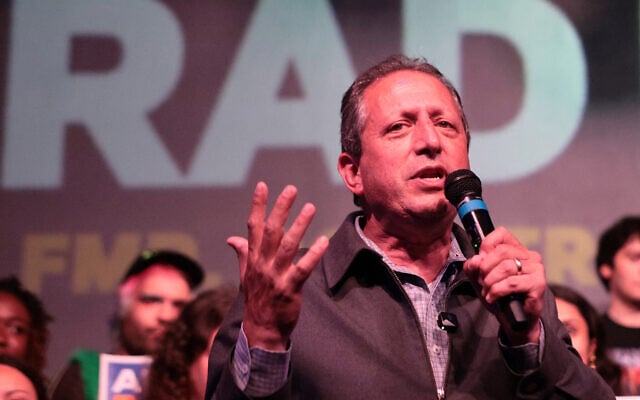
“What Iowa has begun tonight is a political revolution,” said Sanders, who has focused on building a movement around campaign finance reform and a more equitable society.
“So you guys ready for a radical idea? Well, so is America,” Sanders said to cheers. “We are going to create an economy that works for working families not just the billionaire class.”
Sanders — who calls himself a democratic socialist — said he came to Iowa nine months ago with no money, name recognition or political organization. He said he took on “the most powerful political organization in the United States of America” — namely the Clinton family.
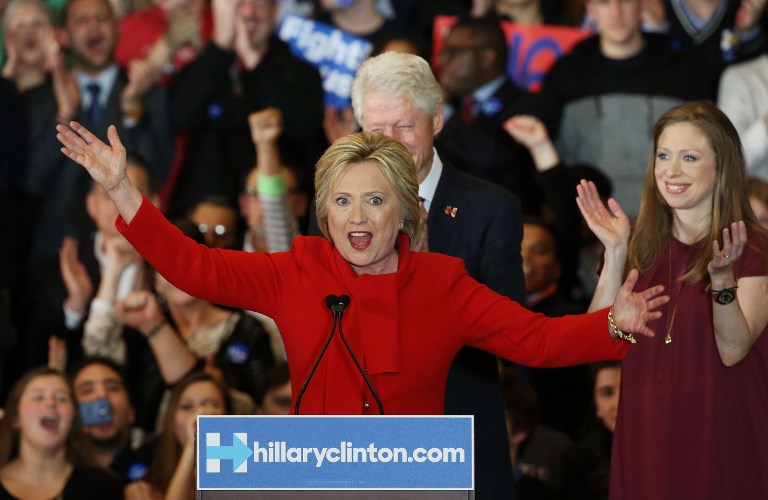
Clinton took the stage at her own campaign rally saying she was “breathing a big sigh of relief” but with the Democratic race too close to call. Well aware that even a slim victory over Sanders would reinvigorate questions about her candidacy, she foresaw a long race to come.
“It is rare that we have the opportunity we do now, to have a real contest of ideas, to really think hard about what the Democratic Party stands for and what we want the future of our country to look like,” Clinton said.
The Iowa caucuses kicked off voting in the 2016 presidential race, a tumultuous contest with unexpected candidates challenging both the Republican and Democratic establishments.
Candidates faced an electorate deeply frustrated with Washington. While the economy has improved under President Barack Obama, the recovery has eluded many Americans. New terror threats at home and abroad have increased national security concerns.
The victory of Cruz, a fiery conservative loathed by his own party’s leaders, over Trump was a testament to his massive get-out-the-vote operation in Iowa and the months he spent wooing the state’s influential conservative and evangelical leaders. It was also a harsh blow to Trump, the supremely confident real estate mogul who has riled the Republican field for months with controversial statements about women and minorities.
“Iowa has sent notice that the Republican nominee and next president of the United States will not be chosen by the media, will not be chosen by the Washington establishment,” Cruz said.
Trump, the supremely confident real estate mogul, sounded humble in defeat, saying he was “honored” by the support of Iowans. And he vowed to keep up his fight for the Republican nomination.
“We will go on to easily beat Hillary or Bernie or whoever the hell they throw up,” Trump told cheering supporters.
Trump barely edged out Florida Sen. Marco Rubio, who took 23% and cast his stronger-than-expected showing as a victory.
“We have taken the first step, but an important step, to winning the nomination,” Rubio said at a campaign rally in Des Moines. He congratulated Cruz, saying he’d “earned his victory.”
Voters at Republican caucuses indicated they were deeply unhappy with the way the federal government is working. Half said they were dissatisfied and 4 in 10 said they were angry, according to surveys conducted by Edison Research for The Associated Press and the television networks.
Six in 10 Democratic caucus-goers wanted a candidate who would continue Obama’s policies. Young voters overwhelmingly backed Sanders, with more than 8 in 10 caucus-goers under the age or 30 backing the Vermont senator. Clinton won the majority of voters over age 45.
Both parties were drawing new voters. About 4 in 10 participants in each party said they were caucusing for the first time.
In Iowa, which has for decades launched the presidential nominating contest, candidates also faced an electorate that’s whiter, more rural and more evangelical than many states. But, given its prime leadoff spot in the primary season, the state gets extra attention from presidential campaigns.
Iowa has decidedly mixed results in picking eventual nominees. The past two Republican caucus winners — former Arkansas Gov. Mike Huckabee and former Pennsylvania Sen. Rick Santorum — faded as the race stretched on. But Obama’s unexpected 2008 victory was instrumental in his path to the Democratic nomination, easing the anxieties of those who worried the young black senator would struggle to win white voters.
Clinton was seeking to overcome the ghosts of her loss to Obama in 2008. Her campaign spent nearly a year building a massive get-out-the-vote operation in Iowa.
Yet she faced an unexpected challenge from Sanders, who drew big, youthful crowds across the state and his campaign was hoping for high turnout.
Cruz modeled his campaign after past Iowa winners, visiting all of the state’s 99 counties and courting influential evangelical and conservative leaders. He spent the closing days of the Iowa campaign focused intensely on Rubio, trying to ensure the Florida senator didn’t inch into second place. Rubio is viewed by many Republicans as a more mainstream alternative to Trump and Cruz.
Rubio, who previously lashed back at criticism, adopted the same reflective tone as many of his rivals on Monday, telling NBC that Cruz “has a very strong ground game.” He dismissed attacks against him as “politics as usual.”
The caucuses marked the end of at least two candidates’ White House hopes. Even before the results were final, former Maryland Gov. Martin O’Malley ended his longshot bid for the Democratic nomination. So did Huckabee on the Republican side.
Even as votes came in, fourth place Ben Carson was forced to deny reports he was dropping out of the race.
“Contrary to false media reports, Dr. Ben Carson is not suspending his presidential campaign, which is stronger than ever,” said campaign spokesman Larry Ross.
The threat of a snowstorm late Monday appeared to do little to deter voter turnout, though campaigns were still anxious that the weather could hinder the hopefuls in their rush out of Iowa.
Republicans John Kasich, Chris Christie and Jeb Bush were all spending Monday night in New Hampshire — not only to get a jump on the snow but also on their competitors in a state with voters who are expected to be friendlier to more traditional GOP candidates.
While both parties caucused on the same night in Iowa, they did so with different rules.
Republicans voted by private ballot. The state’s 30 Republican delegates are awarded proportionally based on the vote, with at least eight delegates going to Cruz, seven to Trump and six to Rubio.
Democrats form groups at caucus sites, publicly declaring their support for a candidate. The final numbers are awarded proportionately, based on statewide and congressional district voting, determining Iowa’s 44 delegates to the national convention.
Even without a declared winner, The Associated Press awarded all but one of those delegates. Clinton led Sanders 22 to 21, with the remaining delegate to be awarded to the statewide winner.



The Times of Israel Community.