

Former FM insists Israel had no hand in Arafat’s death
If we’d wanted to kill him, the easiest thing would have been to prevent him leaving West Bank for treatment, says Silvan Shalom, after report claims PLO leader was poisoned
 Add ToI as a Preferred Source on Google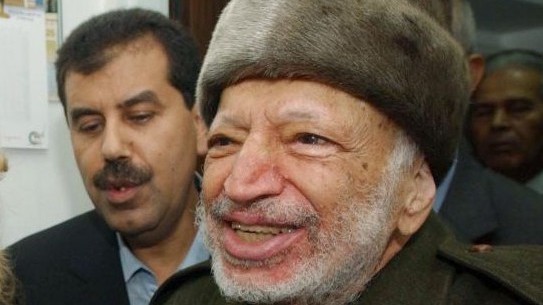
Silvan Shalom, who served as Israel’s foreign minister in 2004 when Yasser Arafat died, insisted Thursday that Israel had “nothing whatsoever” to do with the death of the Palestinian leader. Had Israel wanted to kill Arafat, Shalom said, it would have been “the simplest thing” not to permit him to leave Ramallah for medical treatment in Paris.
Shalom, currently Israel’s energy minister, was speaking to Israel Radio a day after Swiss scientists who tested Arafat’s remains said they found at least 18 times the normal level of radioactive polonium in his bones, according to an Al Jazeera America report.
Shalom, who was also deputy prime minister in the government of prime minister Ariel Sharon at the time of Arafat’s death in November 2004, recalled that Israel had placed Arafat “under curfew,” confining him to the Palestinian Authority’s Muqata headquarters in Ramallah for his alleged fostering of Second Intifada suicide bombings and other acts of terrorism against Israel. “We never took a decision to harm him physically. We did talk about deporting him.”
When Israel was told that Arafat had been taken ill, said Shalom, there was some debate in the government about whether this was a ruse by Arafat, intended to enable him to break out of his Ramallah confinement. But “we decided to let him go to Paris. If we had wanted to harm him physically, the simplest thing would have been not to let him go to Paris.”
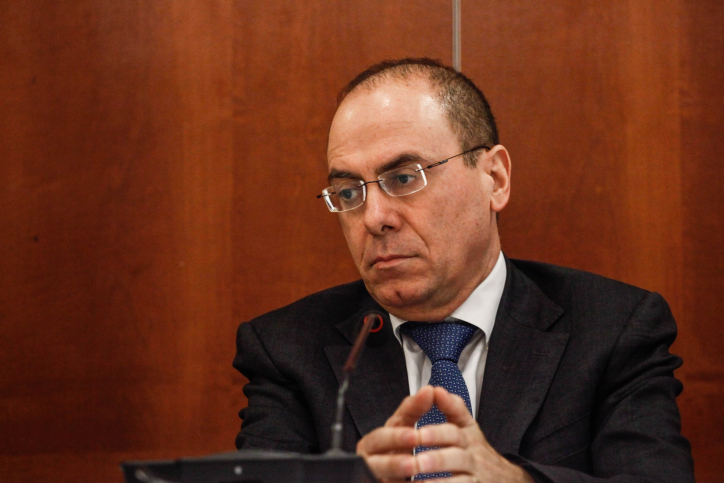
Shalom branded the report ostensibly pointing to Arafat’s death by poisoning as “superficial” and unpersuasive. But if the PLO leader was poisoned “it certainly wasn’t by Israel.”
Al Jazeera said Wednesday it obtained an exclusive copy of the 108-page report by the University Centre of Legal Medicine in Lausanne, Switzerland. “The level of polonium in Yasser Arafat’s rib… is about 900 milibecquerels,” British forensics expert Dave Barclay told Al Jazeera. “That is either 18 or 36 times the average, depending on the literature.”
And on Thursday, the Center’s Professor Francois Bochud told a news conference that the high level of polonium “by definition… indicates third party involvement… Our results offer moderate backing for the theory of poisoning.” But he added, according to the BBC: “Was polonium the cause of the death for certain? The answer is no, we cannot show categorically that hypothesis that the poisoning caused was this or that.”
In their report, the BBC added, the scientists stressed that they had been unable to reach a more definitive conclusion because of the time that had lapsed since Arafat’s death, the limited samples available and the confused “chain of custody” of some of the specimens.
An Israeli expert on radiation quoted by Ynet on Thursday said the Swiss report was “completely fabricated.” Dr. Ehud Ne’eman said there would be no traces of Polonium 210 if the poison was injected before 2004.
Last November, a leading French doctor who teaches at the Paris hospital where Arafat died told The Times of Israel, based on Arafat’s medical report, that there was “absolutely no way” the Palestinian leader was poisoned. Dr. Roland Masse, a member of the prestigious Académie de Médecine who teaches radiopathology at Percy Military Training Hospital in the Paris suburb of Clamart, where Arafat was hospitalized two weeks before his death, said the symptoms of polonium poisoning would have been “impossible to miss,” noted that Percy had tested Arafat for radiation poisoning, and revealed that the hospital specializes in the related field of radiation detection. “A lethal level of polonium simply cannot go unnoticed,” Masse said.
Arafat’s medical records concluded he died in November 2004 from a stroke “that resulted from a bleeding disorder caused by an unidentified infection,” the New York Times reported in 2005. The paper wrote at the time that the first independent review “suggests that poisoning was highly unlikely.”
Arafat’s widow, Suha, told Reuters after receiving the test results that her late husband was murdered. “We are revealing a real crime, a political assassination,” she was quoted saying. She told Al Jazeera, however, that “we can’t point a finger at anyone.”
“The French are conducting a serious investigation. It takes time.”
The report did not speculate on who was responsible for potentially poisoning the Palestinian leader, but Al Jazeera said the primary suspects are “Arafat’s Palestinian rivals or the Israeli government.”
Israel’s Foreign Ministry also emphatically rejected the findings of the report. “This story doesn’t hold water,” Foreign Ministry spokesman Yigal Palmor told The Times of Israel. The Swiss investigative team was “commissioned by an interested party,” he said.
He also cast doubt on the actual scientific value of the study because the scientists said they had only an 83 percent level of confidence that he was poisoned.
“Their conclusions are inconclusive. Either he was poisoned or he wasn’t,” Palmor said. He also said the Swiss investigative team never asked for access to the medical files of the French hospital in which the Palestinian leader died. “They can’t conclude anything if they don’t ask for access to the most basic medical files.”
Furthermore, he said, the use of a radioactive material like polonium would leave detectable traces all around the location of the suspected poisoning. “How come nobody ever found any such traces? Did they ever bother to look for them? The use of radioactive material cannot but leave a wide area of contamination that can easily be detected.”
Anticipating accusations that Israel might have tried to kill Arafat, Palmor categorically stated that “Israel has strictly nothing to do with this.”
“The use, misuse and abuse of these investigations smack of a lack of seriousness,” he said, “and have to do with an internal Palestinian feud between [Arafat’s widow] Suha on one hand and Arafat’s successor on the other.”
Raphael Ahren and the Associated Press contributed to this report.




The Times of Israel Community.