

German court to rule on banning far-right NPD party
Observers pessimistic that judges will move to blacklist now-insignificant group accused of anti-Semitism and racism
 Add ToI as a Preferred Source on Google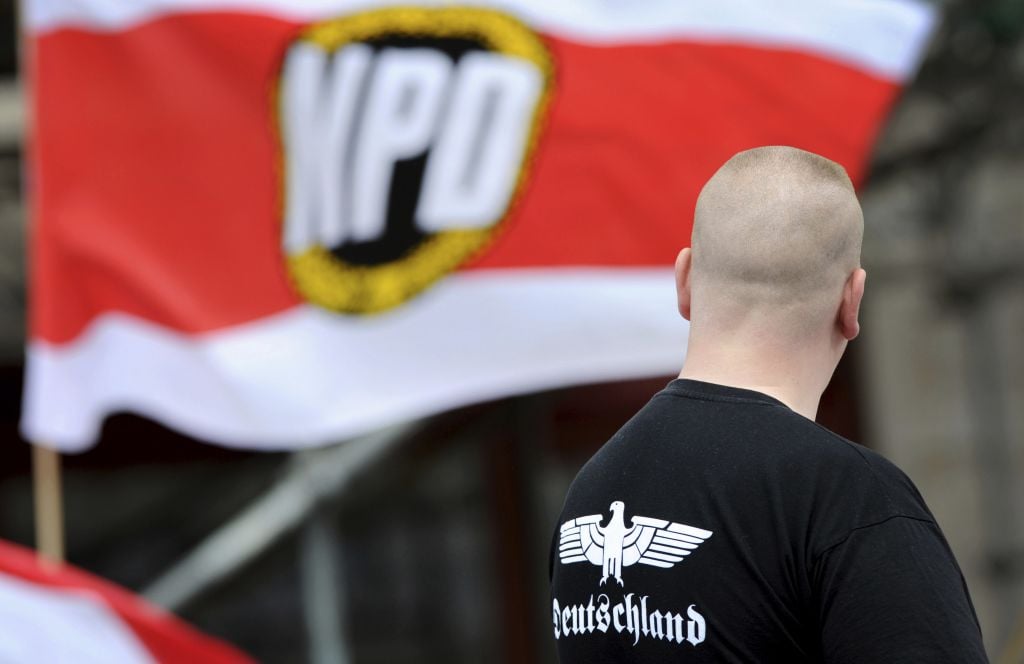
Germany’s supreme court is scheduled to announce its verdict Tuesday on lawmakers’ bid to outlaw a far-right party accused of promoting a racist and anti-Semitic agenda. It would be the first ban of its kind since 1956.
The Bundesrat, the German parliament’s upper house which represents the country’s 16 state governments, applied for the ban at the end of 2013. It’s the second attempt to ban the National Democratic Party, better known by its German acronym NPD.
Officials maintain the party violates the German Constitution and are keen to cut off NPD’s state funding, to which all political parties are entitled.
The Federal Constitutional Court, which held three days of hearings last March, has not indicated which way its verdict will go, and experts differ on whether the NPD poses enough of a threat to justify a ban. Only two parties have been outlawed in West Germany and reunited Germany — the neo-Nazi Socialist Reich Party in 1952 and the German Communist Party in 1956.
The constitution states: “Parties that, by reason of their aims or the behavior of their adherents, seek to undermine or abolish the free democratic basic order or to endanger the existence of the Federal Republic of Germany shall be unconstitutional.”
Most observers expect the judges at the Federal Constitutional Court to reject the bid, the second against the neo-Nazi NPD (National Democratic Party of Germany) after the first one failed in 2003.
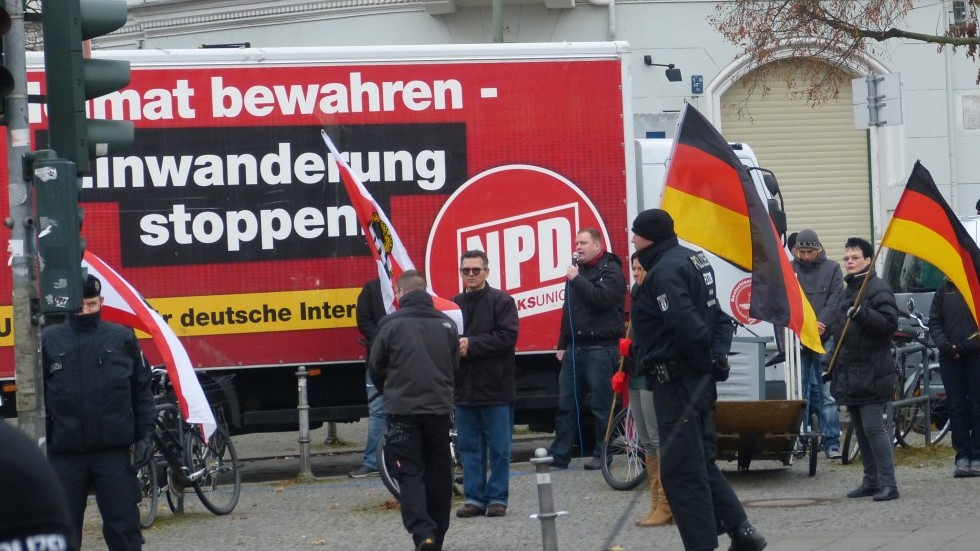
“We aren’t madly optimistic,” one of the initiators of the court proceedings told the Berliner Zeitung daily in December.
While the NPD’s ideology is widely regarded as hostile to the democratic order in Germany, many expect the judges to find it unnecessary to forbid such an insignificant political party.
Spurred by the sensational discovery of a murderous group calling itself the “National Socialist Underground” (NSU) in 2011, the Bundesrat launched the second attempt to outlaw the NPD in 2013.
Since then, the NPD has lost its remaining seats in state parliaments, retaining just one representative, Udo Voigt, in the European Parliament.
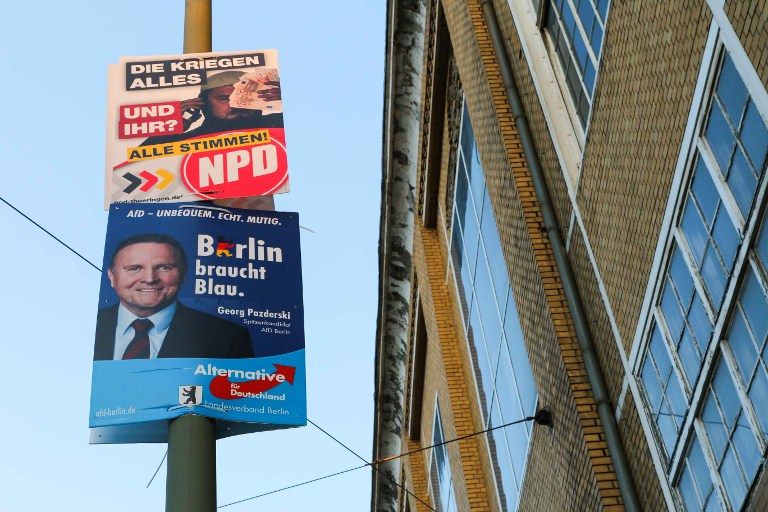
The rise of the nationalist Alternative for Germany party, which has assailed Chancellor Angela Merkel for allowing in large numbers of migrants and appeals to a much broader range of protest voters, has helped erode its support.
Regardless of the verdict handed down Tuesday, “the Federal Constitutional Court will not take the confrontation with right-wing extremism off our hands,” Justice Minister Heiko Maas told the daily Die Welt. “Even if the NPD were banned, that unfortunately does not mean there are no right-wing extremists in Germany.”
To justify a ban, judges must be convinced that under the definition in Germany’s constitution, the NPD poses an active threat to the democratic order and holds an “aggressive and combative attitude.”
For the Bundesrat, the group creates a “climate of fear,” “shares essential characteristics” with the Nazis and “wants to destabilize and overthrow the liberal-democratic order.”
Founded in 1964 as a successor to the neo-fascist German Reich Party, the NPD calls for “the survival and continued existence of the German people in its ancestral central European living space” — or simply, “Germany for the Germans”.
Such language flirts with the turns of phrase used under the Nazi Third Reich.
Germany’s domestic intelligence services classify the ultra-nationalist NPD with its 5,200 members as a far-right party.
The case at the constitutional court in Karlsruhe has gone farther than the first attempt to ban the NPD.
The previous attempt to ban the NPD failed in 2003 because the presence of undercover state informants within party ranks was seen as sullying the evidence.
While those informants have since been “deactivated,” the judges have voiced doubts over the danger the NPD poses to the democratic order.
With an eye cast back at the elimination of dissent in Hitler’s Germany, the drafters of the post-war constitution set high hurdles for banning a party.
Only two political parties have been outlawed since 1945: the SRP, a Nazi successor party, in 1952, and the West German Communist Party KPD in 1956.
New political landscape
Things however have changed in German politics since the launch of the second case against the NPD in 2013.
The AfD has brushed the NPD to the fringes, and the populist movement could see members elected to the parliament in Berlin at polls later this year — something no similar party has managed since 1945.
For most politicians and media commentators, parties such as the NPD must be beaten in the battle of ideas.
“It’s up to politics and civil society, not the courts,” the center-left Sueddeutsche Zeitung daily commented.
“Hating foreigners cannot be banned, no law can help against radicalization reaching the center of society.”
What’s more, the newspaper argues, banning the NPD risks sending a signal to “autocrats” abroad, who could point to the decision to justify crushing the opposition.









The Times of Israel Community.