

Greeks celebrate after rebuffing Europe over debt deal
After over half of the votes tallied, 61% cast ‘No’ ballot in referendum; PM thanks Greeks for making ‘very brave choice,’ opposition leader resigns
 Add ToI as a Preferred Source on Google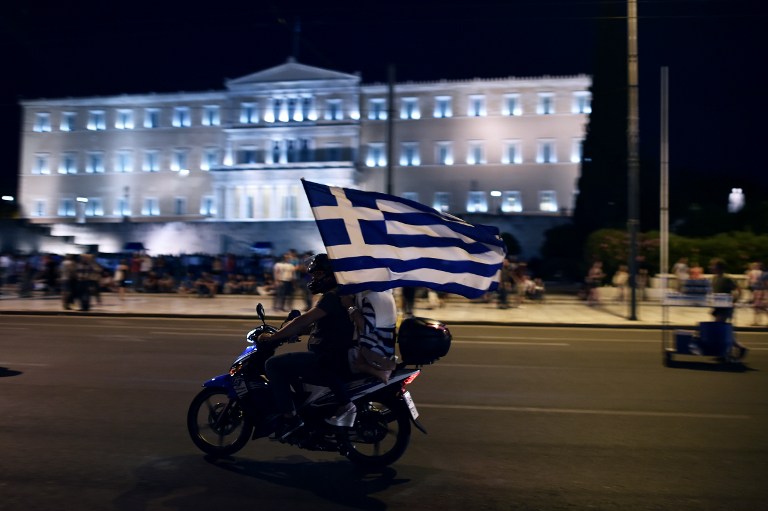
Greece voters on Sunday looked to have said “No” to European bailout terms, sending the euro into a tailspin on fears the debt-ridden country’s rejection could splinter the eurozone.
An official tally of over half the ballots cast showed a resounding 61 percent of Greek voters had backed the government’s ‘No’ in the plebiscite.
Greek Prime Minister Alexis Tsipras said the “no” result in the bailout referendum shows that “democracy won’t be blackmailed.”
In a live TV address, he said Greece was willing to return to talks, but “this time the issue of debt will be on the negotiating table.”
Tsipras thanked Greeks for making “a very brave choice.”
Meanwhile, Greek opposition leader Antonis Samaras announced his resignation after suffering a big defeat in Sunday’s referendum.
Samaras, the 64-year-old former prime minister, said he would step down in a televised address after campaigning for a “yes” vote.”
He urged Greeks to put divisions behind them and hold the government to its promise to find a quick agreement with creditors.
Senior eurozone officials were to hold talks on Monday to discuss the result, a European source told AFP.
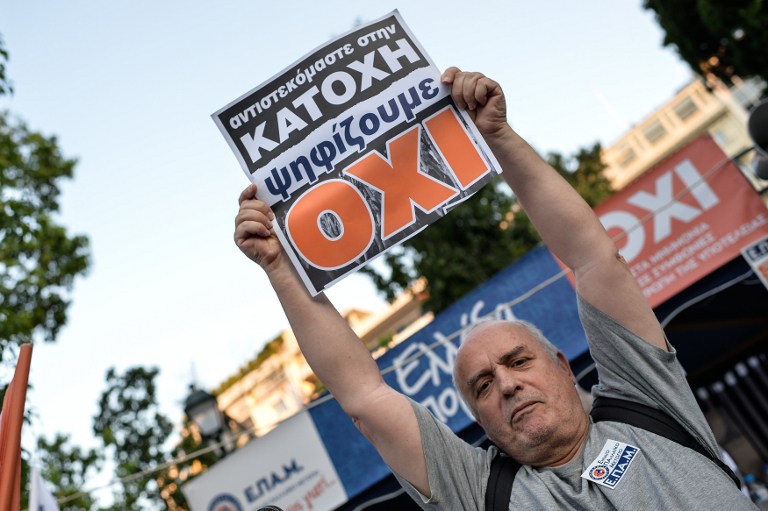
A growing crowd of 6,000 gathered in central Athens late Sunday to celebrate the ‘No’ vote. The scene was festive, with cheering and smiling Greeks shouting “Oxi” (No) and hugging each other.
“I believe in Tsipras and in this government,” said George Stasinopoulos, 25. “The governments in Europe don’t support us but their people do and this gives us courage.”
“We don’t want austerity measures anymore. This has been happening for the last five years and it has driven so many into poverty. We simply can’t take any more austerity,” said Athens resident Yiannis Gkovesis, holding a large Greek flag.
Tsipras, who was gambling the future of his 5-month-old left-wing government on the vote, insisted that a “No” vote would strengthen his hand to negotiate a better deal with creditors, while a “Yes” result would mean capitulating to their demands for austerity.
The opposition has accused Tsipras of jeopardizing the country’s membership in the 19-nation club that uses the euro and said a “Yes” vote was about keeping the common currency.
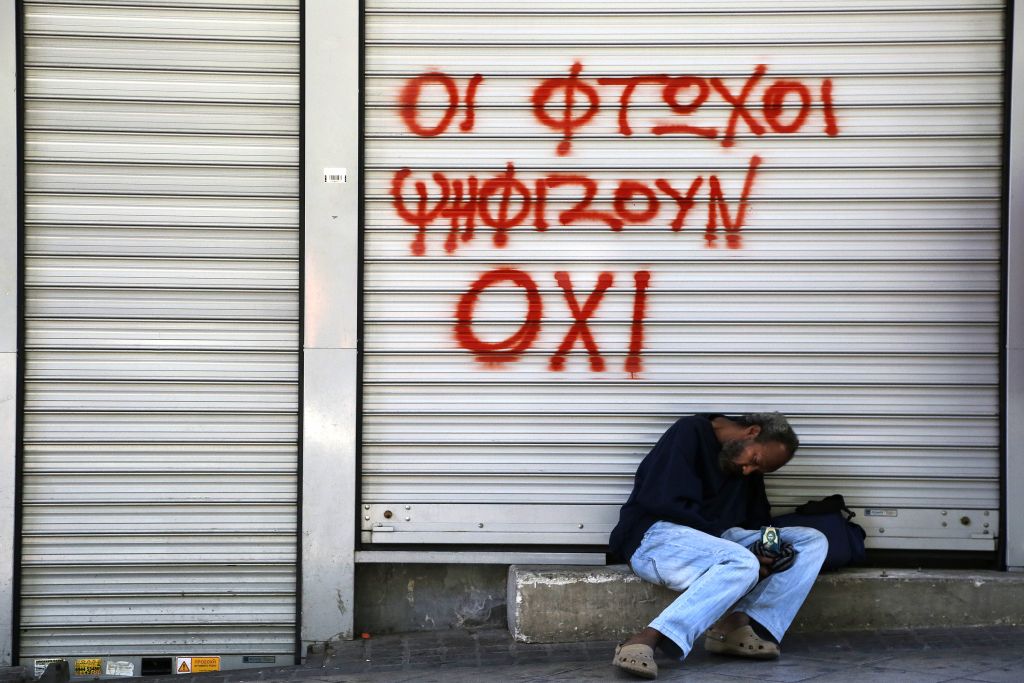
The vote was held amid banking restrictions imposed last Monday to halt a bank run, with Greeks queuing up at ATMs across the country to withdraw a maximum 60 euros per day. Banks have been shut all week, and it is uncertain when they will reopen.
Governing left-wing Syriza party Eurodeputy Dimitris Papadimoulis said that “Greek people are proving they want to remain in Europe” as equal members “and not as a debt colony.” The referendum was Greece’s first in 41 years.
Papadimoulis said the country should wait for the official and final results of Sunday’s referendum, and called on his fellow countrymen to remain calm.
Minister of State Nikos Papas, speaking on Alpha television, said it would be “wrong to link a ‘no’ result to an exit from the eurozone. If a ‘no’ prevails that will help us get a better agreement.”
Tsipras’ high-stakes brinkmanship with lenders from the eurozone countries and the International Monetary Fund resulted in Greece defaulting on its debts this week and shutting down its banks to avoid their collapse. He called the referendum last weekend, giving both sides just a week to campaign.
“Today, democracy is defeating fear… I am very optimistic,” Tsipras said earlier in the day after voting in in Athens.
European officials have openly urged Greeks to vote against the government’s recommendation.

“I hope people say ‘yes,'” European Parliament President Martin Schulz told German public radio. “If after the referendum, the majority is a ‘no,’ they will have to introduce another currency because the euro will no longer be available for a means of payment.”
As voters flocked to polling stations, large lines once again formed at ATMs.
Daniel Tsangaridis, a 35-year-old Athens resident, said he didn’t expect banks to reopen soon, despite a government pledge that they would do so Tuesday.
“It’s not going to happen in the next 48 hours,” he said. “If the situation improves and we can have a deal, then the banks will open.”
Tsipras’ left-wing Syriza party came to power in January after a six-year recession. Since then, the standoff between Athens and its international lenders has grown more bitter, and early signs of some economic growth and recovering employment in Greece have disappeared.
The debt-wracked nation also suffered repeated ratings downgrades and lost access to billions of euros after its existing bailout deal expired last week.
Polls published Friday showed the two sides in a dead heat with an overwhelming majority — about 75 percent — wanting Greece to remain in the euro currency.
“Today, we Greeks decide on the fate of our country,” conservative opposition leader Antonis Samaras said. “We vote ‘yes’ to Greece. We vote ‘yes’ to Europe.”
The sense of urgency was palpable as Greeks struggled to decipher a convoluted referendum question after being bombarded with frenzied messages warning of the country’s swiftly approaching financial collapse.
Neither result on Sunday, however, would lead to a clear answer on what Greece should do about its overstretched finances.
Greece is no longer in a bailout program since its previous package expired last Tuesday. It now has to negotiate a new one with its creditors that involves even more money for the government and banks and new economic austerity measures.
Despite the Greek government’s assertion that a “no” vote will not lead to a euro exit, most experts agree it would open up more uncertain financial outcomes.
A number of European politicians, including Jeroen Dijsselbloem, the top eurozone official, have said a “no” vote would jeopardize Greece’s place in the 19-nation eurozone. Investors are also likely to believe a “no” win increases the chance of a so-called “Grexit,” where Greece returns to its own old currency.










The Times of Israel Community.