

Health Ministry said to have blocked labs’ requests to test for coronavirus
Researchers, medical officials complain that ministry’s strict regulations prevented laboratories from developing extensive testing capabilities in the past few months
 Add ToI as a Preferred Source on Google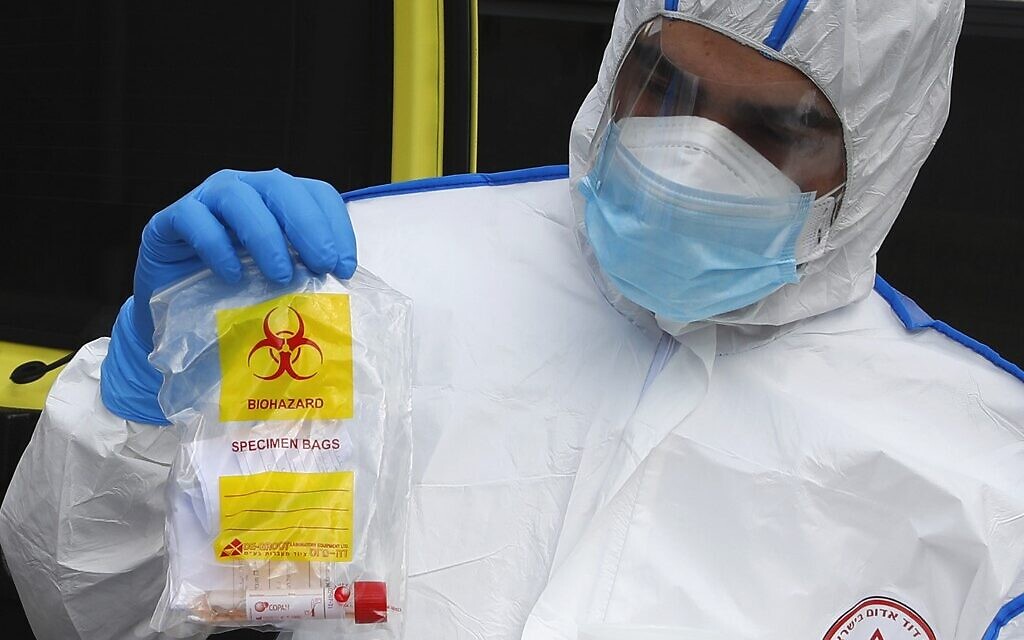
The Health Ministry reportedly blocked requests in recent months for medical laboratories across Israel to be allowed to test for the coronavirus, only permitting testing at a single laboratory until reversing its decision this month as the number of cases started to rise.
According to a report Wednesday by the Kan public broadcaster, the Israeli Association of Public Health Physicians began warning toward the end of January that a large number of laboratories capable of performing the tests were needed.
“What needed to be done and immediately at the beginning we warned about… [is that] all the laboratories in Israel capable of doing the tests need to be located and to begin preparing as many laboratories as possible so that we’ll have the critical infrastructure,” said Dr. Hagai Levine, chairman of the association and an epidemiologist at Hebrew University’s Braun School of Public Health.
Levine said on February 2, the Health Ministry clarified that testing would only be allowed at the Infectious Diseases Research Laboratory at Sheba Medical Center.
“A few laboratory managers reached out to me, they weren’t permitted to develop the ability [to test for the coronavirus],” he said.
Among those seeking to obtain permission to perform the tests were medical laboratories at Israeli universities and HMOs, The Marker business daily reported Wednesday.
The laboratories at universities could perform up to 10,000 tests a day, while those at HMOs could check 3,000 to 5,000 each day, the report said.
“Our capabilities allow us to do these tests and we prepared very, very quickly and just waited for the sign… and perform the tests here with us at the laboratory,” Dr. Moran Szwarcwort-Cohen, head of the laboratory at Rambam Medical Center in Haifa, told Kan.
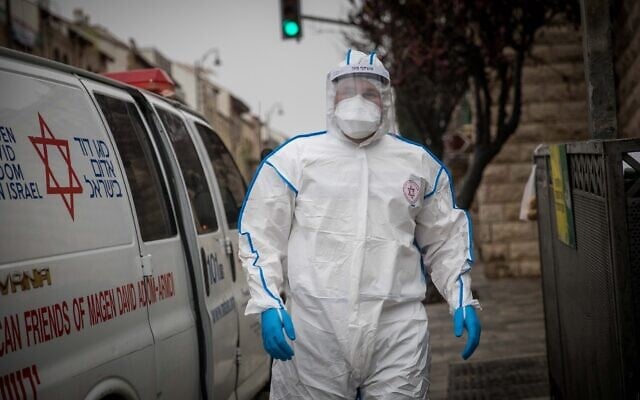
The Health Ministry opposition to allowing testing at other laboratories and permitting medical students to perform testing was due in large part to strict safety and verification regulations, The Marker said.
However, university and HMO officials claimed they could have met the regulatory requirements within 48 hours.
“The World Health Organization put out safety rules for labs that test [for] coronavirus. My laboratory meets these rules,” an unnamed senior researcher at a university told the paper. “The problem is that the Health Ministry invented particular regulations for Israel. The ministry demands meeting more stringent safety rules than those of the WHO and by doing so is reducing the supply of coronavirus laboratories from thousands to dozens.”
Even as the number of cases began to grow in Israel, Prof. Sigal Sadetsky, head of public health services in the Health Ministry, said in late February that testing would still only be permitted at Sheba Medical Center.
On March 1, the Health Ministry granted permission for other laboratories to perform the tests and there are now eight currently doing so around Israel, according to the business daily.
“It’s all right that they want to maintain safety,” the newspaper quoted a senior researcher as saying. “But we’re in a war and this is the time to be flexible.”
In a televised statement Tuesday from the Prime Minister’s Office, Sadetsky said testing is not a “solution” to the coronavirus but a “tool” in helping to stop it.
She said social distancing and quarantines are what will help overcome the COVID-19 outbreak.
The Health Ministry said it has performed almost 11,000 tests for COVID-19 as of Wednesday morning, including over 2,200 on Tuesday alone.
Officials had been criticized in recent days for the slow rate of testing, with Israel testing only 500-700 people a day.
A total of 2,252 people were tested on Tuesday, likely explaining at least part of the jump in the number of cases, from 337 on Tuesday to 433 as of Wednesday afternoon.
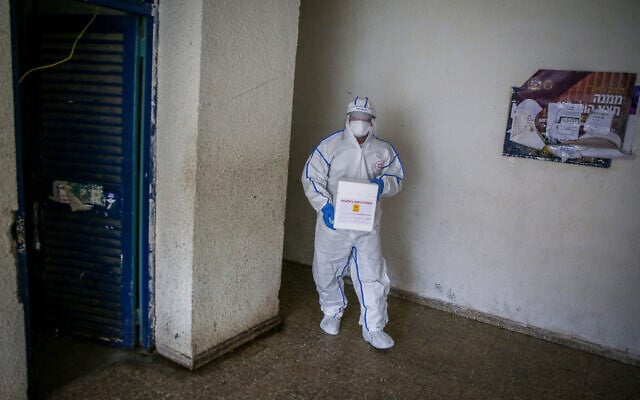
The Magen David Adom ambulance service had been set to open a “drive through” testing station in Tel Aviv Wednesday, but its opening was delayed. According to Channel 13, the delay was due to a shortage of testing kits and swabs. The center only had enough kits for a single day, but was trying to round up more from hospitals, the channel said.
Besides the facility in Tel Aviv, Magen David Adom was planning on rolling out more in other major cities in the coming days. It is now unclear when any will open.
Once in service, those with a note from a doctor will be able to visit the center and get tested without having to leave their cars.
Also Wednesday, Rambam Medical Center and Technion University in Haifa said they have come up with a faster and more efficient way to test people for the novel coronavirus, by pooling samples.
According to the hospital, by testing the samples of 32 or 64 patients at a time, it can quickly rule out who has the virus. Only in cases where the virus is found will the individuals in the pool take tests to determine who is carrying COVID-19.
They said in a statement that the method was able to flag a sample in which there was one carrier out of 64.
Pooling has been used since World War II and was suggested in the 1990s as a method of testing for HIV.
“There are indeed some logical difficulties in deploying the method, but we hope it can up the number of tests and find even silent carriers, those with no symptoms. This possibility can lower the chance of infection and flatten the curve,” said Technion Professor Roi Kishoni.









The Times of Israel Community.