

Israel notifies Bedouin village that it will be razed entirely next month
Authorities maintain offer to the 70 families of Negev village, the site of deadly clashes, to relocate to a nearby community, but they refuse to move
 Add ToI as a Preferred Source on Google
Jacob Magid is The Times of Israel's US bureau chief

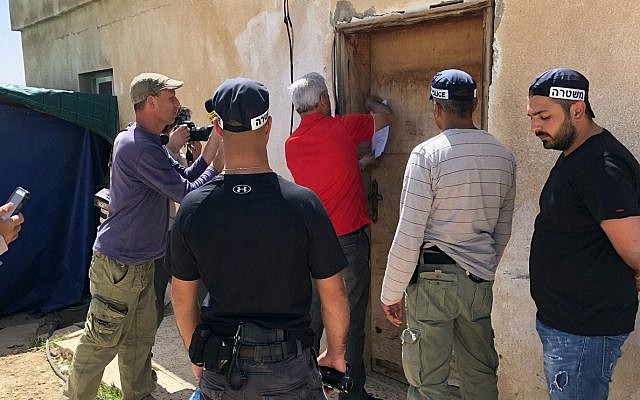
Israeli authorities notified residents of Umm al-Hiran on Wednesday that their unrecognized village in the Negev — the scene of deadly clashes during a previous attempt — will be razed entirely next month.
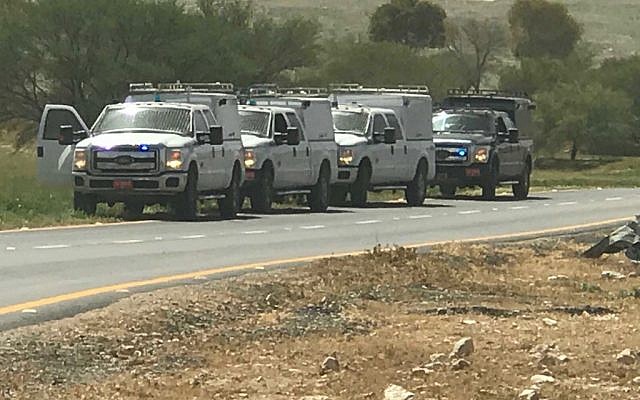
Israel Police along with officials from the Israel Land Authority and the Authority for Bedouin Resettlement in the Negev pinned demolition notices on the tents and shacks of the roughly 70 families living in Umm al-Hiran. The fliers said that it would be cleared at some time between April 15 and 29.
The evacuation will make way for the construction of a new all-Jewish town called Hiran, the Haaretz daily reported.
An April razing would end a 15 year legal battle and carry out a 2015 High Court of Justice ruling that the Bedouin have been illegally squatting on land that belongs to the state.
The Authority for Bedouin Resettlement in the Negev has been negotiating with Umm al-Hiran leaders for the past few years in an effort to convince the roughly 300 residents to move to plots prepared for them in the nearby Bedouin town of Hura.
“Every family will receive a plot and a compensation of up to NIS 200,000 [$57,264]. They will be able to build new structures there and live legally with their neighbors from Um al-Hiran,” the Authority for Bedouin Resettlement in the Negev’s head Yair Ma’ayan told the Kan broadcaster Thursday.
However, the residents have rejected the offer to date.
Following the police’s arrival at Umm al-Hiran on Wednesday, the Adalah center for Arab legal rights sent an urgent letter to Attorney General Avichai Mandelblit, calling on him to postpone the slated demolition.
“Despite the state’s obligations and promises to the Supreme Court, these [eviction] notices have been delivered before a just arrangement has been reached with residents and before they have been ensured an adequate and available housing solution,” Adalah attorneys Suhad Bishara and Myssana Morany wrote.
The last attempt to evacuate the village in January 2017 ended in bloodshed, with a police officer and a resident killed in controversial circumstances.
In December, the Justice Ministry concluded its reexamination into the police shooting of Umm al-Hiran resident Yaqoub Mousa Abu al-Qia’an.
The case was transferred to State Prosecutor Shai Nitzan who has yet to decide whether to close the case or summon additional officers for questioning.
In November, in light of new evidence, the ministry’s Police Investigations Department was ordered to take another look at the events surrounding al-Qia’an’s death, who was slain by police in during a nighttime incident in in which his car drove into officers, killing 34-year-old Erez Levi.
The car-ramming was initially described by police as terrorism, but authorities have indicated since that Abu Al-Qia’an likely lost control of the vehicle after being shot and did not intentionally hit the officers.
A six-month probe by the PID concluded in August there was no indication that the officers had acted criminally in shooting Abu Al-Qia’an.

The new evidence reportedly concerned the shots that killed Abu Al-Qia’an and a sponge-tipped bullet that allegedly injured MK Ayman Odeh, leader of the Joint (Arab) List parliamentary faction, who was injured during protests against the January 18 home demolitions.
In the immediate aftermath of the incident, Public Security Minister Gilad Erdan and the police asserted that Abu Al-Qia’an was a terrorist inspired by the Islamic State group who was shot after intentionally ramming his vehicle into the officers.
The charge was vehemently denied by his family, who argued that he was shot before his car sped up, leading him to lose control of the vehicle.
Activists and others said police had used excessive force, pointing to what they claimed was institutionalized racism against Arabs, including Bedouin.







The Times of Israel Community.