

Oil prices jump over 7% after Trump vows to continue strikes on Iran
Brent crude futures head for biggest daily gains in weeks, as markets fear Strait of Hormuz will remain closed
 Add ToI as a Preferred Source on Google
Oil prices climbed nearly 7% on Thursday after US President Donald Trump said he would continue attacks on Iran, stoking fears of prolonged disruptions to oil supply.
Brent crude futures were up $7.65, or 7.6%, to $108.81 per barrel. US West Texas Intermediate crude futures were up $7.06, or 7.1%, at $107.18 per barrel.
Both benchmarks were heading for the biggest daily gains, in both absolute and percentage terms, in three weeks, though they remained below highs of over $119 a barrel touched earlier in the conflict.
The gains followed drops of more than $1 in both contracts before Trump’s televised speech to the nation on Wednesday.
“We’re going to hit them extremely hard over the next two to three weeks,” Trump said. “We’re going to bring them back to the Stone Ages where they belong.”
While the president stressed several times that the war was close to completion in his speech to the American public, it was unclear how it would end, with The New York Times reporting that multiple US intelligence agencies have assessed in recent days that the Iranian government is not currently willing to engage in substantial negotiations.
He also gave no details on any steps that could lead to a reopening of the Strait of Hormuz.
One-fifth of global oil normally passes through the strait, and Iran’s Revolutionary Guards vowed Wednesday to keep it shut to the country’s “enemies.”
A British-led virtual meeting of dozens of nations will hold talks on Thursday to “assess all viable diplomatic and political measures that we can take to restore freedom of navigation” in the strait, UK Prime Minister Keir Starmer said Wednesday.
Markets are reacting to the absence of any “clear mention of ceasefire or diplomatic engagement” in the speech, said Priyanka Sachdeva, senior market analyst at Phillip Nova.
“If tensions intensify or maritime risks increase, oil could test fresh highs as markets price in potential supply disruptions.”
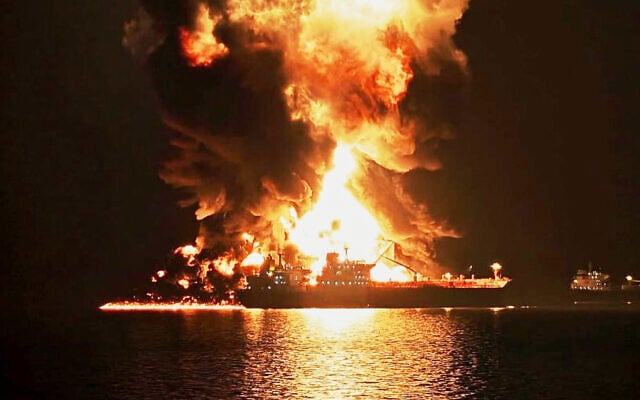
Threats to maritime traffic have grown as the conflict intensifies. On Wednesday, an oil tanker leased to QatarEnergy was hit by an Iranian cruise missile in Qatari waters, Qatar’s defense ministry said.
Some market participants said they had stopped dealing with cargoes priced off the Dubai Middle East benchmark, normally used to value nearly a fifth of global crude supply, because ports inside the Strait of Hormuz cannot be used.
The head of the International Energy Agency also warned that supply disruptions would start to affect Europe’s economy in April, after the region had previously been shielded by cargoes contracted before the start of the war.
“The next critical signal for markets lies in Iran’s response and that of the international community, whether President Trump’s pressure will yield action to secure the strait, which has not yet materialized,” Rystad said in a note.
Meanwhile, Bahrain’s effort to secure a UN resolution to authorize “all necessary means” to protect commercial shipping in and around the Strait of Hormuz ran into new obstacles Wednesday.
“There are ongoing communications and discussions with the Council members to bring a convergence of views and find a draft that can garner consensus, so that it can be adopted soon,” Bahrain’s UN ambassador Jamal Fares Alrowaiei said.










The Times of Israel Community.