

Security Council marks minute of silence for attacks on synagogue, church
UN chief demands world ‘step up to stamp out anti-Semitism, anti-Muslim hatred, persecution of Christians’ and other forms of hate
 Add ToI as a Preferred Source on Google
Members of the United Nations Security Council marked a moment of silence on Monday for the victims of a shooting attack on a California synagogue.
The commemoration was proposed by Israeli Ambassador Danny Danon, who was attending the body’s regular meeting on the Israeli-Palestinian conflict.
“I encouraged the UNSC to take a moment of silence for the community and victims of the shooting at Chabad of Poway,” Danon tweeted. “Anti-Semitism has no place in our society.”
Before hearing the monthly report on the situation in the Middle East, Christoph Heusgen, German Ambassador to the United Nations, asked council members to stand “in observing a minute of silence in solemn commemoration of those who lost their lives in these attacks at their places of worship.”
Heusgen mentioned both an attack on a Protestant Church in Sildadji, Burkina Faso and the Saturday shooting at the Chabad of Poway, north of San Diego.
One congregant was killed and three others hurt in the shooting at the synagogue on the last day of Passover.
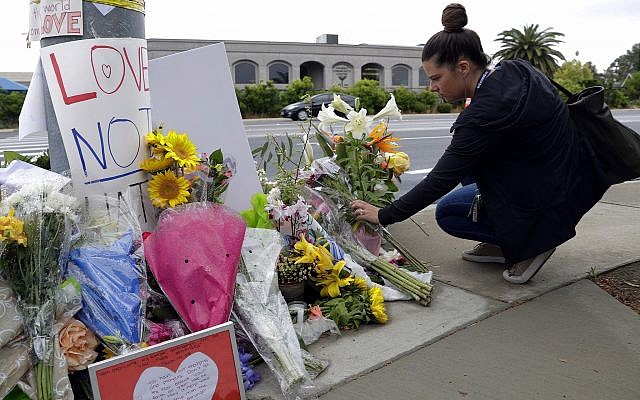
Six people including a pastor were killed in the attack on a Christian church Monday in northern Burkina Faso, where a number of jihadist groups are known to operate.
Separately, UN Secretary-General António Guterres demanded that the world “step up to stamp out anti-Semitism, anti-Muslim hatred, persecution of Christians and all other forms of racism, xenophobia, discrimination and incitement.”

The UN chief said he was responding to incidents “that have become all-too familiar — Muslims gunned down in mosques and their religious sites vandalized, Jews murdered in synagogues, their gravestones defaced with swastikas, Christians killed at prayer, their churches often torched.”
He specifically cited the attacks in California and Burkina Faso.
Beyond the murders of worshipers, he said, “there is loathsome rhetoric” aimed not only at religious groups, but at migrants and refugees as well as “assertions of white supremacy, a resurgence of neo-Nazi ideology (and) venom directed at anyone considered the ‘other.'”
Guterres said “parts of the internet are becoming hothouses of hate, as like-minded bigots find each other online, and platforms serve to inflame and enable hate to go viral.”
AP contributed to this report.





The Times of Israel Community.