

Stuck in the middle… with Trump and Netanyahu
AIPAC is desperately trying to maintain its bipartisan identity. Events inside and outside its annual policy conference this week underlined the near-impossibility of the mission

 Add ToI as a Preferred Source on Google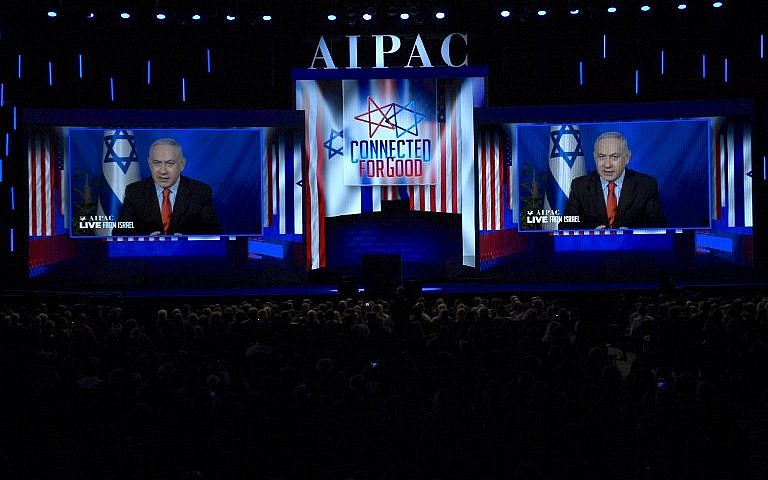
WASHINGTON — AIPAC’s annual Policy Conference is usually a very well choreographed affair. While the circumstances surrounding the confab differ each year, its orchestrators are relentlessly focused on keeping one tradition ongoing: Democratic and Republican lawmakers assuring thousands of pro-Israel Americans that the United States is committed to Israel’s security and that support for Israel is bipartisan on Capitol Hill.
The latter promise is arguably more important than the first, as the party in the opposition today could well be in power tomorrow. Since Israel receives $3.8 billion in yearly military aid, vital diplomatic support, intelligence-sharing and a vast array of other benefits from the United States, it is at risk when pulled into America’s electoral currents.
Historically, members of Congress from both parties, who are rivals on everything else, have maintained the powerful pro-Israel lobby’s mandate. The House Democratic and Republican leaders used to perform a schtick in which they told the AIPAC crowd: we agree on hardly anything, but we agree on Israel.
In the age of Trump, however, those traditions this year seemed like a relic. In what must be a first in the history of the conference, a member of the administration directly attacked the opposing party for insufficiently backing Israel. “Support for Israel,” US Vice President Mike Pence said on Monday, “has been a long, bipartisan tradition in the Congress, spanning generations. But how things have changed.”
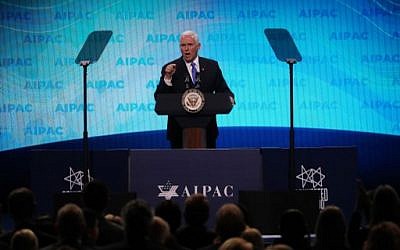
Implicitly, Pence was rebuking Minnesota Rep. Ilhan Omar, a recurrent target at this year’s event, who in February tweeted that “It’s all about the Benjamins,” in reference to AIPAC’s allegedly vast influence on American politics. Explicitly, Pence was castigating the entire Democratic Party. “It’s astonishing to think that the party of Harry Truman, which did so much to create the State of Israel, has been co-opted by people who promote rank anti-Semitic rhetoric and work to undermine the broad American consensus of support for Israel,” he said.
Donald and Benjamin
The president, Pence’s boss, has moved the US embassy from Tel Aviv to Jerusalem, withdrawn the United States from the Iran deal and recognized the Golan Heights as part of sovereign Israel, which officially happened Monday with Prime Minister Benjamin Netanyahu at the White House.
AIPAC has good reason to celebrate these victories; it’s been pushing for all of these moves for years. But in the process, it faces the danger of falling into the same trap it has always sought to avoid: alienating itself from one of America’s two major parties.
Trump’s latest gift to Israel — the Golan recognition — didn’t happen in a vacuum. Coming two weeks before Israel’s April 9 election, it was a major boost to Netanyahu’s reelection campaign. The prime minister went to the White House for the signing of the declaration, but cut his trip short after Hamas fired rockets into central Israel Monday, missing his AIPAC appearance scheduled for Tuesday and instead opting to address the gathering by satellite from Israel.
While plenty of Democrats showed up for the conference — Senate Minority Leader Chuck Schumer and House Speaker Nancy Pelosi chief among them — members of the party generally loathe both Trump and Netanyahu.
Conventional Washington wisdom is that the rupture in the US-Israel relationship began when Netanyahu accepted a backdoor invitation from Republicans to address a joint session of Congress lambasting former president Barack Obama’s Iran nuclear deal.

And the man who orchestrated Netanyahu’s 2015 speech, Israel’s ambassador to the United States and former GOP operative Ron Dermer, took implicit aim at Democrats speaking to AIPAC on Sunday.
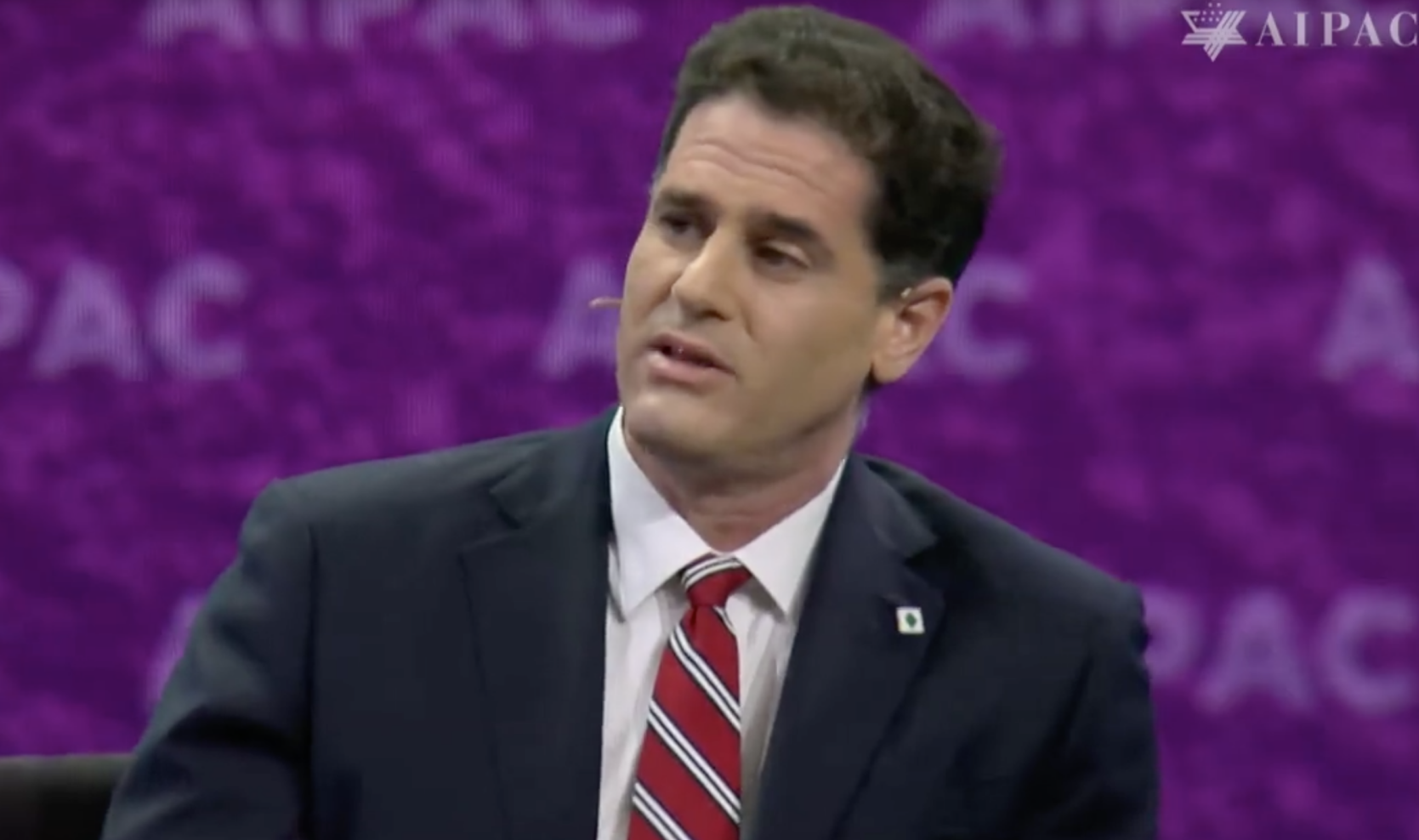
Less than a week after several of the leading Democratic 2020 candidates vowed to rejoin the deal with Iran if elected, Dermer said that re-entering the agreement was inconsistent with supporting Israel.
“There are leaders who are calling to return to that deal,” he said, without specifically mentioning the Democrats. “That is something that has to be seen as totally unacceptable.” Such a move, he added, would mean giving “hundreds of billions of dollars to people who are committed to Israel’s destruction.”
Days before the conference kicked off, a top AIPAC official told The Times of Israel that this year’s confab would “focus on further strengthening bipartisan support for the US-Israel relationship.” In the immediate aftermath of the three-day gathering, things don’t seem to have gone exactly as planned.








The Times of Israel Community.