

Thousands protest police killing, rampant crime in Arab town
Days after local man was killed during riot in Kafr Qassem, demonstrators rail against authorities’ conduct
 Add ToI as a Preferred Source on Google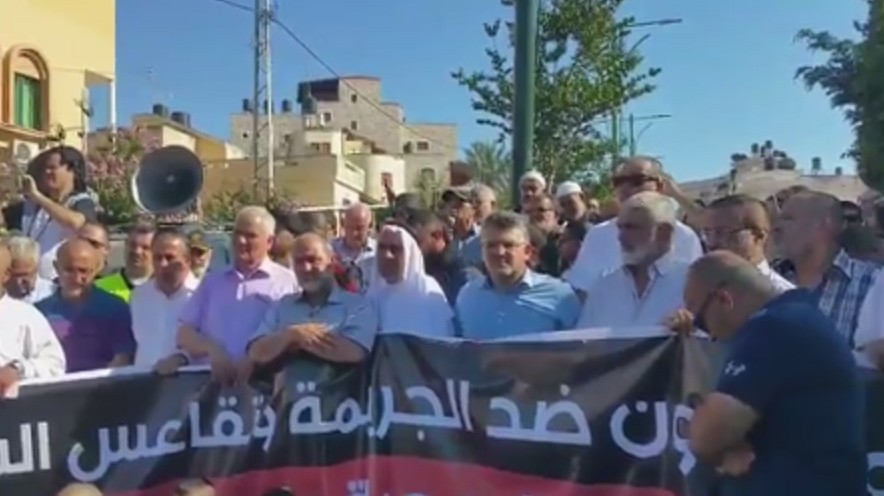
Thousands of people demonstrated in the Israeli Arab town of Kafr Qassem Saturday to protest the killing of a man by a police security guard earlier this week, as well as police’s failure to tackle violent crime in the town.
Mohammed Taha, 27, was shot dead by a private security guard outside the town’s police station in the early hours of Tuesday morning as rioters attacked the station.
Local Arab leaders have long accused the police of neglecting their communities and allowing crime to flourish unchecked.
The riot on Tuesday erupted when officers detained a man hired by locals to provide private security in the crime-ridden town. Police said rioters set police cars on fire and pelted cops with stones.
The guard who shot Taha, who has not been named in media, was questioned by police and then allowed to go home. Taha’s father, Mahmoud, accused the guard who killed his son of murder.
כפר קאסם, בהפגנה נגד הפשיעה והנשק המשתולל ונגד היד הקלה על ההדק של המשטרה.في مظاهرة كفر قاسم ضد العنف والجريمة والسلاح وعنف الشرطة pic.twitter.com/r748RE6Po3
— Ahmad Tibi (@Ahmad_tibi) June 10, 2017
At Taha’s funeral mourners, including several Arab Israeli politicians, decried what they called authorities’ reliance on deadly force when it comes to dealing with Arab protesters.
“There is only one collective in Israel that if it goes out to demonstrate is in danger of being shot and killed: Arab civilians,” said MK Ahmed Tibi of the Joint (Arab) List.
Tibi said that the anger in Kafr Qassem comes “against a backdrop of incompetence by police in dealing with rising crime in the community and in the Arab society in general.”
Another Joint List lawmaker, Jamal Zahalka, charged that Public Security Minister Gilad Erdan and Israel Police Commissioner Roni Alsheich have failed to address the increasing crime rates in Arab communities.
“The police are abandoning Arab citizens to gangs of criminal organizations, and there is no rule of law,” Zahalka said in a statement.
He said Israel has successfully tackled organized crime in Jewish-majority cites, leaving Arab towns and cities more vulnerable to criminal activities.
“Arab cities suffer from severe discrimination, violent crime in Arab society is 50 percent, while police only allocate 5% of their overall budget to fight crime in Arab communities,” he said. No wonder the disparity is so stark, he added.
Erdan has acknowledged the “decades-old problem” and said he was working to rectify it with a proposed increase in budget for Arab towns, as well as efforts to recruit Muslim officers in the communities. He noted that police data showed reductions in crime in the Arab population in recent years.
But the minister, speaking to Army Radio Tuesday, also blamed the lack of law enforcement on “some in the Arab population who seek to terrorize anyone who would help police increase their presence in the communities.”
Police chief Alsheich and President Reuven Rivlin met Wednesday with Kafr Qassem Mayor Adel Badir. The three discussed ways of restoring calm in the town.
They agreed to continue with efforts to boost law enforcement in Arab towns and villages throughout the country.
In the meeting, the sides agreed that “such activity requires full cooperation [from the community], led by Arab leaders, which will enable the return of law and order to the streets,” the President’s Residence said in a statement.
The statement also said that a work meeting would be scheduled in the near future at the President’s Residence between senior police officials and heads of Arab local authorities.
Stuart Winer contributed to this report.







The Times of Israel Community.