

Traditional Rosh Hashanah fare, minus the sheep’s head
Braise beef cheeks in pomegranate sauce and wine for a festive holiday dish
 Add ToI as a Preferred Source on Google
Shira Buzelan, an olah from Montreal, lives in Maale Adumim with her husband and five children. Combining her love of Israel and passion for food, Shira strives to incorporate locally grown and produced foods in her cooking style, highlighting the bounty of the land.
I’ll never forget the first time I boiled a sheep’s head, the final siman, or symbol, eaten as part of the seder of blessings on Rosh Hashanah. It was just when I was beginning to feel more comfortable exploring my husband’s family’s cuisine. And, frankly, that was the very last time I involved myself in that particular custom.
Since then I have tried every configuration of serving a head of sorts for the holiday. One family favorite, which we still include each year, in lieu of the sheep’s head, is the snipped-off heads of candied jellyfish.
But I still spend time before Rosh Hashanah thinking about the seder of symbols customarily eaten at the beginning of the meal. I put a lot of effort into these tapas-like starters because the custom is still relatively new to me, and I think there is something special about placing such significance on each dish, each with its own blessing. I do my best to find unique ways to present these dishes each year, and that’s my plan for this year as well.
I wanted to think outside the box, as well as save time by including symbolic foods that could serve as the first course. Here is a recipe uniquely suited to Rosh Hashana, including four of the symbols, creating an elegant plate to start the meal.
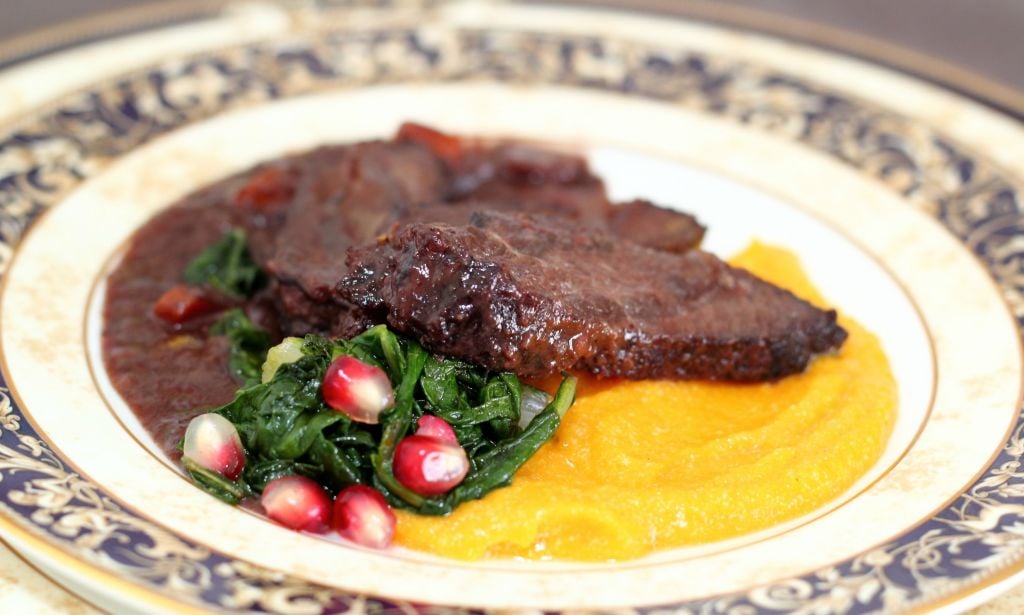
Beef cheeks, rather than the more traditional sheep’s head, are a tough cut of meat and require a longer cooking time than most. Here, they are slowly braised in a sauce of rich red wine and acidic pomegranate juice, an ideal combination to break down the tough meat, leaving the finished product tender and rich in flavor. Served with a purée of roasted butternut squash and accompanied by lightly sautéed beet greens, the colors are explosive and the presentation is very apropos for the holiday.
Braised beef cheeks in pomegranate wine sauce, served on creamed butternut squash with wilted beet greens
- 1 kilo beef cheeks (if purchased frozen, they may be labeled basar rosh)
- Salt and pepper to taste
- ½ cup all purpose flour
- 2-4 tablespoons olive oil
- 1 medium onion chopped
- 1 carrot chopped
- 2 cups dry red wine
- 1 cup fresh pomegranate juice
Creamed Butternut Squash
- 1 large butternut squash
- 1 tablespoon olive oil
- 1 tablespoon pareve margarine (or an additional tablespoon of olive oil if you’d rather not use margarine)
- ¼ cup Alpro pareve cream (any kind of neutral flavored milk is fine; this cream is trans fat-free and made of soy)
Wilted Beet Greens
- 2 stalks beet greens (or Swiss chard)
- 1 tablespoon olive oil
- salt and pepper to taste
- Wash and pat dry the beef cheeks. Season with salt and pepper and lightly dredge through the flour.
- In a large shallow pan, heat oil on a medium flame and brown each cheek until golden. Remove from pan. Add chopped onion and carrot and sauté lightly until softened. Return beef to pan and add the wine and the juice. Bring to a boil then remove from the flame. Cover and place in a preheated oven, 160°C (325°F), and cook for three to four hours until fork tender.
- While the beef is braising in the pan, prepare the puree. Slice squash in half and drizzle with olive oil. Place flesh side down and roast in 350°F oven for about an hour until tender. Remove from the oven, scoop out seeds and discard. Scoop out remaining flesh and puree in blender with margarine, cream, salt and pepper.
- In a separate pan, prepare the greens. Wash stalks well and cut into bite-size pieces. Cover with water and bring to a boil. Drain and repeat. (This removes any remaining sand from the leaves and the bitterness as well).
- Place pan back on flame and add remaining olive oil. Sauté the leaves for about one minute and season with salt and pepper.
- Plate the squash first on the plate, topped with the greens and some thinly sliced beef cheek. Drizzle lightly with remaining braising liquid and a sprinkling of pomegranate seeds, if desired.









The Times of Israel Community.