

Trump price tags Israel: 8 things to know for August 22
The president says Israel will pay a ‘higher price’ for his recognition of Jerusalem, sparking some worries and some dismissals
 Add ToI as a Preferred Source on Google
Joshua Davidovich is The Times of Israel's Deputy Editor
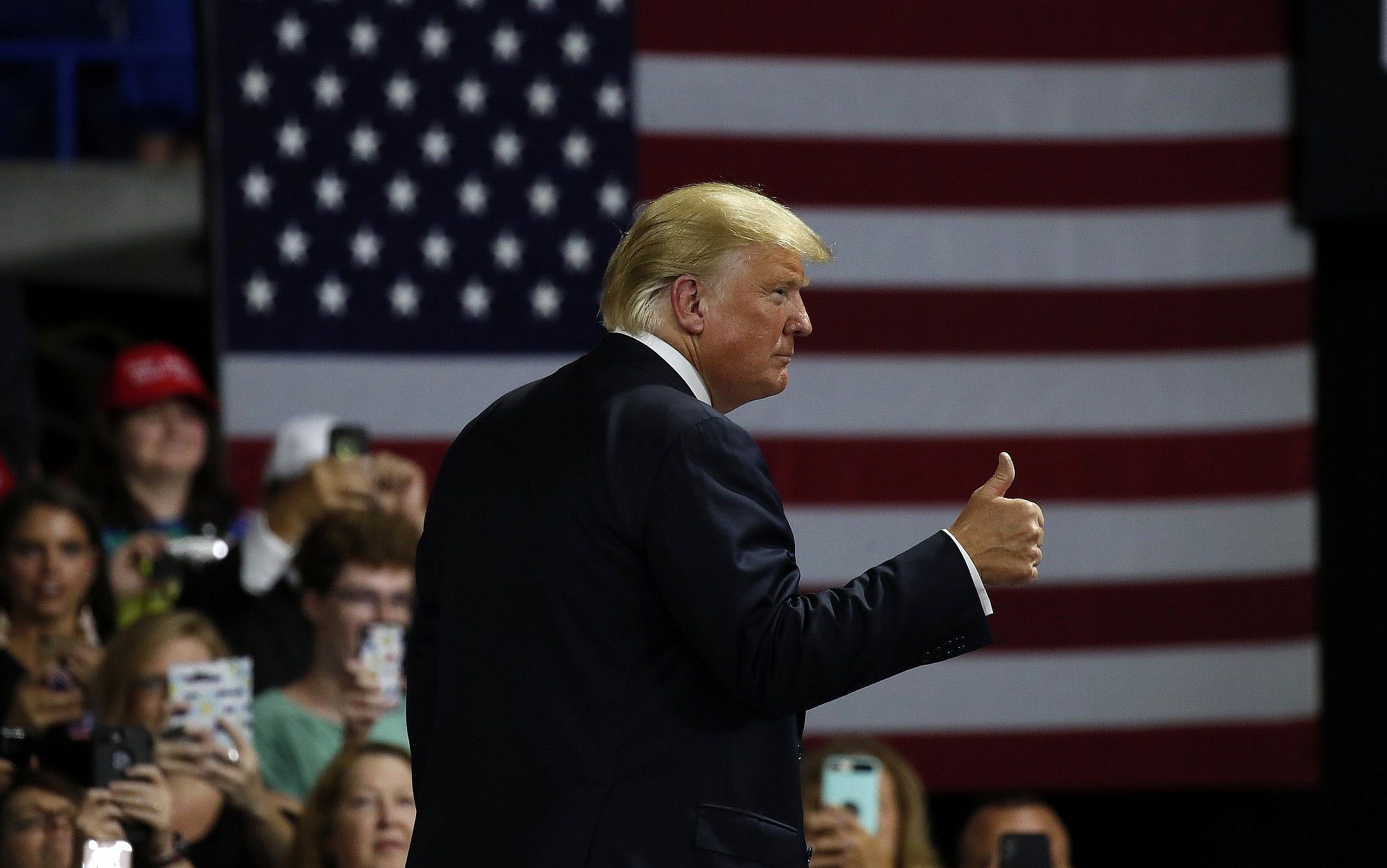
1. Paying the price: While the US media is rightfully obsessed with former Trump fixer Michael Cohen copping a plea deal and possibly bringing President Donald Trump to account, Israel is more concerned with what type of account settling the White House is expecting it to do in exchange for recognition of Jerusalem as the capital.
- While Trump has mentioned the possibility of Israel having to give something back in return for the US recognition in the past, he never put it in such stark, or dare one say foreboding, terms as during a rally in West Virginia. (And if one wonders why he thinks Johnny Coal Miner cares about Israel policy, one only need listen to one of his many rally appearances to know that the embassy move story is a mainstay and crowd favorite.)
- “We took it off the table. In past negotiations, they never got past Jerusalem. Now Israel will have to pay a higher price, because it’s off the table. The Palestinians will get something very good, because it’s their turn next,” Trump told the rally.
2. How much is that capital? As for what that price will be, it’s anybody’s guess, but some are jittery over the possibility of having to open their wallets.
- Minister Uri Ariel from the Jewish Home party tells Army Radio that “there’s room for concern.”
- However, Regional Cooperation Minister Tzachi Hanegbi says Israel will “push back against dictates or pressure” and there is “no need to worry,” on Facebook.
- Former defense minister Amir Peretz says the promise from Trump “was expected,” according to Hebrew media, though he adds on Twitter that an Israeli-Palestinian peace agreement “is not some deal made with the US.”
- Former Foreign Ministry director Alon Pinkas also throws cold water on Trump’s supposed proposition.
- “1. Jerusalem has never been taken off the table. The opposite. Unfortunately, it’s become the center. 2. What ‘expensive’ price will Israel be asked to pay that has not already been proposed — and rejected — in the past.”
-“We just took the most important thing to you off the table. What else do you want?”
-“Nothing”
-“Deal!”— Neri Zilber (@NeriZilber) August 22, 2018
3. Steep price: On the Palestinian side, Madji al-Khaldi, Palestinian Authority President Mahmoud Abbas’s senior diplomatic adviser, tells ToI’s Adam Rasgon that the only “compensation” the US could provide to the Palestinians for its Jerusalem moves would be recognizing a Palestinian state with East Jerusalem as its capital.
- He also says Trump would need to define the two-state solution as the “sole solution,” and rescind UNRWA funding cuts.
4. No quid-pro-quo: Top Trump adviser John Bolton, meanwhile, seems to be contradicting Trump, telling a Jerusalem press conference that there was no quid-pro-quo, ToI’s Raoul Wootliff reports.
- “I don’t think there’s any change in policy. I think the president looked at the recognition of Jerusalem as being Israel’s capital and the inevitable consequence of that is that the US embassy ought to be in the capital city of the country which its accredited as the right and natural thing to do,” Bolton says.
- The upshot is either that the two are not on the same page, that they believe Israel needs to pay for the US recognizing reality (how much will recognition of Ramat Gan as part of Israel cost?), or that Trump was just running his mouth.
5. Rights on the heights: Bolton also says the US is not discussing recognizing Israeli sovereignty over the Golan, putting a damper on Israeli hopes there.
- Israel Hayom reports that Israel has asked the UN to reinstall its peacekeeping force on the Golan border with Syria, citing military commander Asher Ben-Lulu.
- Ben-Lulu says Israel wants the squad of Blue Helmets upped from 1,000 to 1,200 or 1,300 strong.
- He also says the IDF is going to build a mock Hezbollah village on the platuea for military drills.
6. Probing Gaza deaths: Other print press publications lead off with the news that the military will probe the shooting deaths of two Palestinian teens during protests along the border.
- Yedioth Ahronoth reports that the two investigations are the fruit of preliminary checks into dozens of cases where wrongdoing was suspected in shootings.
- Haaretz’s Mordechai Kreminitzer writes that the move is a good opportunity for the army to review its rules of engagement.
- He cites the so-called Hannibal directive, which supposedly allows commanders to use nearly any means to prevent a hostage from being taken alive, and which has come under scrutiny after it was used in Gaza in 2014, leading to the deaths of over 70 civilians.
- “The way the Hannibal directive was handled shows one cannot assume that open-fire orders are clear and unambiguous. What’s more, the ultimate test of an order is not what’s written in it but how it is understood and implemented, and here there can be substantial gaps. The understanding of orders is influenced by the general public atmosphere, including remarks by public officials,” he writes.
7. Gun reform misfire: Outrage is spreading over new gun laws that may put weapons in hundreds of thousands of more Israelis’ hands, touted as an answer to terror attacks.
- “The more weapons at home or on the streets — the more tragedies will occur,” Eyal Mizrahi, whose son Oren was shot and killed in 2009 by a friend using the latter’s father’s pistol, tells Ynet.
- Meretz MK Michal Rozin has asked the Committee on the Status of Women to convene an urgent meeting over the new gun laws, Haaretz reports.
- “It is inconceivable that the approval of the weapons license will take place during the Knesset’s summer recess, without a substantive discussion in the Knesset,” she writes on Facebook.
- Israel Hayom reports that the opposition to the loosened restrictions is mainly in the Arab community, where gun violence is already an issue.
- “Some Arab towns already look like battlefields. The police aren’t doing much and now they will arm hundreds of thousands of more civilians,” it quotes a “senior member of the community” saying.
8. Terror capital: The same right-wing paper also dubs Arab town Umm al-Fahm Israel’s terror capital, after a funeral for a terror suspect killed while trying to stab a cop was marked by chants calling to avenge his blood.
- “No one is surprised by the fact that the majority of Israeli Arab terrorists come from Umm al-Fahm,” columnist Daniel Siryoti writes.



The Times of Israel Community.