

Trump trip leaves US and allies lost in translation
After positive reception in Middle East, American president fails to bridge gaps with European leaders during NATO, G7 meetings
 Add ToI as a Preferred Source on Google
TAORMINA, Italy (AFP) — Donald Trump’s first trip overseas was supposed to be about building bridges and clarifying his administration’s intentions to friends and foes alike.
But the US president heads for home Sunday with some of Washington’s allies as bewildered as ever by the billionaire tycoon’s abrasive, unpredictable style and the substance of his policy plans.
Trip stops in Saudi Arabia and Israel and the Palestinian territories secured broadly favorable coverage with Trump seen by some commentators as having finally hit a presidential note.
He then emerged from his Vatican meeting with Pope Francis in buoyant spirits, declaring himself inspired to work harder than ever in pursuit of peace around the world.
But the mood started to sour when the 70-year-old hit Brussels on Thursday.
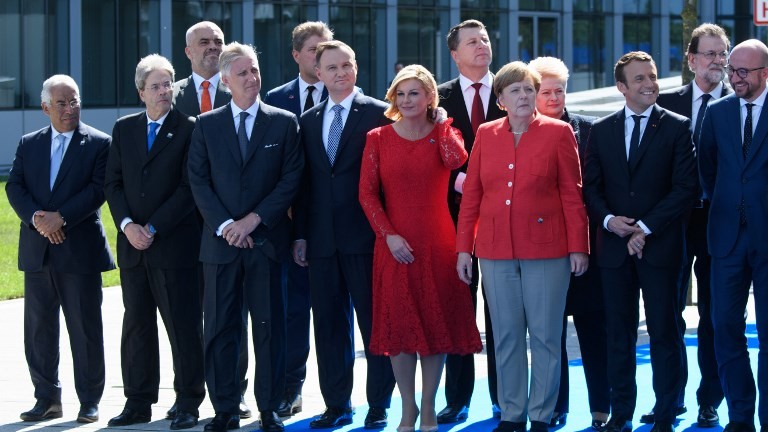
There, he bluntly accused 23 out of 28 NATO countries of taking advantage of US taxpayers by failing to pay their way in the Atlantic alliance.
In talks with EU leaders, Trump appeared to display a limited grasp of how the world’s biggest market operates a common trade policy, railing against Germany’s “bad, very bad” surplus with his country.
Strategic ambiguity
Rolled eyeballs were the order of the day among senior EU aides who couldn’t decide whether Trump was badly briefed, incapable of mastering a complex brief or consciously engaging in megaphone diplomacy in order to show he is serious about his America First agenda.
Brussels also provided one of the abiding images of the trip when the leader of the free world was filmed muscling Montenegro’s Prime Minister, Dusko Markovic, out of his way to get to the front of a photo opportunity.
And European hopes that Trump could be pressured into a more conciliatory stance on trade, climate change and migration at the G7 summit in Sicily were dashed.
It left his Italian hosts with virtually nothing to show after months of preparations. Compounding the diplomatic damage, Trump upstaged Italian Prime Minister Paolo Gentiloni’s closing press conference by tweeting that he would next week make his long-anticipated decision on US observance, or not, of the Paris climate accords.
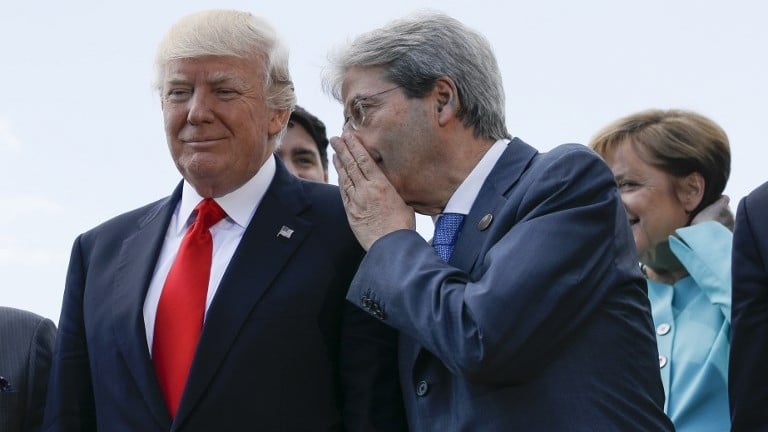
Julianne Smith, from the Center for a New American Security, said the summit showed how team Trump appeared determined to maintain a “strategic ambiguity” whatever the cost to long-established relationships.
“We understand that this is a tool that the administration finds useful to deal with adversaries,” she said.
“But for European allies across the continent, it’s creating a tremendous amount of uncertainty and insecurity.”
Stonewalling on climate change
Another US foreign policy expert, Derek Chollet, says it was no coincidence that the mood of the trip “changed dramatically when Trump left the controlled confines of the Middle East.
“In Europe, where the leaders were less fawning and the press less forgiving, Trump got himself into trouble.
“The contrast was remarkable: for this first time I can think of, we saw an American president who is more at home among Arab monarchs than democratic European allies,” Chollet, a former Obama administration official, wrote in Foreign Policy.
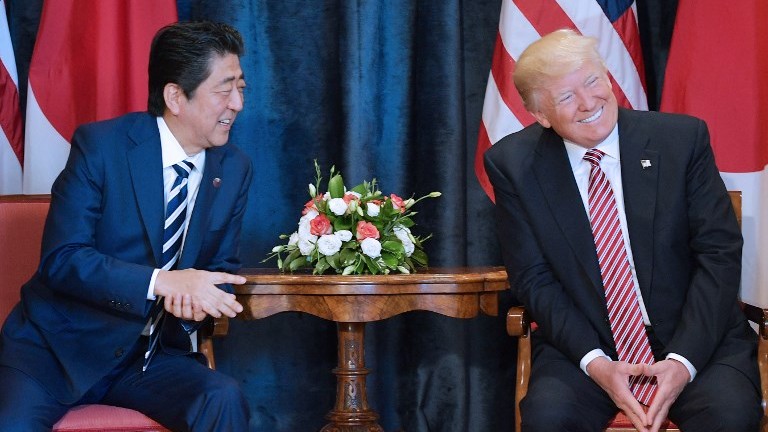
With the exception of Japan’s Shinzo Abe, with whom he shares a love of golf, Trump appears to have struck up little rapport with other G7 leaders.
His stonewalling on climate change amounted to politically damaging rebuffs for new French President Emmanuel Macron and Angela Merkel.
The German chancellor offered an insight into her view of Trump when she reacted good-naturedly to his outburst on Germany’s exports, adopting the manner of a teacher patiently explaining the basics of supply and demand. And she described the debate on climate change as “very unsatisfactory.”
Trump view ‘evolving’
US Secretary of State Rex Tillerson had promised that the Sicily leg of the trip would showcase Trump’s strengths as a communicator.
However many summit participants disputed that had been the case, noting that the US team appears still to be a prisoner of the dynamics of last year’s election campaign.
That, they say, explains the confrontational rhetoric despite the administration having yet to define exactly what it plans to do on either of those issues.
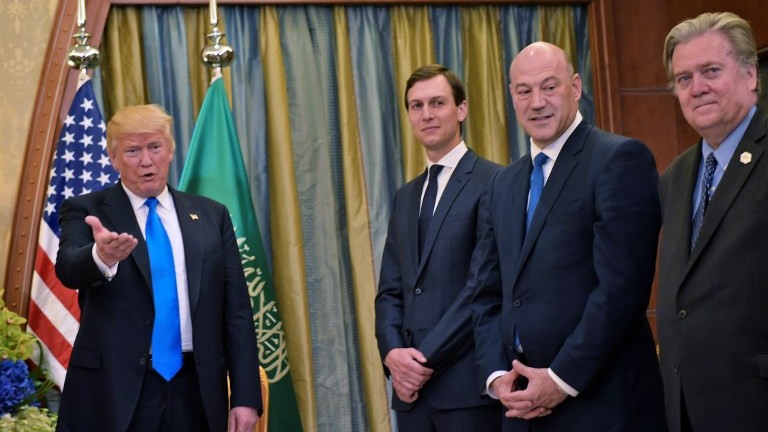
“His views are evolving, he came here to learn,” Trump’s economic advisor Gary Cohn declared on Thursday — only to have his remarks immediately reframed by National Security chief H.R. McMaster.
“The one thing that won’t change, though, is that he will make his decision based on what he thinks is best for the American people,” McMaster said.






The Times of Israel Community.