

Why a true long-term deal for the Gaza Strip is still a long way off
The sides may soon agree on a ‘mini’ ceasefire in Gaza, but Hamas’s current insistence that border protests and airborne arson continue would soon derail that too

 Add ToI as a Preferred Source on Google
Avi Issacharoff, The Times of Israel's Middle East analyst, fills the same role for Walla, the leading portal in Israel. He is also a guest commentator on many different radio shows and current affairs programs on television. Until 2012, he was a reporter and commentator on Arab affairs for the Haaretz newspaper. He also lectures on modern Palestinian history at Tel Aviv University, and is currently writing a script for an action-drama series for the Israeli satellite Television "YES." Born in Jerusalem, he graduated cum laude from Ben Gurion University with a B.A. in Middle Eastern studies and then earned his M.A. from Tel Aviv University on the same subject, also cum laude. A fluent Arabic speaker, Avi was the Middle East Affairs correspondent for Israeli Public Radio covering the Israeli-Palestinian conflict, the war in Iraq and the Arab countries between the years 2003-2006. Avi directed and edited short documentary films on Israeli television programs dealing with the Middle East. In 2002 he won the "best reporter" award for the "Israel Radio” for his coverage of the second intifada. In 2004, together with Amos Harel, he wrote "The Seventh War - How we won and why we lost the war with the Palestinians." A year later the book won an award from the Institute for Strategic Studies for containing the best research on security affairs in Israel. In 2008, Issacharoff and Harel published their second book, entitled "34 Days - The Story of the Second Lebanon War," which won the same prize.
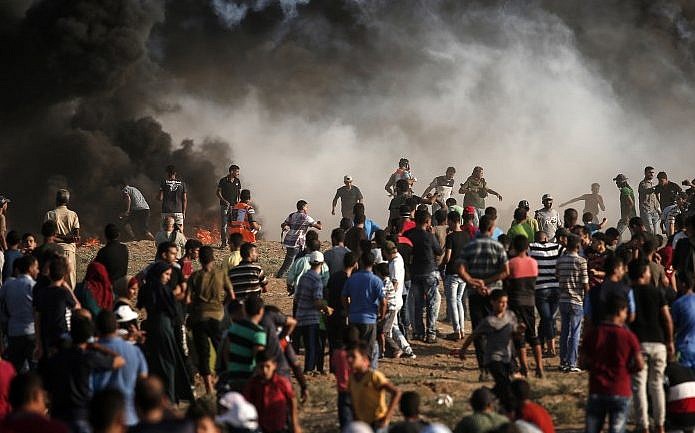
Several thousand Palestinians gathered near the Gaza border Friday for the weekly “March of Return” protests. The Hamas-run health ministry reported that two people were killed and 270 injured in clashes with Israeli troops, 60 of them by live fire. Hamas’s Gaza leader Yahya Sinwar, who has not been seen in public for some time, visited one of the protest tents to encourage demonstrators.
In other words, Friday was ostensibly business as usual in Gaza.
But sources in the Strip have said that despite appearances, Hamas is not interested in hurting the prospects of an Egyptian-brokered long-term ceasefire agreement that is under negotiation. In fact, they note, Friday’s protests, though violent, had fewer participants than in previous weeks, and were generally more subdued.
Still, even though both sides appear to want calm, there is a difference in understanding regarding the scope of the potential truce.
Hamas does not view the ongoing “popular protests” along the border, or the kite and balloon arson attacks that have burned over 7,000 acres of southern Israeli land, as a violation of any such agreement. As far as Hamas is concerned, those attacks are part of the popular Palestinian struggle against Israel. If Hamas does reach a long-term ceasefire deal with Israel, the terror group insists it will be obligated to cease rocket and mortar fire, but nothing more.

This perception may be at odds with the discourse in Israel, where many expect a ceasefire deal with the terror group to include a cessation of the months-long border clashes and arson attacks.
Conversely, Hamas says it will not agree to such a truce unless Israel stops bombings its facilities in the Gaza Strip, which have caused considerable damage to its infrastructure in recent weeks. (It may also be more difficult for Hamas to repair this damage due to the financial crises currently being experienced by Iran and Turkey — countries which have helped in the financial department in the past.)
Israel has carried out such strikes in response to arson attacks and particularly egregious violence at the protests, and is unlikely to accept an arrangement in which it would agree to halt such responses while Gazans remain free to riot and burn Israeli farmland.
The bottom line is that, contrary to the portrayal by some media outlets, any potential arrangement with Hamas is not likely to be dramatic or all that significant. Yes, it would provide for a ceasefire, but one along the lines of the deal that ended the 2014 war in Gaza. It’s far too early to start talking about something more significant, something, for example, that might provide for constructing a seaport for Gazans in Cyprus, or a complete lifting of border restrictions.

In other words, it would be a mini-ceasefire — an understanding, nothing more. And, both sides agree, nobody is going to sign any documents. Neither Prime Minister Benjamin Netanyahu nor Hamas can afford to sign on to an agreement with a declared an enemy.
Thus the mediating Egyptian officials are at the present stage only looking to stop the exchanges of fire between the sides. Only in a later stage could there be talk of easing the blockade on Gaza — something Israel simply will not do so long as Hamas remains a military threat — a maritime crossing, prisoner exchanges, and more.
The problem with a mini-ceasefire is that reaching that next stage is critical in preventing it from falling apart. If the demonstrations continue and the death toll rises, it’s clear, even the most limited arrangement will not survive.
And that second stage currently appears utterly out of reach, and not just because of Hamas and Israel: The Palestinian Authority is doing its part to torpedo any understanding between Hamas and Israel.
On Friday, the Kan news broadcaster quoted a senior PA official as saying that if any deal were reached, the Ramallah government would stop all financial assistance it provides to the Strip. PA President Mahmoud Abbas made similar threats on Saturday.

The Cairo talks on the potential deal have included various Palestinian factions, but not the PA’s Fatah. While their involvement may help stem the bloodshed, they don’t have the clout to reach a comprehensive settlement. Meanwhile, the reconciliation talks Egypt is also facilitating between Hamas and Fatah are going nowhere.
Perhaps realizing the current state of things, senior Hamas leader Husam Badran announced Friday that negotiations were being put on hold for a week, to resume only after next week’s Muslim holiday of Eid al-Adha. Having spent many years in an Israeli prison with Jewish jailers, and understanding Hebrew well, perhaps he’s picked up that ultimate of procrastinatory Jewish phrases, “After the holidays.”







The Times of Israel Community.