

Netanyahu and Lapid at odds over Cabinet jobs
In secret meeting, held at the weekend and revealed on Monday, prime minister says he wants to hold on to foreign affairs, offers finance to Yesh Atid head
 Add ToI as a Preferred Source on Google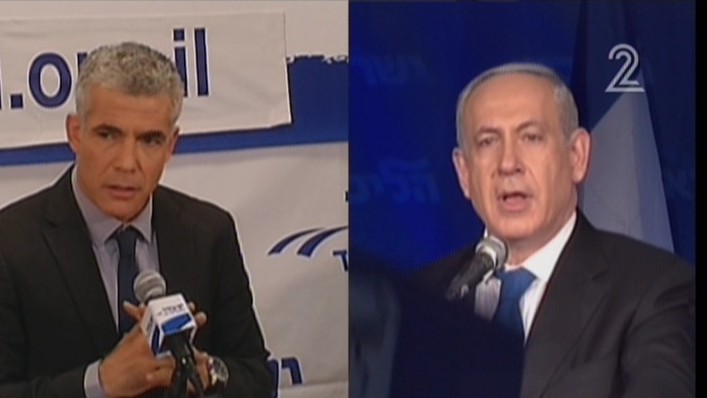
Prime Minister Benjamin Netanyahu held a secret weekend meeting with prospective coalition partner Yair Lapid, Channel 2 News reported Monday night. The meeting took place Saturday, a day before Netanyahu sat down with Jewish Home leader Naftali Bennett, and reportedly dealt with the division of Cabinet posts.
On Monday, Yedioth Ahronoth reported that Lapid was aiming for the Foreign Ministry for himself, and also sought the Education, Welfare and Interior ministries for party members. The Channel 2 report said Netanyahu wanted to keep the foreign affairs portfolio for his own Likud-Beytenu alliance — former foreign minister Avigdor Liberman has said it is being held for him or a member of his Yisrael Beytenu party — and offered Lapid the finance portfolio instead.
For his part, Bennett will seek the Industry, Housing and Religious Affairs ministries, and possibly one additional portfolio, the Yedioth Ahronoth report added. According to Israel Hayom, Bennett is also interested in the finance minister post.
On Monday, Lapid said that coalition negotiations “are far from over.”
“There are many issues that we’ve resolved,” Lapid said, addressing a faction meeting in a jovial, upbeat tone, “but Israeli politics holds surprises…. We’ve waited until now. We can wait a little while longer and will know everything.”
On Sunday, Netanyahu held a long meeting with Bennett, leading to speculation that a deal to let Jewish Home and Yesh Atid into the government was nearing. Netanyahu also told the ultra-Orthodox Shas party that he would not be able to include them in the coalition — a key Yesh Atid demand.
Bennett said there was a good atmosphere in discussions surrounding the prospect that his and Lapid’s parties would enter Netanyahu’s coalition, but warned against rushing into a deal.
“We rolled up our sleeves and are working very hard to help Netanyahu form a government that serves the people,” Bennett said Monday. “There is a good will to form a government as soon as possible, and we are merely coming to be a help to the prime minister.”
In his address, Lapid said his party seeks to represent everyone’s interests, including those of the ultra-Orthodox. “I hope to establish a good, broad government that’s good for the people, and not for the politicians. And even the ultra-Orthodox will find that Yesh Atid is not only not against them, but takes care of them too.”
Netanyahu has until March 16 to form a coalition, at which point President Shimon Peres could ask another person to try to form a government or call new elections.
Yesh Atid garnered 19 Knesset seats in the January 22 election, second only to Likud-Beytenu’s 31. It has been working together with the 12-seat Jewish Home party to demand new legislation to draft most ultra-Orthodox young men. The ultra-Orthodox parties are opposed to such a drastic change, and Netanyahu has thus far been unable to resolve this and other differences between his potential coalition partners.
Labor leader Shelly Yachimovich, for her part, promised Monday that her party would serve as an “effective opposition.” She cited Netanyahu’s intention to pass severe budget cuts next term, and said that Labor wouldn’t be a part of it.
“We are preparing diligently to be an effective opposition, which also fights, and that would be far more effective than sitting in a government whose plans are dictated by Netanyahu,” Yachimovich said at her faction’s policy planning meeting.
Labor’s Isaac Herzog added that the first matter the party would tackle would be the budget cuts. “We will fight them in every way,” he said.
Asher Zeiger and Michal Shmulovich contributed to this report.









The Times of Israel Community.