

Of houses and ministers, tablets and protests
Dissecting Beit Hamachpela and Netanyahu’s tablet of achievements
 Add ToI as a Preferred Source on Google
Ilan Ben Zion is an AFP reporter and a former news editor at The Times of Israel.

Two stories garnered the majority of the Israeli press’s attention on Wednesday morning: the Beit Hamachpela controversy in Hebron, and the commencement of the fourth year of Prime Minister Benjamin Netanyahu’s term.
Beit Hamachpela, which was supposed to be vacated by 3 p.m. Tuesday, remained occupied at press time by the families that moved in and claim to have purchased the property. Maariv‘s headline tacitly suggests victory for the settlers: “The ultimatum expired, but nothing happened.”
Haaretz, a later edition paper than the rest, reports a last-minute overnight meeting to resolve the Beit Hamachpela issue between Netanyahu, Defense Minister Ehud Barak, MKs Benny Begin and Moshe Yaalon (Likud), and Defense Ministry and Civil Administration representatives. They agreed to a moratorium on forcefully evacuating the house so legal experts could determine the authenticity and legality of the inhabitants’ claims. If those claims are proven unlawful, they must leave by April 25 or will be forcefully removed. (In the event, the building was evacuated on Wednesday, after the attorney general ruled against a delay.)
Likud politicians visited the Hebron house on Tuesday in a public expression of solidarity with the residents and their right to inhabit the building. Yedioth Ahronoth calls the procession of Likudniks — Transportation Minister Yisrael Katz, Welfare Minister Moshe Kahlon, and MKs Tzipi Hotovely and Gila Gamliel — a “pilgrimage to Hebron.”
The four visitors denounced Barak’s “unilateral decision” and “political provocation” to evacuate Beit Hamachpela, and promised that the residents were not going anywhere, especially not before Passover.
Hotovely assured the Machpelaites that “they will celebrate the Passover seder in the house, as well as many more future holidays.”
Maariv and Yedioth Ahronoth run a photo showing Katz putting up a mezuza in one of the building’s apartments, demonstrating his commitment to the permanence of their stay.
A Haaretz editorial excoriates Netanyahu’s wheedling of Barak to countermand the removal the settlers from Beit Hamachpela by Civil Administration order. Haaretz points out that by law, even if the settlers purchased the property, they still require a permit from the Civil Administration to reside in the house, which they did not receive. Netanyahu is ignoring the Civil Administration’s legal department’s decision that “the presence of settlers [in Hebron] threatens to disrupt the delicate status quo between the Israeli and Palestinian populations,” Haaretz says.
Dan Margalit contends in Israel Hayom that it should be up to the government, not the military, to change the status quo and to rule.
Haaretz argues to the contrary: “[Netanyahu] doesn’t understand that the laws in Hebron are not the same as the laws in Tel Aviv. A country that doesn’t allow a Hebron resident to settle in Tel Aviv cannot allow a Tel Aviv resident to settle in Hebron.”
Israel Hayom and Maariv place especial emphasis on Foreign Minister Avigdor Lieberman’s comments on Tuesday evening about the Beit Hamachpela issue. Speaking at a Yisrael Beitainu party gathering, Lieberman condemned the government’s “dissonant policy” vis-à-vis Beit Hamachpela and Migron. In the latter, the residents are being expelled for illegal habitation, in the former they are being expelled despite legal habitation.
“In coalition terms we’re talking about a grave mistake,” he said. “We don’t want elections now,” he continued. “But if anyone thinks that we will be held hostage by coalition politics or by legal procedures, they are incorrect.”
Lieberman’s not-so-veiled threat to bring down the government is not the first, Mazal Mualem writes in Maariv, but it is a bluff. “These threats are designed to mark territory, keep Netanyahu alert, and to wink at his voter base,” Mualem says.
Nonetheless, Mualem cautions, “Lieberman does not intend — for the moment — to dissolve the government, but no one can guarantee that in few months that won’t happen.”
What, me worry?
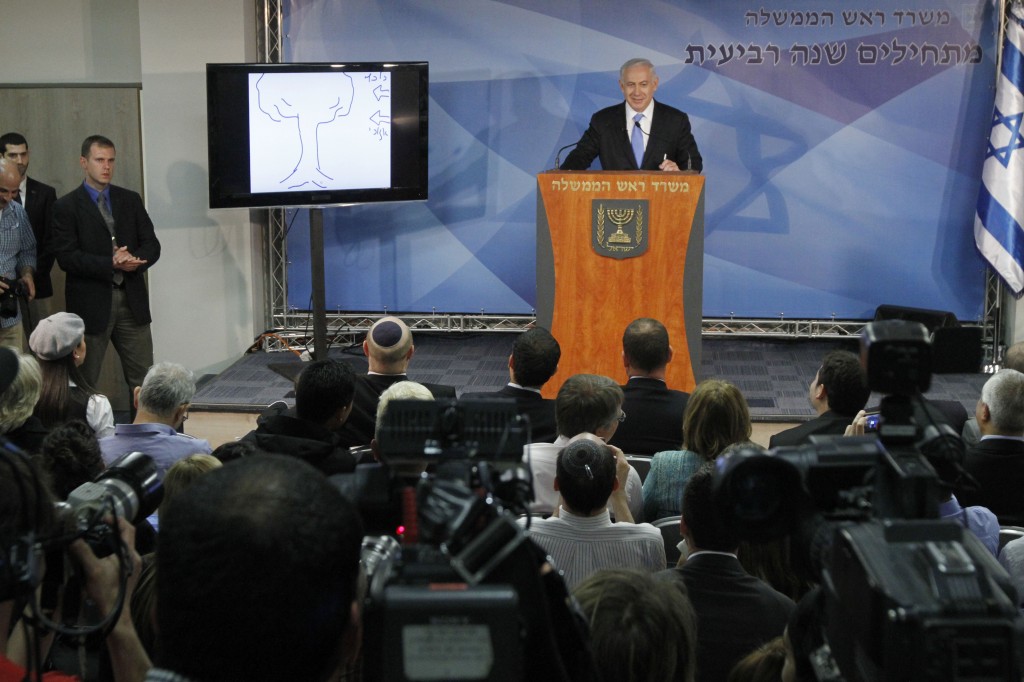
Netanyahu’s press conference on Tuesday smacked of approaching elections, Maariv writes, whether they’re in 2012 or 2013. Speaking at the beginning of his term’s final full year, Netanyahu discussed economic and security issues, and addressed the rumor of 2012 elections. Haaretz’s front-page headline reads, “Netanyahu: I will not advance elections, I am not worried about a social protest.”
Netanyahu sketched out his conception of Israel as a tree on his tablet computer. He described ethical values and security as the country’s roots, economy as its trunk, and society as its fruit. “To sum up three years, the tree is exceptionally stable. It is growing and yielding fruit,” he said. Israel Hayom quotes him saying, “Not everything is perfect, but we’re working on it.”
Mocking Netanyahu’s showboating of technology, Doron Rosenblum penned an article entitled “Bibi-pad, version 4.0,” in which he says, “There aren’t revolutionary changes in the new version [of Netanyahu]; before us is the same flat screen.”
Yedioth Ahronoth dissected his list of economic accomplishments and says Netanyahu came up short.
Yedioth deems six of the 13 claims factual. Under the Netanyahu administration a fence has been constructed along the Egyptian border, the economy has grown despite the global recession, the country’s credit rating rose to A+; apartments are being built, subsidies have been dispensed to people who move to peripheral cities and towns, and education has been made free for children under three.
The other seven claims, mostly that cost of living has gone down in the past three years, are not precisely true, Yedioth Ahronoth says, and represent the prime minister’s effort to “try to paint a rosy, optimistic picture of life in Israel” in advance of a possible return of social protests this summer.










The Times of Israel Community.