

Waiting for Lapid
Yesh Atid and Likud still haven’t reached an agreement; Netanyahu feels the heat from inside his party
 Add ToI as a Preferred Source on Google
Ilan Ben Zion is an AFP reporter and a former news editor at The Times of Israel.
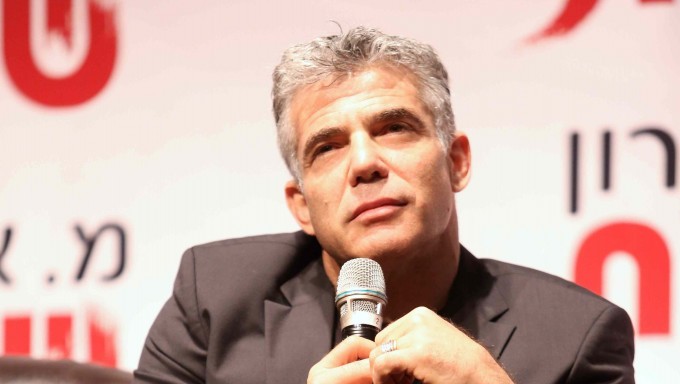
Three days of intense negotiations between Jewish Home, Yesh Atid, and Likud-Beytenu have yet to yield a breakthrough to a final coalition deal. The papers try to discern where the holdup is.
Maariv reports that while the leaders of the three parties are divvying up the final ministerial portfolios, the point sticking in the craw of negotiations is the issue of drafting the ultra-Orthodox. The paper says that Prime Minister Benjamin Netanyahu, Jewish Home leader Naftali Bennett and Yesh Atid leader Yair Lapid are cooking up an arrangement to see the religious enlist and that “the bottom line indicates no small drama.”
“Sanctions will be levied against yeshiva students who choose to break the law and not appear for military or civil service” in addition to the institutions to which they belong, it reports. The sanctions will likely be financial rather than legal, however.
Concerning the issue of ministerial appointments, Maariv writes that the main argument between the sides is over who will take the Education Ministry. Ultra-Orthodox MKs are reportedly pressuring Netanyahu to ensure the education portfolio remains with Likud, so as to prevent Yair Lapid from putting his “big plans” into effect. Yesh Atid and Likud are at loggerheads over what Israeli schoolchildren will learn.
Israel Hayom says a “crisis” broke out Sunday night between Jewish Home and Yesh Atid which prevented any sort of coalition agreement from being cemented. According to sources cited by the paper, Lapid insists the government consist of fewer than the 24 ministers previously agreed upon. Others tell the paper that the “crisis is in fact a planned crisis, based on Lapid’s demand to receive the education portfolio and take it from the hands of Likud-Beytenu.”
The paper reports that members of the negotiations team say that “while Jewish Home is interested in closing the deal — and as far as it’s considered it’s a done deal — Yesh Atid is spinning its wheels for an unknown reason and is not rushing to sign a coalition agreement.”
Haaretz also writes that the issues preventing a coalition deal are the Education Ministry and the size of the cabinet, but Yossi Verter notes that Netanyahu faces dissent inside the party. “Netanyahu’s greatest test will come from current ministers who are looking for advancement. Environmental Protection Minister Gilad Erdan would like to stay in office for one more term, and Finance Minister Yuval Steinitz has always felt he deserves bigger and better things,” he writes.
Amos Harel contends in Haaretz that Lapid’s inclusion in the government could have a significant impact on Netanyahu’s foreign policy vis-à-vis Iran. As finance minister, Lapid would sit on the inner security cabinet which deliberates such matters. “Lapid was elected to the Knesset on a mandate to lighten the burden faced by Israel’s middle class, not to push the Middle East into a regional war. It doesn’t appear very likely that Lapid will vote in favor of a deliberate attack against Iran in a situation where not all other options have been exhausted,” Harel writes. Expected defense minister Moshe Ya’alon and Tzipi Livni as justice minister would add two other voices opposed to all-out war against Iran to the party.
Yedioth Ahronoth’s top story is Netanyahu’s unwillingness to back Knesset Speaker Reuven Rivlin for another term in office. According to the paper, Rivlin met with Netanyahu this weekend to ask him for his support, and Netanyahu didn’t give it.
Rivlin, according to Yedioth, is all or nothing for the speakership.
“Netanyahu dismissed Rivlin, and that’s already clear; the two have had a complex relationship, and [Netanyahu] doesn’t want him in for another term,” a Likud source told the paper.
Nahum Barnea writes that Netanyahu’s dismissal of Rivlin is unprecedented, for Knesset speakers traditionally are replaced with regime change, death, or promotion. He says the sin Rivlin committed to deserve dismissal was that people liked him too much, and the issue at hand is the presidency.
“Netanyahu suspected that in this Knesset, which must choose the next president, Rivlin would be more attentive to every MK, to every party. Rather than silence the opposition, he would let it act as it wills. Preventing Rivlin’s election to the speakership also prevents his election to the presidency,” he writes.
Israel Hayom also reports that Syrian rebels have vowed to “liberate” the Golan Heights from Israeli control. It cites a video uploaded to the Internet which shows one fighter telling the camera that “these are blessed lands,” speaking of the Golan Heights seen behind him.
“The hideous Assad family vowed to liberate [the Golan], but in 40 years the Syrian army did not fire a single bullet,” he says. “We will launch a military operation against Israel, we will shoot the bullets that Assad didn’t fire and we will liberate the Golan.”
Maariv also reports that Likud MK Tzipi Hotovely opened fire at her fellow party member, outgoing Culture and Sport Minister Limor Livnat. She said that Livnat need not be a minister anymore, but not because of Livnat’s calls for self-censorship of artists critical of the government. Rather, Hotovely protested the fact that Netanyahu is saving Livnat a ministerial position even though she ranked far lower than Hotovely and others in the party primaries.
“She was at the bottom of the list,” Hotovely told Galei Israel radio. “Thousands of votes separated us. The decision to prefer her over younger MKs is an expression of no-confidence by Netanyahu in the outcome of his party’s primaries.”







The Times of Israel Community.